The first European colony in what would become Canada — on St. Croix Island, N.B. — had barely clawed its way through a deadly winter. Then, in 1606, as a fleet of reinforcements from France sailed through the icy waters of the Maritimes, they spotted something that shocked them: other Europeans.
“We arrived four leagues from Canso,” wrote Marc Lescarbot, a Parisian author travelling with the fleet. There, they discovered a small harbour. “This port is small but very beautiful, and has no name,” Lescarbot noted.
Curious, they sailed in for a closer look — and found it was inhabited by Basques.
Today, the Basque Country lies across the Pyrenees Mountains between Spain and France. It's a distinct region with its own language, Euskara, and a culture that goes back centuries. The Basques were known as expert fishermen, but that’s really underselling it. They were exceptional mariners, crossing the Atlantic in large ships, some armed with cannons and crewed by seasoned sailors.
At this tiny harbour, Lescarbot met the leader of the camp: The “port [was] led by a good old man named Captain Savelette, who received us with all the courtesies in the world.”
This wasn’t a bustling outpost. Lescarbot counted just 16 Basques. But they were far from alone. According to the Canadian Journal of Archaeology, by the 1570s, there were around 6,000 Basques operating off Atlantic Canada every summer, sailing in about 200 ships.

“Captain Savelette is quite a character,” Lescarbot wrote. “He told us this was his 42nd trip he has made across the sea, and that the Newfoundlanders come across the ocean every year.”
They’d been here for roughly a century by that point, but the Basques weren’t here to settle. Instead, they were more like seasonal workers.
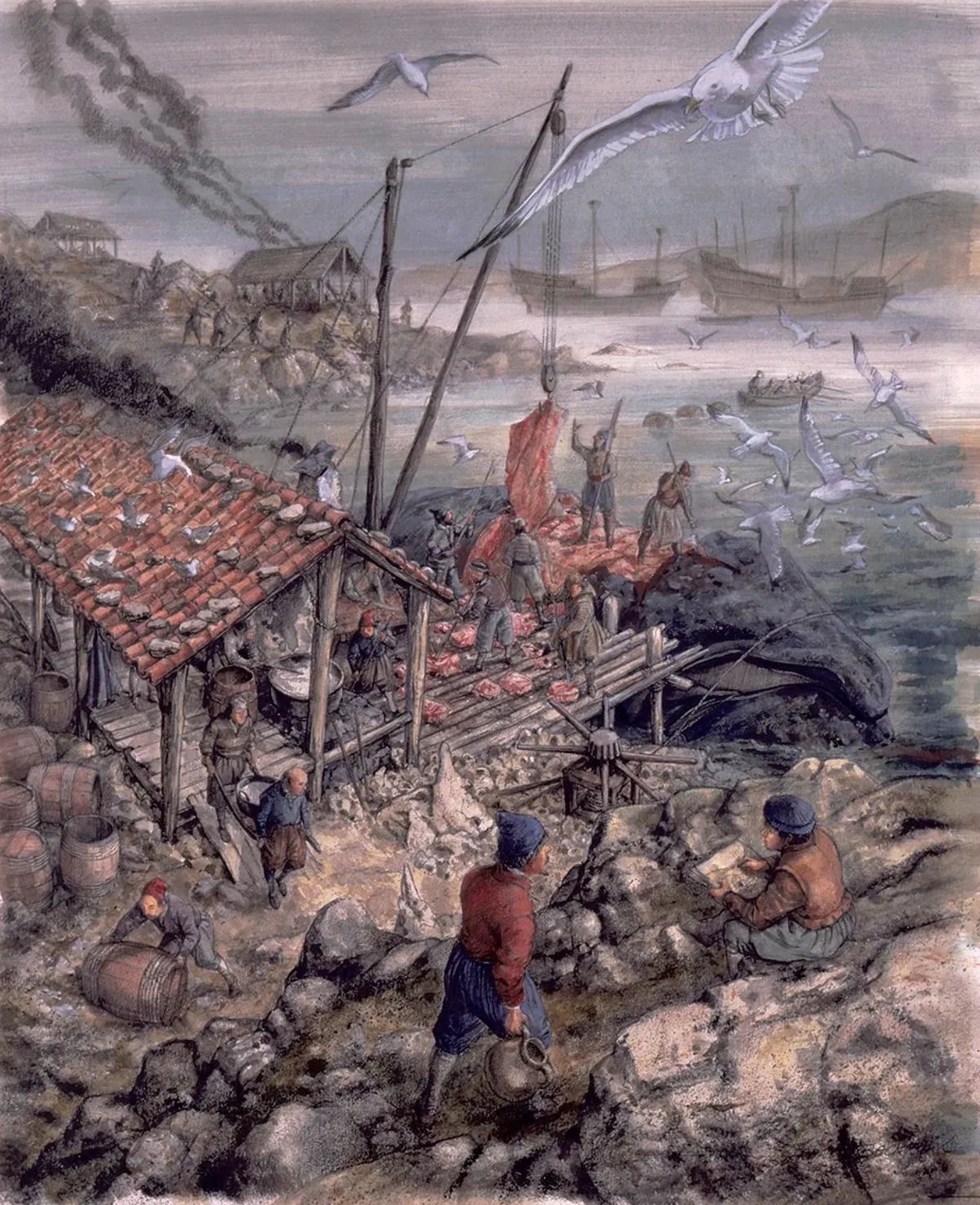
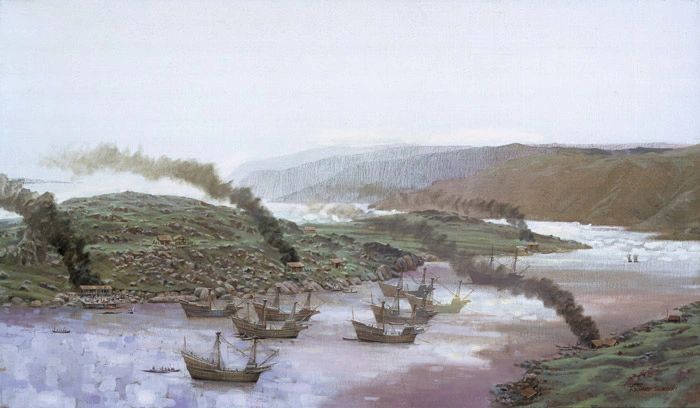
Each spring, they crossed the Atlantic to set up huge, carefully planned seasonal camps. These weren’t just tents on a beach. They built wharves, drying racks, and stone ovens — called tryworks — for rendering whale blubber. They dried cod in the sun and packed it in salt. They hunted whales and walruses, too.
“Captain Savelette told us that on his trip he would bring home 100,000 salted and dried cod fish, which he would sell for ten thousand livres,” wrote Lescarbot. “He was wonderfully happy.”
The fish was brought back to Europe, where Basque merchants sold it across France, Spain, and the Mediterranean.
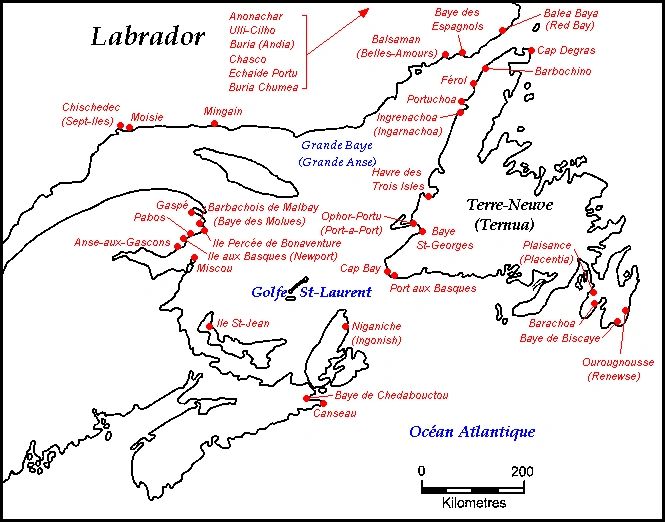
They returned year after year, often to the same sites, which were scattered across Atlantic Canada. Archaeological and historical evidence confirms at least one in New Brunswick, one on Prince Edward Island, three in Nova Scotia, 14 in Newfoundland, nine in Quebec, and nine more in Labrador. One of the best-known sites today is Red Bay, Labrador — now both a National Historic Site and a UNESCO World Heritage Site.
But back in 1606, Lescarbot had another question for Captain Salvette — one many Europeans would’ve had. He wanted to know about the people who lived here before even the Basques ever arrived. Were Indigenous people dangerous?
Salvette “privately admitted” that at first, he had been “worried that the [Mi’kmaq] might steal from his ship.” They came and went from his camp as they pleased, boarding his ships to “inspect his catch.”
“But,” Salvette hastily added, they “had never done him any harm.”
They never stole anything. They were open to trade — though not interested in cod. What they did like, Salvette said, was hake.
Salvette left Lescarbot with a warning that it was not the Mi’kmaq that he needed to worry about, but his fellow Europeans:
“He regretted to tell us that many [Europeans] who passed his port were far worse than the [Mi’kmaq], and that he had to be on his guard because they would steal from him unless they took up arms against them,” wrote Lescarbot.
Later, after Marc Lescarbot settled at Port Royal and got to know the Mi’kmaq firsthand, he was impressed to learn they had developed a trade language combining Mi’kmawi’simk and Euskara.
Only a handful of words from this shared language survive. Ania meant brother; kessona meant man; a makia was a stick; and origna referred to an elk — interestingly close to the French word for moose, orignal.
According to Aitor Esteban, a Basque professor at the University of Deusto, “Collaboration between Mi’kmaq and Basques went beyond mere trade relations. … the natives worked shoulder to shoulder with our ancestors in cod fishing and whaling. … A little-known fact is that the last name ‘Basque’ is quite common among the Mi’kmaq, especially in the northern part of New Brunswick and in Listuguj.”
“If there is one thing above anything else that the Basques and the Mi’kmaq have in common, it is the survival over the centuries of our culture and language despite the vicissitudes of history and being surrounded by nations far superior in number,” Esteban added.
New Brunswick’s lone Basque camp was on Miscou Island, at the northeastern tip of the province. Strategically located at the mouth of the Baie de Chaleur, Miscou gave easy access to rich fishing and whaling waters.
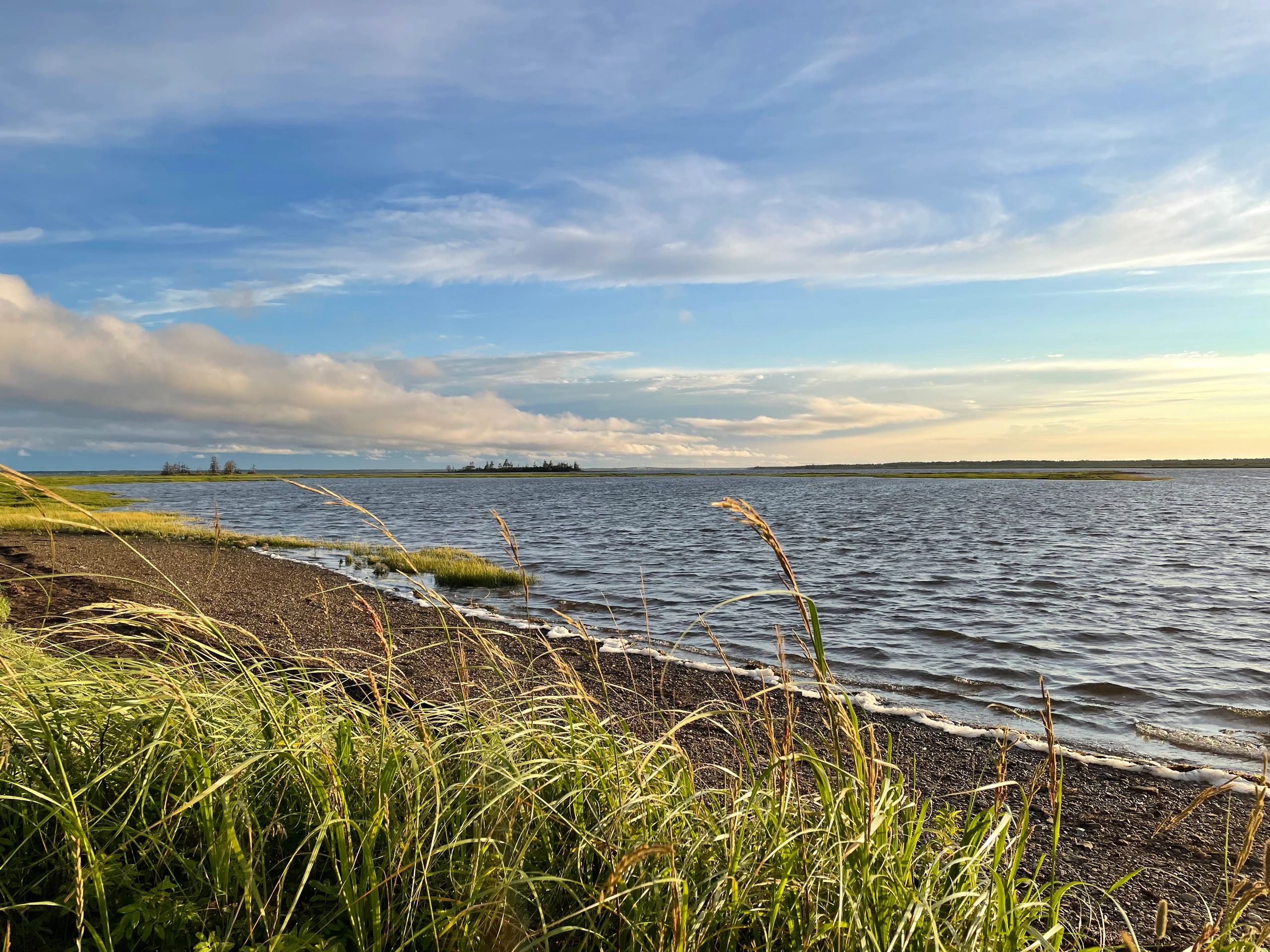
In 1903, the great New Brunswick naturalist and historian William F. Ganong went to Miscou to investigate evidence of a Basque presence, abandoned roughly three centuries earlier. By the early 1600s, the Basques had been crowded out by settlers, shifting markets, and the growing complexity of transatlantic trade.
Ganong surveyed the island. He wondered if Basque activity had been centred on tiny Money Island, in Miscou Harbour.
Unfortunately, when he arrived, he learned that Money Island — as its name suggests — had gained “a great local reputation as a place of mystery and buried treasure.”
Ganong wrote that “some excavations … largely if not wholly the work of money diggers … seemingly have left scarcely any part of the island’s surface undisturbed.”
In chasing after hidden riches, treasure hunters had destroyed historical evidence of a Basque presence.
Though they didn’t build cities or claim land, in their own seasonal, sea-borne way, the Basques were among Canada’s earliest European pioneers. Their story, however, is rarely mentioned in textbooks.
SOMEWHAT RELATED STORIES: