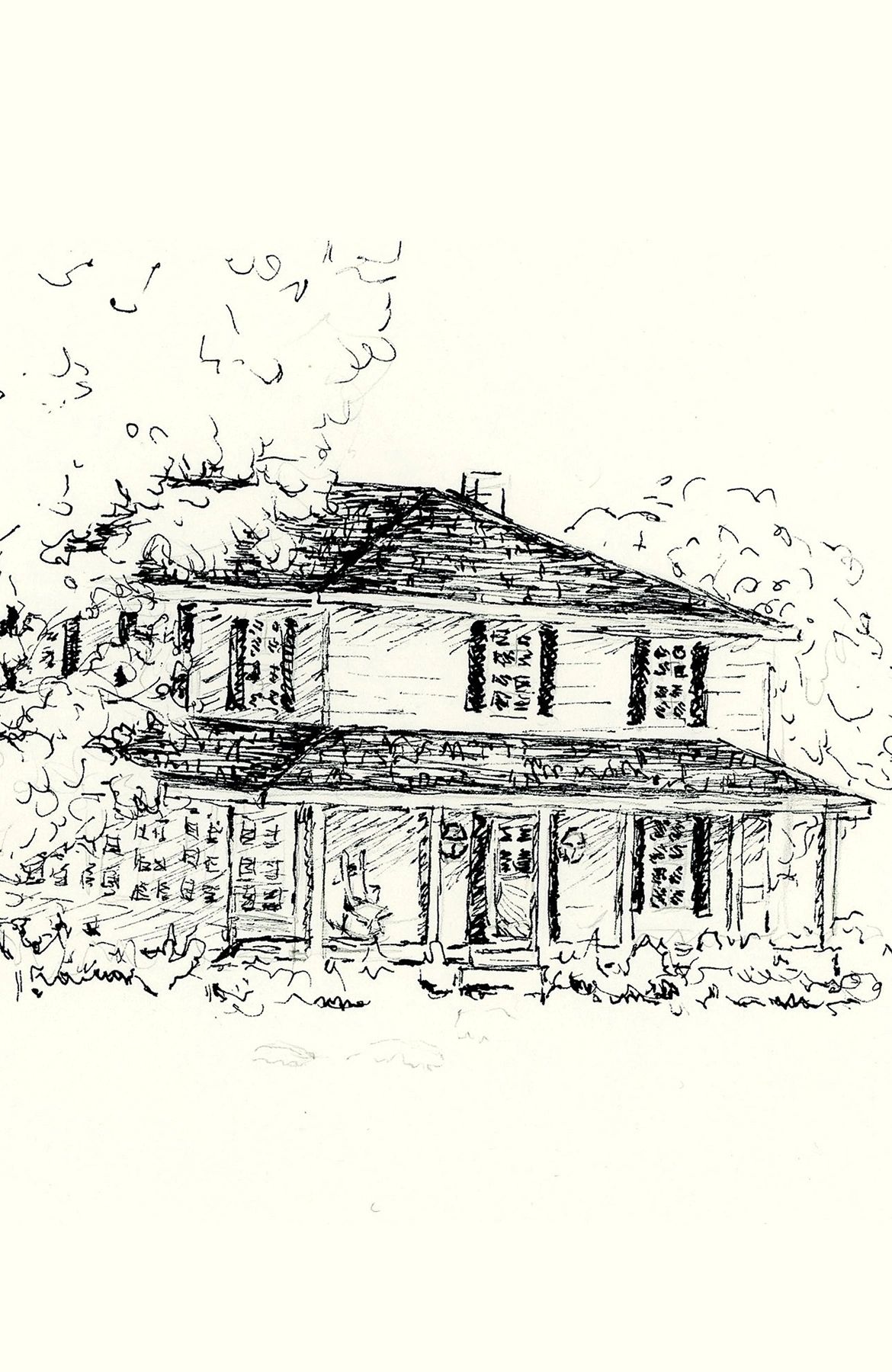
After encountering a ghost in the PEI mansion she just moved into, one Victorian woman's remarkable first-person letters tell how she decided to investigate the haunting herself…
“It was in the year 1856 that my husband took me to live at a house called Binstead, about five miles from Charlottetown, Prince Edward Island,” began Georgina Pennée’s unique first-hand account of her investigation into a ghost in her house. “About ten days after we had established ourselves at Binstead we commenced hearing strange noises…”
Georgina Pennée had grown up in London, England, the youngest daughter of a famous cricket player-turned-Member-of-Parliament. Her husband, Arthur Pennée, was one of those aristocratic Victorian men of undetermined income and little need for a job.
On her husband’s whim, they moved to PEI. There they purchased an enormous mansion on the outskirts of Charlottetown — the largest house in the province — named Binstead Manor.
“It was a good sized house," she wrote. "The back had been considerably extended, since there were about 200 acres of farmland around it, necessitating several resident farming men.”
She noted that a young farm worker who had lived there before they moved in named Harry was “most careful to fasten his door before retiring. … At the time, I attached no importance to his ways."
Georgina wrote that soon after moving in she began to hear a “noise, more like a rumbling, which made the house vibrate.” She remarked that it was like the sound “produced by dragging a heavy body.”
That winter, she invited two friends over. They stayed the night in the guest room.
“About 2 o'clock, Mrs. M. was awakened by a bright light which pervaded the room,” Pennée wrote. “She saw a woman standing by the fireplace. … In her left arm was a young baby, and with her right hand she was stirring the ashes.”
“… Just then the figure turned her face towards them, disclosing the features of quite a young woman with a singularly anxious pleading look upon her face. … [she] screamed and pulled the bedclothes tightly over the heads of herself and her companion.”
She wrote that the haunting soon grew worse, and she heard: “… shrieks, sobs, moans, and half-uttered words … which would grow fainter or louder, as if someone was being chased round the house.”
Seemly unphased by her friends' experience, one night, when her baby was sick, Georgina decided to sleep in the guest room.
She wrote that night at “About 12 o'clock I got up to give her some medicine and was feeling for the matches when she called my attention to a brilliant light shining under the door. I exclaimed
that it was her papa and threw open the door to admit him. I found myself face-to-face with a woman.”
“She had a baby on her left arm, a check shawl crossed over her bosom, and all around her shone a bright pleasant light, whence emanating I could not say. … She … moved across the staircase, vanishing into the opposite wall.”
Pennée wrote that she had been not afraid, but fascinated by the ghost: “Her look at me was one of entreaty — almost agonizing entreaty … Neither my daughter nor myself felt the slightest alarm … nor did my dogs bark.”
Georgina Pennée instead decided to investigate Binstead Manor’s ghost. Her first-person write-up of the 1856 haunting was later published in the academic journal of the Society for Psychical Research in London, which deemed her ghost story “striking enough to plead for serious attention to.”
She learned that about two decades earlier, Binstead had been owned by “a man of low tastes and immoral habits,” named Charles Braddock. A wealthy businessman who owned a shipyard, farms, and mills, Braddock had reputedly been “much addicted to the use of intoxicants.”
Georgina learned that Braddock: “had two sisters in his service, the daughters of a labourer who lived in a regular hovel, about three miles nearer town. After a time each sister gave birth to a boy.”
She became convinced that these two sisters and their baby boys were intertwined in the ghost story, writing: “It is certain that one sister and one baby disappeared altogether, though when and how is a complete mystery.”
A short report from the Islander newspaper from the time when Braddock owned Binstead Manor notes that he had two sons within a short time, but one of them had died. No cause of death was offered, but the death was not considered suspicious, and there had been no inquest.
Pennée wrote that she had learned that “The other sister returned to her father's house, and leaving the baby with Mrs. Newbury, her mother, went to the States, and had never returned. Before leaving, she would reveal nothing, except that the boy was her sister's, her own being dead.”
However, Georgina was unable to figure out the missing woman's name, or what had happened to the son, who, by her estimates, would have been a young man by then.
Georgina's husband lost interest in PEI. They were in the process of packing up to move home to England when, she finally thought to ask Harry, a quiet long-employed farm worker on
Binstead farm, whether or not he had ever seen the ghost.
“Harry had had several visits but would tell no particulars," she noted, adding: "I never could get Harry to tell me much.”
It seems that only at this point did it dawn on Georgina that, despite having lived in the same house as Harry for the past three years, she didn't actually know much about him.
She didn’t even know Harry's last name.
When she asked Harry for the first time what his last name was. She was shocked by his reply:
Newbury.
Georgina wrote that the missing baby “was this very Harry Newbury that we had unwittingly engaged as farm-servant.”
Harry revealed that the ghost — apparently of his mother who had died giving birth to him — frequently visited him, and “had several times stood at the foot of his bed," watching over him.
Georgina Pennée wrote that "he would not tell me more.”
The Backyard History Halloween Adjacent Story Collection
Old Ned, The Lake Utopia Monster (Appears in Book One)
The Ghostly Fire Ship of the Baie des Chaleurs (Appears in Book Two)
The Spectre of Rexton (Appears in Book One)
The Ghost of Binstead Manor (Appears in Rebellious Women In The Maritimes)


