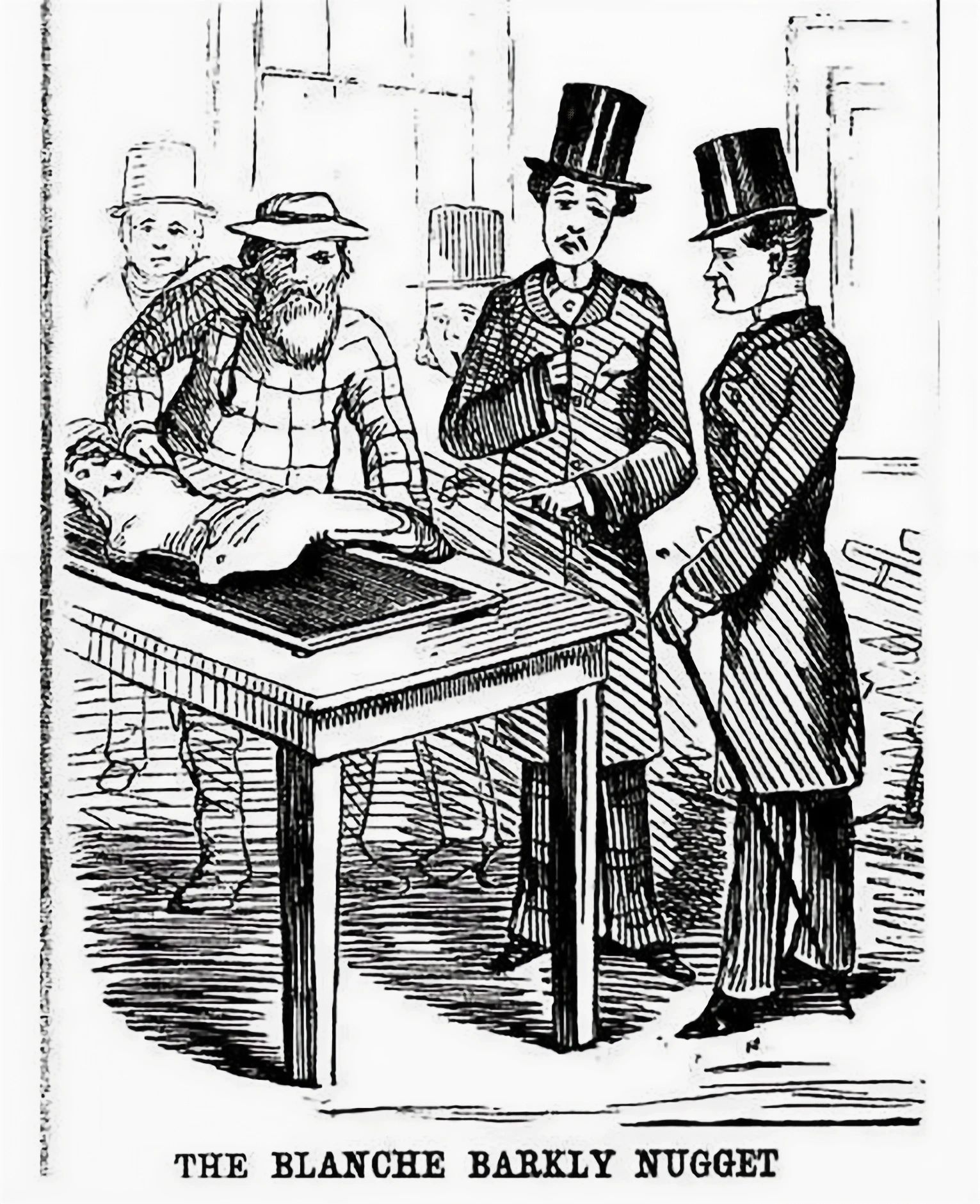
Getting Samuel H. Napier to talk about the time he found the world’s largest gold nugget was easy — just buy him a drink, wrote reporter Frank Risteen. The tricky part was that Napier would almost certainly ask to borrow money, too. “He had no difficulty getting separated from his easily acquired wealth,” wrote Risteen.
[Dedicated Backyard History readers might remember Frank Risteen: he was the reporter who had a close encounter with the very human man behind the Dungarvon Whooper ghost story. That full story appears in the book Mysterious Stories From Atlantic Canada's Past.]
“This writer is in favour of irrigation, in moderation,” Risteen told Napier, who began his story:
“It was in 1854 that I left this country for Australia in the barque Marco Polo. … She was no chicken, I can tell you, even back in the fifties! I sailed four voyages … before I caught mining fever.”
Napier was originally from Bathurst, but his claim to fame came in the goldfields of Australia. While many hopefuls flocked to the big, flashy gold rush sites, Napier tried his luck at a lesser-known spot called Kingdower, about 200 kilometres north of Melbourne. He wasn’t alone:
“My brother Charles H Napier was in partnership, and our cook and general factotum was an old Englishman, 75 years of age, Robert Ambrose. He is dead now.”
Napier paused to do some math. Ambrose had been 75 forty years earlier when the events happened. He shrugged: “If he isn’t dead now, it’s time he was.”
For six long months, the three men found nothing but disappointment. Then, on August 14, 1857, at 10 a.m., everything changed:
“We had dug down about 14 feet to the pipe-clay strata, and were browsing around in the bottom of the shaft more dead than alive from the heat. Old Ambrose lit his pipe and learned against the side of the hole to rest. Just then, I struck something with my pick. I turned it up — and good heavens! — it was a hunk of gold as big as the moon! Well, that minute I knew our fortune was made!”
Ambrose, overwhelmed, started dancing in the pit.
“Old Ambrose got excited and jumped around until I thought he’d have the whole diggings brought down upon us.”
They had found the largest gold nugget … ever.
“How much did it weigh?” Risteen asked.
“The heft of that nugget was 146 pounds, 4 ounces and three penny weights, and when it was smelted it was found to be 23 ⅞ carats fine, containing only 10 ounces of dross,” replied Napier.
The goldfields were rough places, and robbery — or worse — wasn’t uncommon. It would require craftiness to get the gold to civilization and live to tell the tale.
They covered up the nugget and waited. That night, after the other men in the mining camp had drunk themselves unconscious, the trio snuck back to the site, unearthed the gold and brought it to the camp.
“We set to work as foxy as possible with our picks and sunk a shaft six feet under the table in the tent and buried the nugget out of sight. For three long months it stayed there, with us eatin’ and walkin’ over it, sleepin’ on it and dramin’ on it, not a soul at the diggins’ any wiser,” said Napier.
By November, they’d found enough gold to afford a cart and get back to Melbourne. They dug up the big gold nugget, hiding it in a rough box. “We carried no arms for fear of being suspected and told everybody we met we were going to New Zealand.”
In Melbourne, they took the gold to a bank, bought insurance on it, then boarded a ship to London. Apparently, the bank let the news slip, because by the time their ship reached England, they were already international celebrities.
“We thought nothing of having half a dozen lords and dukes for breakfast while the craze lasted,” Napier recounted. “We were presented to the Queen. She sent her carryall and a battalion of mounted policemen to portash the nugget and us to the palace. We stopped with her for lunch, and I must say she made herself generally agreeable. I teetered the Prince of Wales on my knee.”
Risteen may have raised an eyebrow at this image — the Prince of Wales, by then, was famously girthy. Napier clarified: “he was just a stripling then.”
“We sold our beauty to the Bank of England for 10,000 sterling,” Napier said.
He moved home to Bathurst, built himself a grand mansion, and was promptly elected MLA — though Napier claimed that hadn’t been his idea: “When I got here the boys took hold and elected me to the Legislature at the head of a poll by a 140 majority.”
His career in the House got off to a shaky start when he referred to his fellow MLAs as “the 41 dogs.” Later, the Speaker threatened to have him arrested, shouting: “I’m not going to sit here and listen to the incoherent ravings of a man who is not fit to sit in the House.”
As his term limped along, Napier found himself embroiled in scandals over misappropriated funds and political patronage. At the time, MLAs personally controlled road-building budgets in their ridings — an invitation for old-school pork-barrel corruption if ever there was one. Whether Napier was genuinely worse than other MLAs or just more unpopular isn’t clear. But when the next election rolled around, he didn’t run. Not long after, he declared bankruptcy.
He told Risteen that he’d gone bankrupt due to bad business deals in England, “and soon every cussed ounce of the nugget was gone to kingdom come.”
Risteen wasn’t so sure. He strongly hinted that the real cause of Napier’s ruin was a drinking problem so profound it cost him everything.
Napier, once a household name and a guest of royalty, ended up penniless and wandering. Four years after that interview, his body was found in an abandoned logging camp in northern Ontario. He’d last been seen alive over a year earlier.
Guarding his body was his loyal dog. “The dog was his sole remaining friend,” the Fredericton Daily Mail wrote. No one knew what Samuel Napier had been doing there, but the paper guessed he was still looking for gold.
MORE FRANK RISTEEN STORIES


