The Dungarvon Whooper is one of the Maritime’s most famous ghost stories. Two years ago, I argued that this "ghost" had actually been a hermit living in the forests of the Miramichi. Now, a recently uncovered news report offers a remarkable "interview" of sorts with this man commonly thought to be a ghost.
- The early version uncovering "The True Story of the Dungarvon Whooper" appears in the 2023 book Backyard History: Forgotten Stories From Atlantic Canada's Past. Since then, I have managed to uncover lost accounts from those who met the Whooper, and a more complete version of the story, pulling together these eyewitness accounts, is in the 2025 book Backyard History: Mysterious Stories From Atlantic Canada's Past.

Frederick Irland, an American journalist usually based in Washington, D.C., reporting on Congress, had an unexpected encounter during a fishing trip to New Brunswick. In an 1895 article for Forest and Stream magazine, he described meeting a mysterious figure he called "The Lost Man," writing, “Readers may puzzle over the matter as I have done.”
Irland had been invited to New Brunswick by Frank Risteen, a somewhat eccentric reporter in the Legislature who fancied himself as the province's top tourism promoter. Hoping to attract American tourists, Risteen arranged for Irland to go on a fishing trip with him on the Miramichi.
Their trip, however, took an unexpected turn.
“The thing happened,” Irland wrote, “in a corner of the wide, little-known wilderness which forms the larger part of the province of New Brunswick. Under the pilotage of that greatest of all New Brunswick guides, Mr. Henry Braithwaite, of Stanley, three of us had started from Boiestown on our way to Little Sou’west Lake, a good sixty-mile walk. … over a very old and long unused lumber road, full of fallen trees, up steep hillsides, across quaking bogs …”
Miles away from the nearest human habitation, Irland wrote that they decided to spend the night "At an old lumber camp, the last purpose of even that barbaric relative of civilization. Beyond … stretched the grim and unmapped wilderness.”
After catching trout and a seven-pound salmon for dinner, Irland wrote: “We turned in as soon as it was dark, occupying the long-deserted bunks of the lumbermen of other days. The fire outside flickered and fizzled. In two minutes after I lay down I fell asleep.”
Not long after, they were jolted awake by a bloodcurdling scream — a whoop.
Shaken, they could not go back to sleep.
As they lay awake they spotted a dark silhouette cross the open doorway of their cabin. In walked an old man with matted hair and tattered clothes who walked up to their fire and began to warm his hands by the fire.
Remarkably, the American slept through the commotion.
“I was awakened by Risteen," he explained, "who crept back into the bunk, saying that a lost man had come into camp … and that neither the men nor himself could make anything out of him. I was too sleepy to take much interest in the matter.”
The legend of the Dungarvon Whooper had begun 25 years before in 1869. After five years of strange bloodcurdling “whoops” spooking lumberjacks, the sounds disappeared.
After fifteen years, though, in 1889, the haunting screams returned. It was now accompanied by distinctly human behaviour including break-ins to logging camps and cabins, where flour, salt cod, and pork went missing.
After finally waking up the following morning, Frederick Irland found that his vague memories of Risteen talking about a strange man having entered the camp was not, in fact, a dream.
He described the stranger, offering the only written description of this man widely believed to be a ghost, calling him: "a grizzled, skinny old chap, who might have been 70, and was more likely 60. He was tall and bony, and strong considering his age. … He had refused to come into the camp, but slept all night on the ground by the fire. … He had with him no matches, no compass, no blanket, no food.”
Irland couldn't wrap his head around how someone could possibly survive in the woods, writing: “That vast tract of mountain and forest is an extremely bad place for a man who has neither food nor fire …[yet,] the fact of being far astray in an absolutely unpopulated wilderness did not arouse a word of alarm or regret. ”
Frederick Irland tried to interview the mysterious stranger, but found he spoke haltingly “with an uncertainty of utterance which made him difficult to pronounce intelligibly.”
The stranger claimed that he was going to Grand Falls.
“But great goodness, man," Irland wrote, "Grand Falls is on the Saint John River, seventy miles in a straight line, and a hundred from here, the way you’ll have to go!”
“This information did not seem to disturb the man much," observed Irland, "and in fact nothing else did.”
Irland did manage to glean some information about the man's origins, writing: “He had been in the American war. … If he could get to Grand Rapids he had friends there … ”
While this raises more questions than it answers, the implication is that the Dungarvon Whooper was not a ghost, but a somewhat unstable veteran of the American Civil War who had been living in the woods for decades.
Henry Braithwaite, their guide, summed up the group's astonishment: “Well, I’ve been in these woods most of my life, and he beats me!”
Frederick Irland tried to ask him his name, though, he noted: “It was difficult for him to pronounce his own name intelligibly [but] it sounded like Dorns or Torrance.”
Irland wrote that “While breakfast was being cooked I took his photograph – a thing he did not like.”
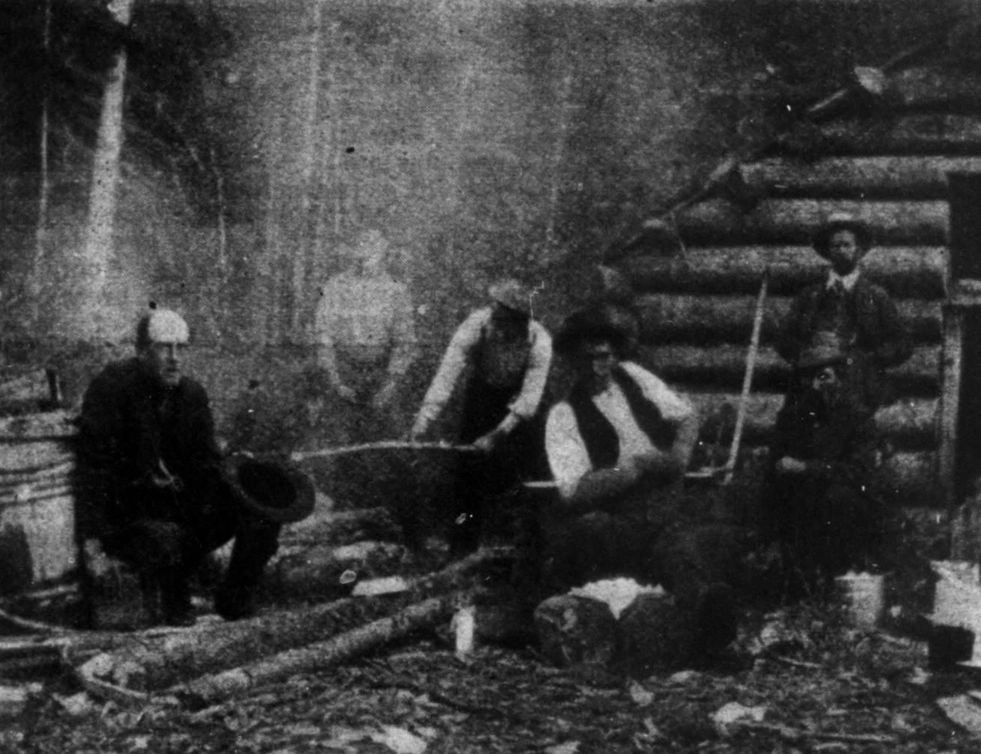
After breakfast, Frederick Irland wrote that “The Lost Man” departed:
“As he left us he turned and looked us all over. He did not express a word of thanks [or even of] interest. He seemed to be all the time in a sort of trance. … Then he turned and swung off down the portage at a good gait … up the bank of the Southwest Miramichi River all alone, barefoot, with his boots in hand, and without means of sustenance…”
“I have often wondered what happened to him … I have presented so much of his story as I know to the readers … [now] what do you suppose became of him?”
- The full version of The True Story of The Dungarvon Whooper appears in the book Backyard History: Forgotten Stories From Atlantic Canada's Past
- The full Dungarvon Whooper story, combining the two tales.


