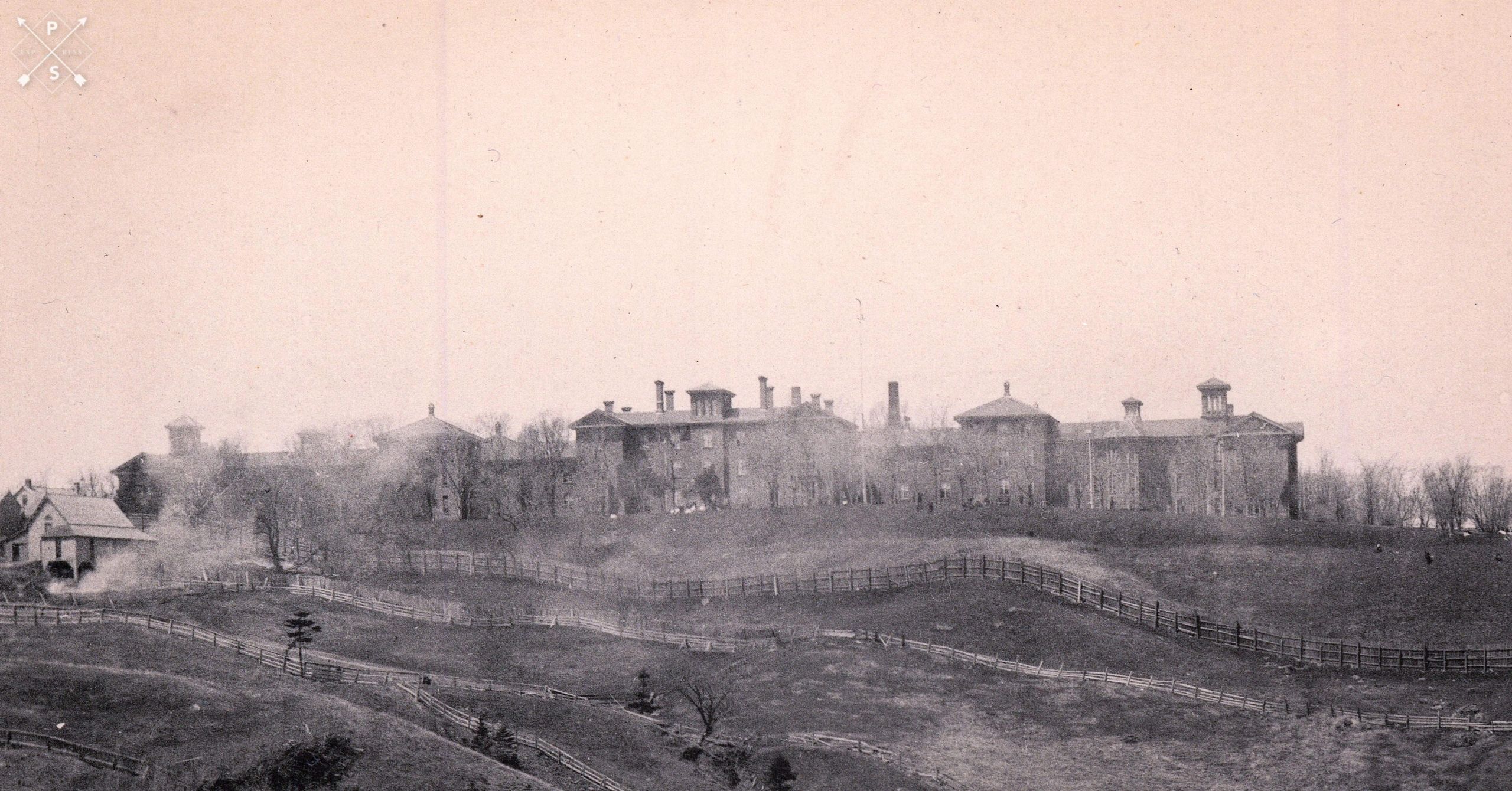
“They will not allow me to go home,” begins the haunting diary that Mary Huestis Pengilly wrote while locked up in the Saint John Lunatic Asylum, Canada’s first ever mental health institution.
Mary Huestis Pengilly wrote vividly in a secret diary about her experiences as a patient in the Asylum in the 1880s, which she later published in a book. After her release, she became a high-profile and outspoken advocate for reforming how mental health was treated in both Canada and the United States
Mary Huestis Pengilly had actually gone willingly to the Saint John Lunatic Asylum, accompanied by two of her sons on October 29th, 1883.
While she was in the Lunatic Asylum, Mary kept a secret diary, which she tucked in her mattress to hide. In it, she wrote:
“I thought I was perfectly safe here. All I need is good nourishing food, and I know better than anyone else what I require to build me up and make me as I was before I met with this strange change of condition.”
As her sons checked her into the Saint John Lunatic Asylum, Mary caught sight of her reflection in a window. She was shocked.
“I can’t bear to see myself in the glass. I am so wasted. So miserable, My poor boys, no wonder you look so sad, to see your mother looking so badly.”
Immediately after her sons departed the Asylum, leaving Mary there, she had her first meeting with the doctor. She explained to him that all she needed was some food, and some rest so that she could recuperate.
The doctor didn’t react as she expected: “I was startled and alarmed when the doctor abruptly stood up and said, "I know better than any other man,” and walked out of the room without another word.”
“The morning after my arrival, I begged for milk and a biscuit, but they refused. They brought me a bowl of common-looking soup with a black looking baker’s bread. I refused to eat it. They do not live to coax crazy people here. Mrs. Mills called in her help. They held me back and she stuffed the soup down my throat.”
Mary Huestis Pengilly was born into a relatively wealthy family in Connecticut. She moved to Saint John after marrying Robert Pengilly in 1847, and they had a prosperous and well off life in that large and cosmopolitan Atlantic Canadian port city, where they had a big and healthy family of five sons and one daughter.
Her relatively idyllic life came crashing down in a single day: June 20th 1877.
A spark fell on a pile of hay in a warehouse on the docks of Saint John at 2:30 that afternoon, and in only nine hours two-fifths of the city burned to the ground in a catastrophic inferno, which surrounded the entire harbour. Eyewitnesses described that it looked like even the water itself was on fire.
Mary and her family all survived, but they, along with 20,000 other people, lost everything in the fire.
This was before insurance became mainstream, and in the months after the fire, one by one her suddenly destitute and impoverished family dispersed, either going to Western Canada or the United States to look for work.
Mary herself moved to Massachusetts to look for work, her daughter Clara following her there shortly after.
In 1882, Mary’s only daughter Clara died.
Mary wrote about those events in her secret diary while in the Asylum:
“Two years ago, I was watching by the bedside of my dying child."
"Everyone loved her for she had a loving heart and a nature so full of sunshine she could not be unhappy. Her teacher brought me two large bouquets from her schoolmates. The boarders in our building also brought flowers. Dear Lorelle, the blind child in the boarding building, who Clara took for walks, arranged vines and woven flowers around her face and said “I will never know a truer friend than the one who lies here. I know she was so fond of flowers. This is the least that I can do.”
"My tears unbidden flow – why do I go back in memory to those sorrowful days?"
"I cared not for the flowers, I only knew her loving heart was stilled in death and I was now left alone.”
After her daughter’s funeral she abruptly disappeared, returning to Saint John without telling anyone.
She described her emotional state at that time:
“My hands would not remain folded or my brain idle. I was much alone, engaged in writing a book on the laws of health. I became so absorbed in my work I forgot to eat. After days I seemed to think I had done some wrong. Angel voices whispered I must fast and pray. I fasted for eight days. I wasted to a shadow. I sang to myself. I wept and wished to die.”
One of her five adult sons, Lewis, took the train up from Boston to Saint John to search for his 60-year-old mother.
He was joined by his brother Thomas, who owned a little shop in Saint John. Thomas joined the search for his mother despite being rather busy at the time. He was running as a candidate in his first-ever election campaign, seeking to become an Alderman (which means city councillor).
The two sons found their mother in a decrepit and filthy Saint John boarding house in October of 1883. She had no heat, no food, and was completely alone.
Mary wrote that at first she tried to send her sons away:
“I told them to nail up the doors and leave me there. My poor boys. How worried they must have been. They watched me night and day alternatively. Tom fell asleep in my rocking chair. How often I have wished for that rocking chair since I came here.”
The sons brought a doctor to see her. Mary was argumentative, declaring that the angels –meaning the voices she was hearing– would protect her and that she must continue her fast. The sons and the doctor tricked her into eating toast and tea by pretending it was communion bread and wine.
Once she had some food, the first she’d eaten in over a week, she seemed to calm somewhat. Aware that she needed help, she rather begrudgingly agreed to be checked into the Saint John Lunatic Asylum, a massive, towering grey building perched on a hill on the far side of town.
Her sons dressed her and carried her out of the cold filthy boarding house.
“My sons carried me in their arms like I had carried them as babies. They lifted me into the carriage. I looked so badly."
"After we were on our way, I began to feel happy. I was so happy when I was with my sons. I thought of going home. I thought I was going home to see my friends. The voices of the angels whispered to me, “keep hold of your sons. Keep them close and you will be safe.” I sang.”
But her sons weren’t taking Mary home.
They were taking her to the Saint John Lunatic Asylum.
The Saint John Lunatic Asylum was the first ever asylum in all of Canada. It had been built fifty years earlier with the highest ideals in mind, by a progressive and well-meaning young doctor named George Peters.
Dr. Peters had actually been born and raised in Saint John, but when he studied medicine in Edinburgh, in Scotland, he became acquainted with the cutting edge of the most humane psychiatry in Europe.. at the time.
However, at that time, the big debate in psychiatry was whether or not those considered medically insane should be locked in dungeons, beaten, and left chained to walls for their entire lives.
The cutting edge of progressive new ideas of psychiatry at that time –the ones which Dr. Peters came to believe in– were then making what was at the time the extremely controversial argument that chaining up people who were experiencing mental health struggles was actually not very good for their mental health.
And these new and progressive doctors were experimenting with bold new ways of treating mental health struggles, which was to NOT chain up patients.
However, this was exactly the state Dr. Peters found patients in in 1836, when he returned home from Scotland, and he toured the Saint John Almshouse. There, he was horrified to find that patients were mixed with criminal prisoners. In an angry letter to the province’s government, he described how patients were restrained with chains, writing that “some of them [were] perfectly naked and in a state of filth.”

It was pressure from Dr. Peters that led to the establishment of the Saint John Lunatic Asylum, the first ever mental health treatment centre in all of Canada. It was based on progressive principles of compassion and leniency, and might be best described as an effort to allow the patients into a relaxed state rather than a medical intervention.
Dr. Peters’ contemporaries didn’t think that what he was doing at the Asylum was even really a medical practice – he avoided giving patients drugs at all, and generally tried to give patients freedom and mental space to allow them to get better on their own.
His goal was to get patients out of their homes and away from the places that caused them the stress that caused the mental health issues, and to allow them time and space to recuperate.
He liked to call it “The Humane Method.”
Dr. Peters' commitment to the best outcomes of his patients was never questioned, though some did question if he was perhaps a little too dedicated to his patients.
In 1847, he caused a curious little scandal in Saint John when he found that two patients in the Asylum had the severely contagious and extremely deadly disease of Smallpox. Smallpox is now extinct, but it was the deadliest disease in human history. Dr Peters’ solution to not infect the rest of the Asylum with Smallpox was to take the two patients who had it to his house in Saint John’s suburb of Lancaster to recover, so as to not put the other patients at risk. His neighbours were furious.
The problem though, wasn’t that anybody didn’t have good intentions; it was that right from the start, the Asylum was drastically overcrowded and seriously underfunded. It was home to 284 people in a building only built to house 200. It was critically short-staffed and lacking money from the government.
The deterioration of conditions in the Asylum only got worse after Dr. Peters' death, under his handpicked successor, Dr. John Waddell. He replaced “The Humane Treatment” with “The Moral Treatment.”
During Dr Waddell’s 27 years as superintendent, the Asylum became overcrowded and the subject of allegations of mistreatment. Notably, Dr Waddell also brought back what he called “medical restraints”, arguing that “sometimes they had to be applied for the good of the patient.”
Some drugs also began to be used then, mostly tranquillizers and purgatives, to control the patients.
By that time, the Asylum was home to nearly double the people it actually had space to house. It was critically short on staff and struggled to have enough funding to cover even basic necessities like food, and frequently ran into coal shortages, meaning there were problems heating the place.
Mary wrote extensively about the cold that winter in her diary, though she focused less on complaining about it and more on recounting little tricks she learned to stay warm:
“I have learned to let the cold air from the radiators to let in more heat. I do it when no one sees me. I love to cheat the nurses. I tell them I will tend to the fire if they will leave the coal by the grate. I draw up the huge, uncomfortable chairs by the fire until the seats form a circle. If the seats get filled up [with the other ladies] I add more coal to the fire. I say to myself, “We all have the right to the comforts of life, let us have a nice fire and bask in its comforting rays.” I love the heat. It cheers my heart. There is no situation in life, however unpleasant it may be, [that does not have] some bright spots in it.” ”
In 1864, a reporter for the Morning Telegraph newspaper followed Dr. Waddell around for a day. While the reporter gushes over how wonderful the institution is, he also paints a curious portrait of a superintendent who “enjoys his strange life.”
The reporter recorded several conversations between Dr. Waddell and patients, and it’s sometimes difficult to know how to take them, because reading things you don’t get the tone, and they could come off as either playful joking, or mean-spirited mocking.
For example, in one conversation a longtime schoolteacher, who taught kids Latin and Greek for years, begs Dr Waddell to let him go home, saying he’s cured. The reporter records Dr Wadell replying –and this is an actual direct quote from the article– “Psaw! You’re crazy man! You don’t know yourself.”
Dr. Waddell was very popular in Saint John, where the general public thought he was doing a great job with limited resources.
It does seem that Dr. Waddell did the best he could in a dire financial situation. For example, he established a large farm on the Asylum’s grounds to grow high-quality fresh food for the patients to try and fill the gaps in funding.
That April, Mary recounted a conversation between her and the doctor:
“It was bathing day on a cold, damp April morning, and no hot air came from the radiators. The Doctor came in and I said, “Doctor, can’t you send some coal? We are nearly frozen,” He said the coal is all gone. He said he sent for wood, anything, to keep us warm, but that nobody was taking the trouble to find it. But after dinner, some coal came.”
The reporter in that 1864 newspaper article wrote about Dr. Waddell tenderly stroking the forehead of one patient like a mother would a sick child. He records the doctor finding another patient anxiously pacing the floor, and then going up and locking arms with her, and walking with her, speaking in soothing tones to calm her troubled mind.
Interestingly, in Mary’s secret diary, she was very careful to not depict things in simple blac

k and white, and highlighted that people were doing their best in an overstretched and underfunded system.
The most fascinating example of this was Mary’s changing relationship with an elderly nurse named Mrs. Mills.
When she first arrived, Mary hated Mrs. Mills. She was the one who force-fed her on her first day in the Asylum.
“How unkind Mrs. Mills is. Does she think this kind of treatment is good for our health? I begged for milk today, and she can’t spare any. She has not enough for the other old women, she says. My son Tom gave me some money but no one would do me an errand outside [by buying me milk]. I begged Mrs. Mills to buy me an extra quart of milk but she refused. She said it was against the rules.”
Later, she complained that another woman, who was blind, had an inflamed eye and Mary bandaged it up. Mrs. Mills came along and tore off the bandage and threw it on the floor.
“I told her that that wasn’t a very Christian thing of her to do!”
Mary observed, and wrote about some of the other women she met:
“There is a Miss Short here, a fair-haired, nice-looking girl. She stands up and reads the Testament, recites poetry, and tries to play piano. I didn't think her much out of order when she came, but she is now. She has grown so much worse. She tears her dress off so they have to put leather handcuffs on her wrists so tight they make her hands swell. I said “Oh Mrs Mills don’t you see they are too tight?” She paid no heed, saying: “they don’t hurt her any.” ”
Mary wrote often about the different people she met in the Asylum.
“Another poor victim has come to our ward today. A black eyed, delicate-looking girl. She looked so sad. The girl has been living at Dr. William Bayard’s house for three years as a chambermaid. – That is enough to assure me that she is a good girl. When I went to the hall this morning, she was kneeling by the door; she laid her cheek on the bare floor, praying for her sins to be forgiven. She has lost her health in some way. She has transgressed some law of nature. She is so pitiful and sad! How could Mrs Mills speak so unkindly to her, pushing her with her foot to make her get up? She treats us all like naughty schoolboys in need of correction.”
Gradually, though, Mary and Mrs. Mills began to get along better. That March, five months into her stay at the Asylum, Mary wrote:
“Mrs Mills now gives me a glass of milk at bedtime, with one soda biscuit. It is against the rules, but she now does the same for some of the others as well. This is the only luxury we have here. It is because I have tried to make her think of us as her children. We are but poor little children, left in her care.”
By her sixth month in the Asylum, however, Mary had a remarkable change of heart about her old arch-nemesis, Mrs Mills, writing:
“Poor Mrs Mills has served thirty-two years here. She has become hardened to her surroundings, as anyone would. She is too old a woman; she has seen too much. She works so hard for such an old woman, but she is no longer fit for a nurse. If she were a soldier and had served her country for that long, she would have been entitled to a pension!”
Just like Mary ultimately didn’t blame Mrs. Mills for her condition, the government’s lack of funding is also not quite black and white.
During the 1830s and 1840s, New Brunswick experienced an explosion of immigration, mostly of poor and literally starving immigrants fleeing the Irish Potato Famine. The government had many priorities competing for very little money.
The Saint John Lunatic Asylum –remember this was the first ever Asylum in all of Canada, and regardless of its shortcomings it was vastly more advanced and offered far better care than anything else in the country at the time– there were three other massive infrastructure projects underway in Saint John alone, a hospital, a prison and an Almshouse, which means a home for the poor, all competing for very little money.
You might be able to make the case that the provincial government back in the 1830s invested more in mental health care than even today, relatively speaking.
And for all of its faults, the Saint John Lunatic Asylum could have been much worse. While Mary was in the Asylum in Saint John, a scandal was taking place over an asylum in Massachusetts, where she had recently been living. Mary’s mental health struggles had really dramatically increased.
Massachusetts’ Governor was accusing the Tewkesbury Asylum, in that state, of everything from doctors and nurses embezzling money that was supposed to be for patients’ care, to staff selling the patients clothes, to, and this is dark, selling the bodies of dead patients to medical schools for a profit, and of tanning the patients’ dead bodies skin and using it to make shoes, which were being sold in markets in Boston. So there were definitely worse Asylums around, and you didn’t have to go far to find them.
If the timing were slightly different, Mary might have ended up in Tewkesbury Asylum herself.
As for Mary, though, her treatment by the nurses and doctors in the Asylum improved very suddenly on April 3rd, 1884. A cynical person might think that this seems awfully coincidental with her son Thomas having the night before won the election which he was running in.
“Dr. Steeves came in this morning and congratulated me very pleasantly that my son was elected Alderman. My new room is carpeted and furnished well. He was a little more social than usual, so I suggested he bring some blackberries in from the field. He said yes, he would send some of his men out to the farm and get some, and he left as pleasant as he came. That was the first time he ever left me without refusing a request.”
“I suppose he thinks I have forgotten all the doings of the past winter, and that I will not dare to say anything against such a mighty man as he is. He thought I thought him a perfect gentleman, which he is not. I am glad I have taken [this diary] down in black and white, so as not to forget the wrongs of the Province, and the wrongs of those poor neglected women, of which I am one. My indignation overcomes me.”
Alderman Thomas and the doctors conferred about releasing Mary. It’s important to note that Mary was never a prisoner. On the contrary, Thomas had been paying the exorbitant price of a whopping $5 a month to keep her there, in the hopes that his mother would get better.
Some of the patients may have been there on compassionate grounds for free, but most of them would have been paying a sliding scale of fees to be at what was, for the time, one of the finest specialized care facilities in the country.
On April 30th, Mary was released. She was taken away so quickly she didn't even have time to bid goodbye to the other patients she had befriended while in the Asylum.
The young nurses, however, gathered by the front doors to bid her goodbye.
After departing the Asylum she went to the Saint John Hotel, which the Asylum overlooked.
Mary wrote in her diary:
“I am free at last! Seated in my own room in the hotel, I look at that prison on the hill.”
She almost immediately met another hotel guest, who had also been in the Saint John Lunatic Asylum.
He was “a young man who looked as if he was going to die. He lay back in his chair, looking so sad. “If I should live a hundred years, I should never get that hospital off my mind” were his words. “A disagreeable, unkind nurse, a cold ward, and miserable food.” His words touched my heart, for my experiences had been similar to his and I could never forget them.”
Mary dedicated the rest of her life to improving conditions in Asylums. She met with New Brunswick’s leading politicians, like the Attorney-General, and Governor Wilmot to discuss changes to mental health care, and travelled all over Canada and the United States advocating for better treatment of those struggling with their mental health.
In 1885, she had the secret diary she’d written while in the Asylum published as a book called ‘Diary Written In the Provincial Lunatic Asylum.’ Mary Huestis Pendilly ended the book by directly addressing her audience –that means you– and asking something of them:
“I was anxious to right the wrongs [suffered by] those poor, feeble women I had left behind in the Asylum. I was anxious to right their wrongs."
"I am sorry to say we are not all perfect. Surely there are those among you readers who can apply some of this [weakness of the mind to yourselves.] Perhaps some of your friends believe you to be insane on some subject?"
"Let me here entreat the readers, wherever this little book may find them, to take this work upon yourselves. Rise up in your own strength, the strength you have in yourselves."
"We cannot allow our fellow-sisters and our fellow-brothers to be neglected by those who cannot understand the weaknesses that misfortune can bring to the minds of any of us."
"The public must protect, with kindness and hospitality, the weak."
"I will leave this subject now in the hands of the readers, wherever this little diary may find them, who, I hope, use these words for the benefit of suffering humanity, remembering that we are all children."


