On Easter weekend, 1967, The Turtles’ Happy Together knocked The Beatles’ Penny Lane from the number one spot on the music charts — and the controversial American poet Allen Ginsberg arrived in New Brunswick.
Two staffers at UNB’s brand new campus had basically harassed Ginsberg’s team until they added a lone Canadian stop — Saint John — to his sold-out tour.
The Telegraph-Journal’s editor wrote: “Do poets speak the same language? To find out, the Telegraph-Journal assigned Alden Nowlan to talk with Allen Ginsberg.”

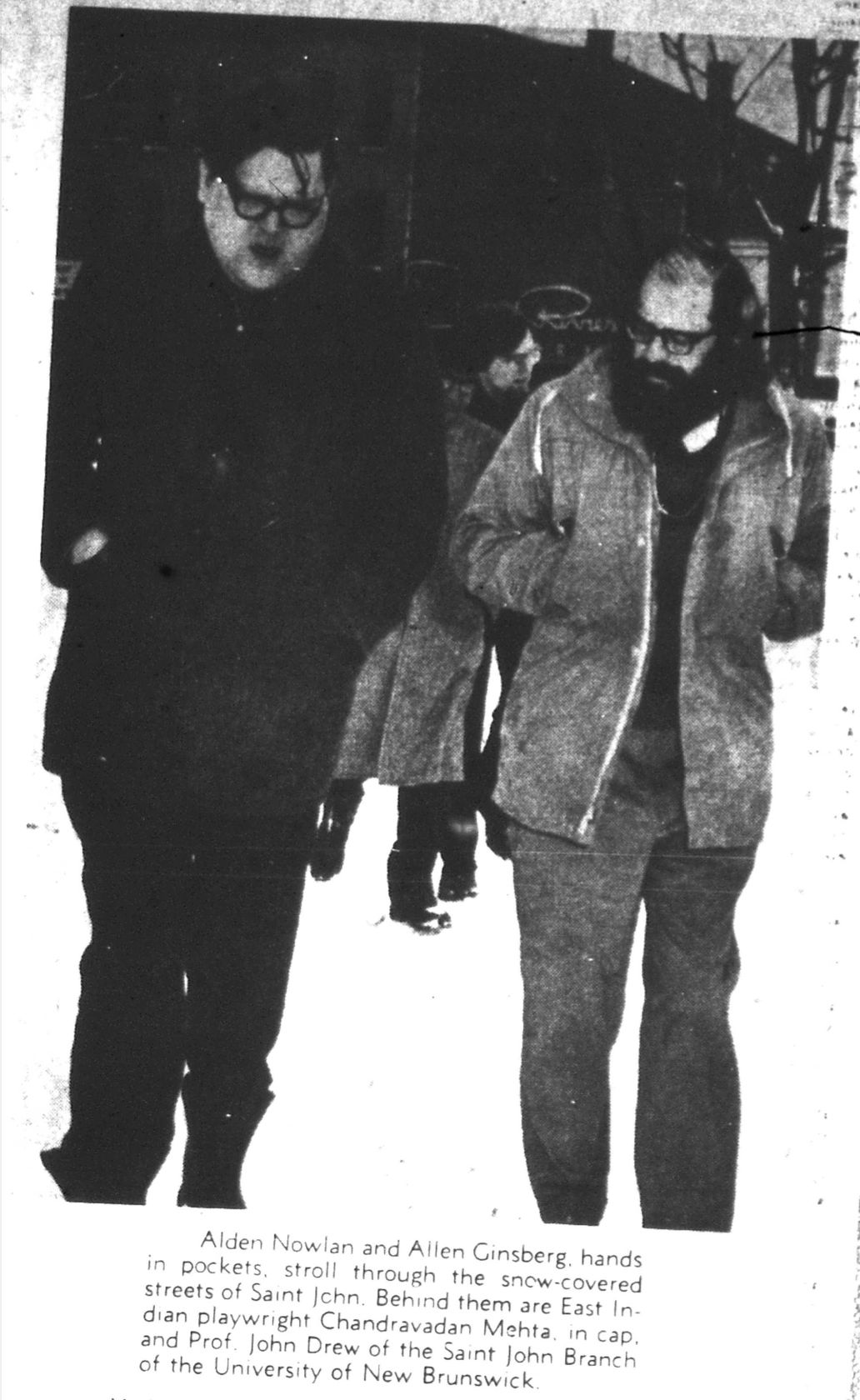
As the two poets walked together down the streets of Saint John, Nowlan observed:
“People stare at Allen Ginsberg. That’s not too surprising; he wears a full beard and shoulder-length hair. The crown of his head is almost bald. The hair cascading down to his collar is black and grey. There are patches of brown in his beard. He could be mistaken for an Old Testament Prophet.”
Nowlan inquired: “Tell me Allen, do you mind being stared at?”
“Well, there’s one thing about it,” Ginsberg replied, “it makes it easier to talk with strangers. That sounds funny, but it’s true. And as soon as people start talking to me and find out I’m not a homicidal maniac, they’re a lot friendlier than they’d be if I didn’t look so crazy.”
The two poets went to the Saint John City Market.
“I like this place,” Ginsberg enthused. “You know, Saint John reminds me of the 1930s. I don’t know why. But there’s something about this market that’s straight out of the 1930s. The good part of the 1930s, that is!”
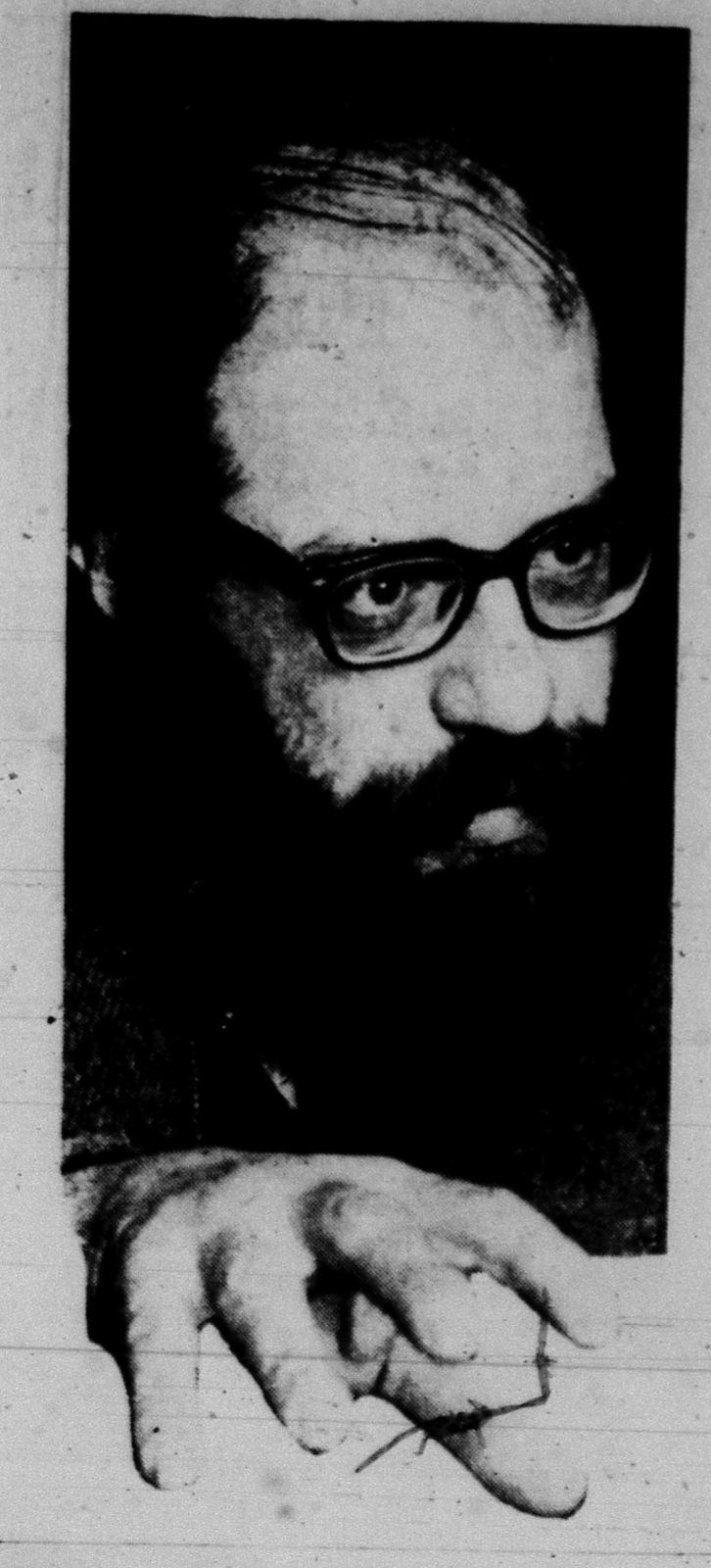
Looking around, he noted a giant moose head mounted on the wall and commented: “I guess the moose is sort of your national symbol here in New Brunswick. The Hindu god, Vishnu, was sometimes reincarnated as an animal. Maybe he was reborn as a moose.”
He laughed at his own joke, and Nowlan observed: “Ginsberg laughs a great deal. It is a surprisingly boyish laugh for a man of 40, just as his voice is surprisingly gentle with just a hint of a New York accent.”
Ginsberg bought a bag of dulse and a tiny container of head cheese. They walked up past King’s Square and strolled through the Loyalist Burial Ground.
“Look Allen,” Nowlan said, “every poet who comes to Saint John writes a poem about the Loyalist Burying Ground. There have been thousands of them. You’ll have to write one.”
“Many drunks have slipped on this snow,
and bloodied their head upon these stones.”
“That’s my poem!” declared Ginsberg with a laugh.
As they walked along the icy streets of Saint John, Allen Ginsberg pulled out the bag of dulse he had bought at the City Market and joked: “Ah, New Brunswick marijuana!”
“Ginsberg’s frank espousal of drugs has got him into hot water a few times,” Nowlan explained to readers. “There were rumours on the eve of his arrival in Saint John that immigration officials would prohibit his entry into Canada.”
Nowlan started to ask about drugs, but referred to marijuana as a narcotic. Ginsberg bristled and launched into a rant:
“Marijuana is not a narcotic but a herb. It wasn’t banned in the U.S. until the 1930s and then the ban was more or less accidental. It’s been proved it is not an addictive drug and that its use doesn’t lead to the use of real narcotics like heroin. …. Marijuana is not only completely harmless, it is actually beneficial. It opens up entirely different areas of consciousness. The time will come when the sale of marijuana is legal…”
A sickening thud on the sidewalk behind them cut his rant short.
“An elderly woman had fallen down on King Street,” Nowlan observed.
Ginsberg rushed towards her as Nowlan updated his readers:
“[Ginsberg] helped her to her feet … blood ran from her nose … he assisted her to a store and an employee brought her a chair. He bought a packet of tissues with which to staunch the blood.”
As Saint Johners ran to help the woman, Ginsberg marvelled: “That wouldn’t have happened in New York. In New York, nobody would have stopped, let alone helped her.”
Ginsberg was in town to read ‘Howl.’ Some have called it one of the greatest poems of the 20th century, yet it remains so controversial that even today, modern broadcasters can land in hot water for publishing it.
The poem was prosecuted in American courts for “obscenity” due to its explicit themes of drug use, homosexual and heterosexual sex, anti-capitalism, mental health, institutionalisation, counter-culture politics, and swearing.
Curiously, out of all those themes, Saint Johners were most concerned about the swearing.
As the poets walked in Saint John, a student approached and said: “Out in Rothesay, all the kids were saying today we’ll have to hear that cat read all those dirty words.”
Ginsberg laughed: “That’ll bring them in and then they’ll get a chance to hear the truth. Do you realize truth is a five-letter word?”
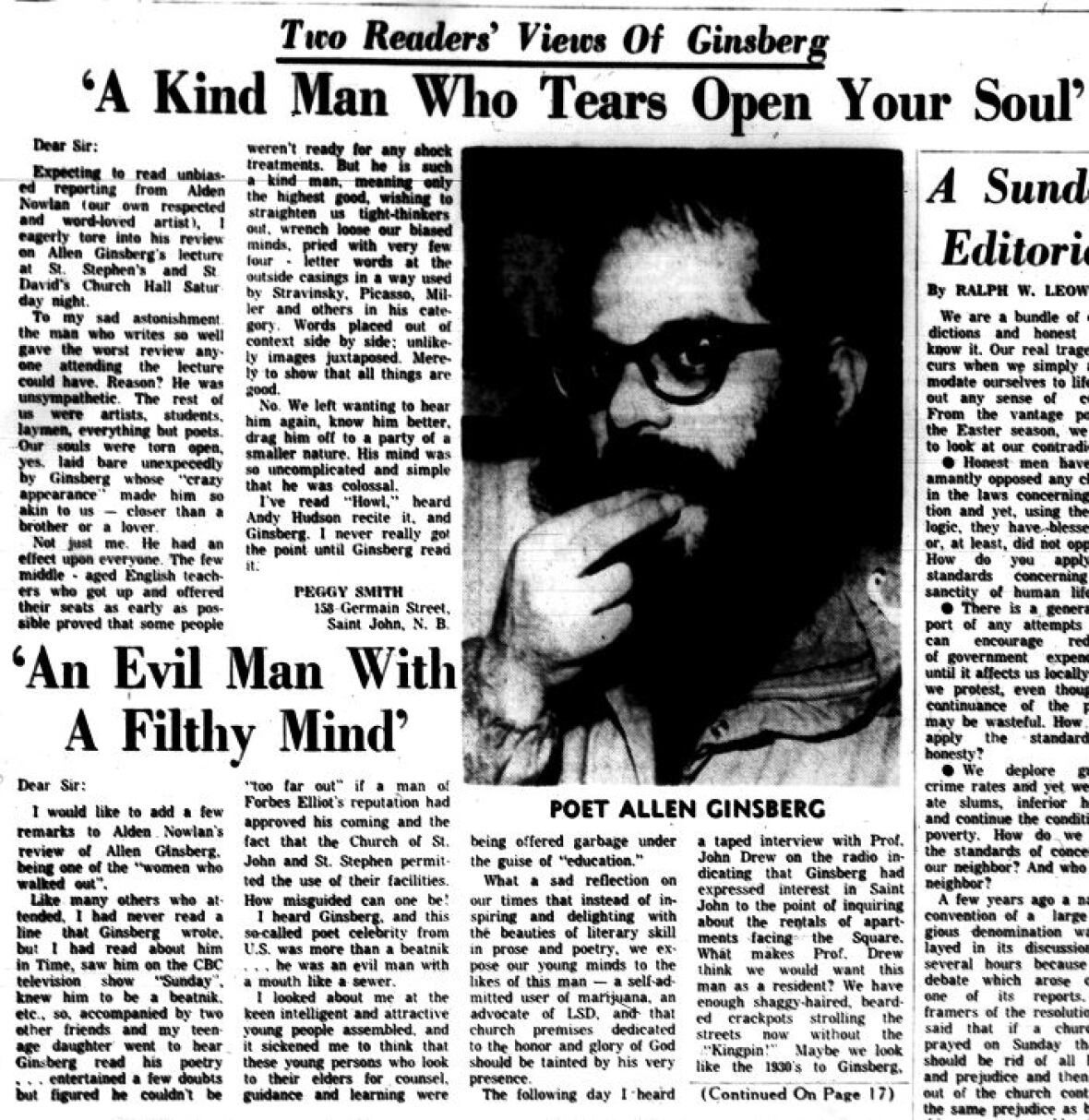
In a fascinating editorial decision, the Telegraph-Journal didn’t send a normal reporter to cover Ginsberg’s Easter reading of ‘Howl.’ Instead, it published two side-by-side reviews written by ordinary Saint Johners.
For one, hearing ‘Howl’ had been a life-changing experience. The other stormed out in an outraged huff.
Peggy Smith wrote that after hearing ‘Howl’: “Our souls were torn open, yes, laid bare unexpectedly by Ginsberg, whose crazy appearance made him so akin to us — closer than a brother or a lover. … We left wanting to hear him again, to know him better, to drag him off to a party of a smaller nature. He was colossal.”
While some were enthralled, others were horrified, including Alice Armstrong, who wrote:
“He was an evil man with a mouth like a sewer! … What a sad reflection of our times that instead of inspiring and delighting with the beauties of literary skill in prose and poetry, we expose our young minds to the likes of this man — this self-admitted user of marijuana!”