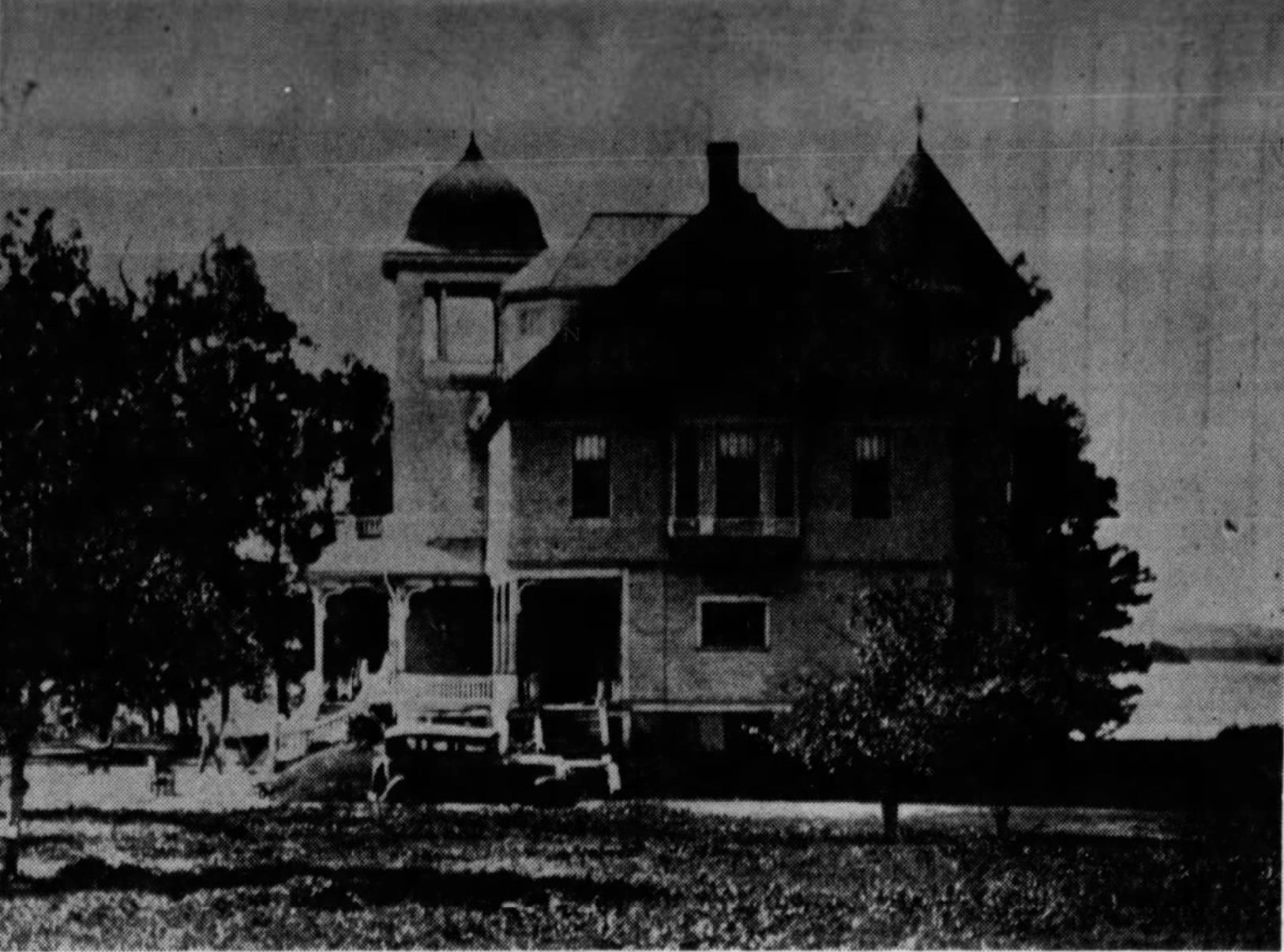
“What happens to a ghost who no longer has a house to haunt?” wondered Telegraph-Journal reporter Dorothy Dearborn as she surveyed the Hampton ruins where Ryan’s Castle had once stood. Seven years earlier, the great mansion had burned to the ground.
“Its owner, Dr. John James Ryan, was reported to have told an acquaintance during the 1930s that he had probably spent $70,000 on the villa,” Dearborn wrote. That’s something like $1.5 million in today’s money. “But after he and his family had gone, the old castle, as it was known, was unoccupied, at least by humans. It was not long before treasure hunters stripped its interior clean … Then one afternoon, it mysteriously caught fire and burned to the ground.”
Ryan’s Castle burned down on July 22nd, 1963. According to the Saint John Times Globe newspaper, it was 65 years old, a “three-storey building featuring a front tower and a glassed-in circular wall on the three storeys at the rear, overlooking Darling’s Lake … For the children of the Hampton area, the place had a fairyland reality, with its stained glass windows, tower rooms, and the coach house, which had a winding staircase housing an old coach and a yellow Mercedes car brought from France by Dr. Ryan.”
Dearborn found that the yellow Mercedes got mentioned pretty often.
Dr. Ryan was, by all accounts, the worst-ever driver in Hampton. Not that there was much competition — he was also the first man in Hampton to drive a car. Frustrated by its mechanisms, he would tear through town angrily screaming at his uncooperative yellow Mercedes until he would go purple in the face. The car had two springs where the rear bumper had once been — Dr. Ryan had left it embedded in Hampton’s bridge piers after an ill-fated reversal.
Dorothy Dearborn wandered around Hampton, interviewing locals about Dr. Ryan. She met Thad Stevens, caretaker of Princess Louise the horse, and Annie Folkins, whose grandmother had babysat the Ryan children. Annie said her grandmother told her the Ryans had a strange relationship with ghosts.
John James Ryan had grown up in Millstream, a tiny community north of Sussex. As a little boy, he had a close relationship with his mother.
The complication with their relationship was that his mother was dead.
She had died shortly after his birth. Then his father had remarried her sister. She was so outraged by the marriage that she stuck around as a ghost.
The little boy would bring friends over, and they’d witness doors slamming and knives flying. He’d just say, “Don’t be frightened, it’s only Mother.”
That little boy had an absolutely brilliant mind. He left New Brunswick for Philadelphia, where he dazzled in dentistry school. After graduating, he moved to Paris, where he became the favourite dentist of the wealthy elite.
“His offices were in the same building as the President of France,” one Hampton resident told Dearborn.
“His clientele was composed of the aristocracy of Europe,” said another.
“His minimum fee was $200,” whispered a local — somewhere close to $10,000 in today’s money. (“The number is a little easier to understand when one realizes the fashion of the time was to have one’s teeth set with diamonds,” noted Dearborn.)
Dr. Ryan loved France. He vowed he would never return to North America. Then he married an American named Minnie Curtis. She wanted to move home to the United States. Canada was their compromise.
Ryan’s Castle wasn't even their house. It was just their summer home. It was a duplicate of the home of the Princesse de Wagram. Everything in it was imported from France.

Among his most prized possessions — and Minnie's most despised — was an enormous tapestry depicting a wolf hunt. He insisted on dragging it back and forth between Hampton and Paris every year.
Dr. Ryan never met an obstacle that money couldn’t sort out. A hill was blocking his house’s view of Darling Lake, so he had it moved, even though it required building a small railway to do it. The trees weren’t arranged to his taste, so he had them dug up and repositioned.
By the 1920s, though, something had shifted. In post-war France, diamond-based dentistry was definitely out of style. His children had moved away. Minnie had passed. His fortune had faded, and his health was going. He could no longer make the trip back to his beloved Paris. He was stuck in Hampton.
While this may not sound so bad when one has a massive mansion, Ryan’s Castle had a major problem: it was in no way winterized.
Dr. Ryan was forced to spend his winters in a small Hampton hotel, bringing that wolf-tapstery Minnie had hated so much with him. Once, his hotel room caught fire.
In his pyjamas, the old man leaped out the second-floor window into the snow, leaving behind all his possessions save one: that wolf-tapestry.
Yet, despite there being visible signs that Dr. Ryan was on hard times, the people of Hampton whispered he had a great treasure hidden. Dorothy Dearborn suspected it was diamonds. The locals told her that whenever he was nearly bankrupt, he’d quietly produce and sell off a diamond and return to living well.
On September 29th, 1934, then 84-year-old Dr. John James Ryan was in the middle of yet another eccentric project. He’d decided the spring water across the road tasted better than his well water and was trying to install a pipe to bring it to his castle. Then he flipped his cart. Trying to right it, he had a heart attack and died.
The people of Hampton told Dearborn that, much like his mother before him, Dr. Ryan did not leave. Somewhere, he had hidden a fortune, and even in death, his ghost was defending it.
“That was 35 years ago,” Dorothy Dearborn wrote in 1970, “but the stories and legends persist. Even now that the house and stable are gone, there are those who will tell you that somewhere a fortune is buried and Dr. Ryan’s ghost watches over it.”