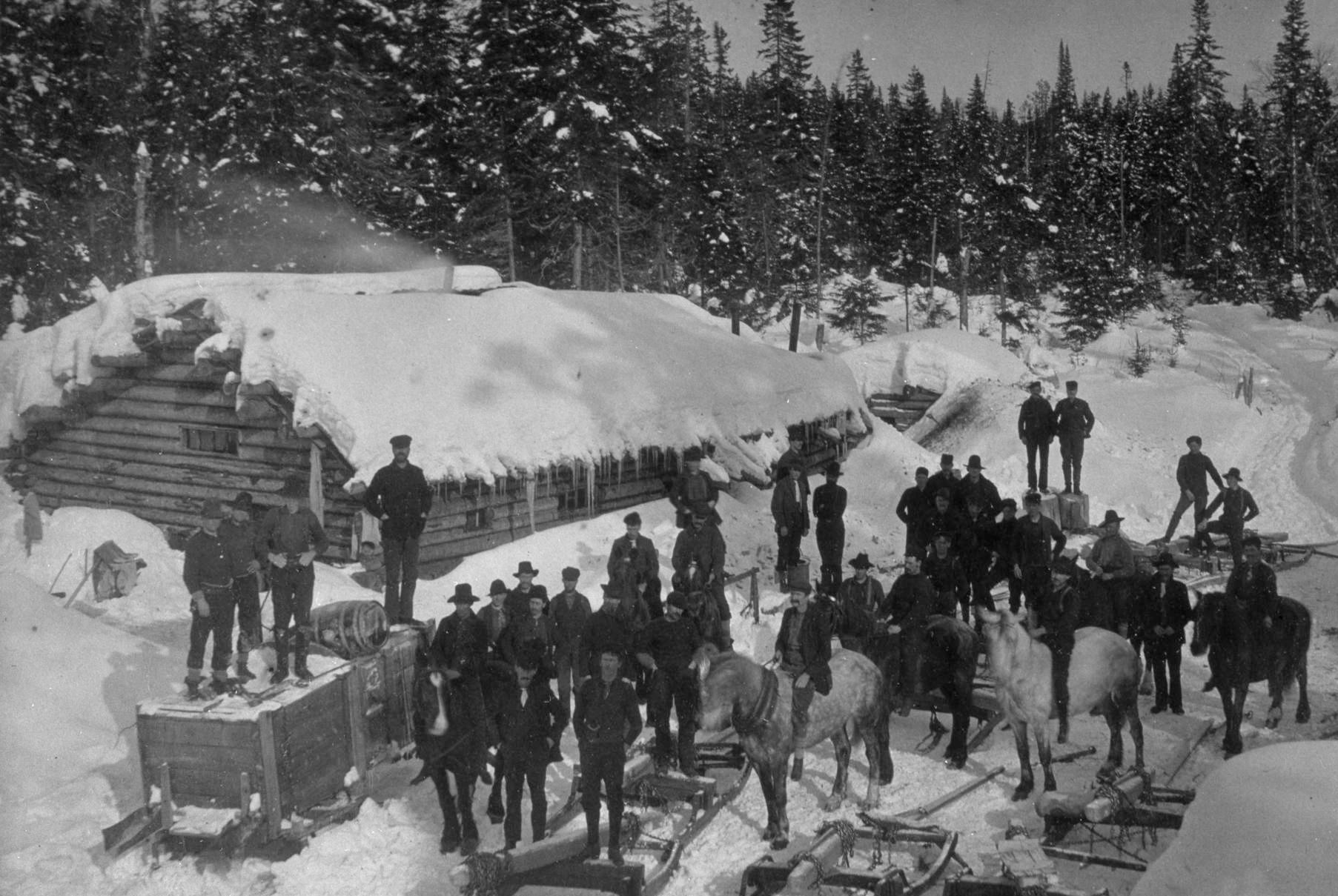
Here’s a selection of some of the words and phrases from the logging camps, and what they meant (in alphabetical order!):
Alder Grabber:
A freshly hired, green, inexperienced woodsman. This wasn’t a compliment!
“All hands and the cook!”:
An emergency call for everyone to gather around.
“All out and hear the birdies sing!”:
One of many possible shouts by cooks in the morning, telling the woodsman breakfast is ready
Axe:
- Every woodsman carried one at all times.
- There was a whole culture around what type they preferred (double-bitted, single-bitted, cruiser, polled, broad).
- A great deal of pride was taken in how sharp the axe was kept.
- Leaving an axe by a stump overnight was considered terrible luck.
Bean Hole:
A way of cooking beans. A hole was dug in the ground, filled with coals, and then a massive crock pot of baked beans was put in, then the pot was covered up with more coals and then earth. The bean hole was, by all accounts, the tastiest way of preparing beans.
Beaver:
Another uncomplimentary word for an inexperienced woodsman.
Billy:
Tea kettle. Typically, woodsmen preferred tossing a few fir tree twigs into their kettle for extra flavour.
Blanket Fever:
Slang for a woodsman who struggles to wake up on time in the mornings.
Bung:
A hole, typically in a leaky barrel.
Cook:
- Typically took on a second-in-command role, while being almost totally independent of the actual camp chain of command.
- Usually played a key role in day-to-day decisions.
- Often expected to double as a nurse for minor medical issues.
- Was occasionally expected to perform church services on Sunday.
- Typically involved 16-18-hour days preparing simple but hearty foods.
- Typically performed by a man, but it was far from unheard of that this role was fulfilled by a woman.
Cook’s Time:
The official time. You weren’t allowed to argue with what time the cook deemed it.
“Can’t step dance when hes sober, nor when he’s drunk either!”:
Clumsy.
Cork:
Spikey points on a log driver’s river boots.
Chaw:
A plug of chewing tobacco.
Clear Cut:
Taking all the sellable wood out of an area. Not the same thing as the modern definition because old woodsmen simply didn’t bother with young trees that weren’t valuable, leaving them alone.
Crazy as a loon:
Uncomplimentary comparison of a woodsman’s antics to those of the bird that appears on a Canadian one-dollar coin. Loons had bizarre mating rituals which involved much flapping around; so did many a woodsman.
Dead Head:
Log that doesn’t float.
Dingle:
The (cold) outdoor space that had to be crossed to get from the (warm) bunkhouse to the (warm) cookhouse.
Dirty Trees:
Snow on trees. When chopping, the snow would fall off the trees and go down the woodsmen’s necks. They had strong opinions on this.
Freshet:
The annual Spring flood.
Frolic:
Woodsmen would frequently get sick on the job, and when they couldn’t work, they wouldn't get paid. Worse, injuries and even death on the job were hardly uncommon. "Frolics" were when a community would come together to support an injured woodsman or the widow and children of a woodsman killed on the job.
Gill (Jill):
A dangerously sharp piece of a branch left on a log, which risked wounding the men on the river working the boom. Being caught leaving Jill's was likely to get you beaten up.
Grub:
Any camp food.
Horse Doctor:
A bad veterinarian. If they were a good veterinarian, they’d get called a veterinarian; if they were bad, they’d get called a “horse doctor.”
Hoot Owl:
Just any old owl.
Hen Fruit:
Eggs from chickens.
Hog’s Back:
Big hill, to be avoided if possible, because those things make life much harder.
Heaves:
A serious respiratory ailment for horses. This was unlikely to end happily.
Highliner:
Compliment meaning a good producer of wood and/or they treat their equipment well.
Hit-the-hay:
- Go to bed.
- Typically, lumbermen’s bedtime was remarkably early — being asleep by 9 PM was normal.
- The days started early, 4 AM if you were the cook or the boss and 5 AM for the woodsman, and the work was tough.
Ink Slinger:
An uncomplimentary word for the agent of the company, usually the clerk or the timekeeper. Typically not the sort of person that woodmen admire.
Iron Monger:
Blacksmith.
Jackpot:
Disaster. Mess. Disorganization. Someone screwed up. This was a strong word, and definately not a positive one.
Larrigans:
Rawhide boots treated with oil. Seen as good quality, but not quite waterproof.
Lead Team:
The best team, usually the first out in the morning and the highest producing.
“Longest Way ‘round is the shortest way home”:
A figure of speech meaning that shortcuts can often end up taking more time, or worse, breaking equipment.
Lumberjack:
Understood phrase, but not especially common round these parts. The usual phrase around here was “woodsman.”
Makins:
Rolling papers and tobacco to make your own cigarettes.
The Main John:
- The Big Boss. Named after the biggest boss of them all, John Glasier.
- This phrase seeped deep into mainstream culture and was a perfectly normal nickname for any boss well into the 1960s.
Moose Bird AKA Gorbies, Whiskey Jack, Camp Robber; Woodsman’s Ghost:
- Grey jays. They’d typically show up at lunchtime, where they were noted for their brazen efforts to get food.
- Gorbie is a Scottish word for glutton.
- Whiskey Jack comes from an attempt to pronounce the Cree word for Wisakedjak, a trickster spirit.
- While you might think the birds would be seen as annoying or hunted as pests, instead, the grey jays were revered by woodsmen who believed they represented the spirits of dead woodsmen of the past.
- Hurting a grey jay was seen as one of the worst things a woodsman could do. Not only would it bring the whole camp bad luck, but they were hurting a fellow woodsman.
- See the story The Woodsman's Ghost.
New Ireland Trunk:
A red handkerchief with white polka dots. Strongly associated with Albert County for reasons that are not clear.
Peaker:
A badly constructed pile of logs.
Peavey AKA Log Wrench:
The most useful tool for prying, invented in Maine.
Powder:
Dynamite.
Pickaroon:
A handle with a sharpened hook.
Porcupine Boarding House:
A tree that turned out hollow.
Rips:
Rapids in a stream or river.
Road Monkey:
High praise, a great compliment specific to the man given the tough task of fixing up potholes in the road. Only the strongest and most experienced men became road monkeys.
Sam Peabody:
Black capped chickadee. Peabody is pronounced “pea-pa-dee” and this was a friendly nickname for New Brunswick’s official bird.
Sawyer:
The man who decided how to cut a felled log into sellable lumber at the sawmill. Extremely important job — perhaps the most financially significant one of all. The Sawyer was paid accordingly.
Shantyman:
Travelling preacher. While opinions on them varied, they were generally seen as not as good as a proper minister or priest.
Slash:
Residue, including branches, left behind after a tree was cut and hauled away.
Stag Tree:
A tree with long branches, presumably bearing at least a faint resemblance to a deer.
Sweeper:
A tree hanging far out over a stream or river. Feared for their ability to flip passing boats.
“Timber!”:
A warning cry that a tree is about to fall.
Tick:
Mattress made of straw.
Toot:
Get drunk, usually for a while. A full-blown bender!
Turkey:
The lumberman’s kit, mostly their clothes.
Turnip:
- An uncomplimentary word for a pocket watch.
- They were regarded as expensive, quick to break, and seen as not telling time properly in the first place.
- Hence, “they keep time as well as a turnip!”
Vittles:
Food.
Vault:
A steep valley. For example, Three Vault Brook in Fundy National Park.
Widowmaker:
Something dangerous, could range from leaning trees to stubs.
Windy:
Someone who won’t shut up. Possibly someone who is simply talkative, but more likely referring to a braggart.
Yarn:
A story told in the camp usually meant more to entertain than to inform.
“Yes ma’am”:
One of the milder expressions heard after hitting a bump in the road while carrying a load of logs.
“You hold the lantern while I chop the wood”:
One of the less insulting and more gentle ways one man tells another that they believe that they are the better woodcutter.


