We’re always taught in school that ever since European colonists arrived in what is now Canada, that it was always a colony of either England or France.
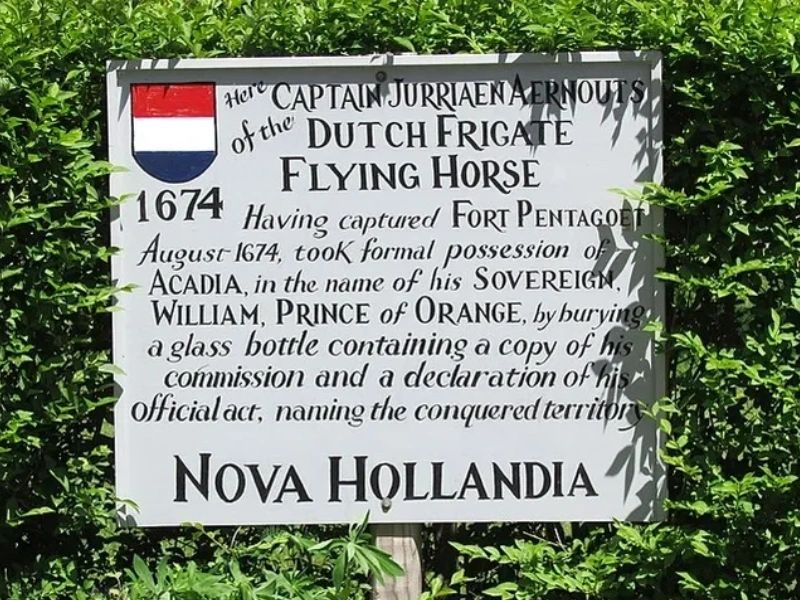
However, it’s a little-known fact that for a brief time, the Maritimes were conquered by the Dutch, and were a colony called Nova Hollandia.
This strange footnote in Maritimes' history began in 1673, when a powerful Dutch fleet was sailing from Dutch colonies in the Caribbean up the coast of what is now the United States. It was commanded by Jurriaen Aernoutsz, in his flagship named the Flying Horse.
There was a blurry legal distinction between a military sea captain and a pirate at the time, and Captain Aernoutsz seemed to walk this line.
His fleet sailed up the coast, attacking British settlements and ships before coming to port at a city then named New Amsterdam. You may recognize the name that little settlement goes by today: New York City.
It was then home to some 2500 people – a big city by the standards of European settlements in North America at the time. By contrast, all of the French settlements in what was then called Acadia –now the Maritimes– were then home to fewer than 800 Europeans.
When he docked in New Amsterdam, Aernoutsz learned that the war with the British was already over, and he shouldn’t have been attacking all those towns. Oops.
While figuring out what to do next, he happened to meet the mysterious John Rhoade. At the later trial after the end of Nova Hollandia, the enigmatic Rhoade was painted as the mastermind behind all of the events which later occurred, and was variously described as “a pirate,” “a coasting pilot,” and “an adventuring type.” The reality is that we really don’t know for certain who he was, where he came from, and who he may or may not have been actually working for.
Rhoade told Aernoutsz about the French colonies called Acadia, how wealthy and prosperous they were, and how thinly populated and barely defended this land that is now the Maritimes was.
Aernoutsz was convinced by Rhoade to take over Acadia. He got Rhoade to agree to become his pilot and take an oath of allegiance to the Dutch Prince of Orange, and they set sail.
Acadia was somewhat larger than the Maritimes are today back then, – they also contained parts of Maine. The largest French fort was in Pentagoet, in that American state.
According to New France’s Governor Frontenac’s letters, the Dutch arrived at Pentagoet on August 10th, 1674, with “110 corsaires hollandais” against a tiny force of only 30 defenders. The French fort fell in only two hours. The fort’s commander was captured, and the Dutch burned the nearby French village.
The Dutch sailed onward up the coast of Maine, burning French villages like Machias as they went.
Curiously, the Dutch invasion fleet avoided the completely undefended French capital of Port-Royal (now Annapolis Royal, Nova Scotia) by far the largest French settlement in Acadia, home to some 400 people, which was actually half the population of Acadia.
Instead, they sailed up the St. John River, plundering small communities as they went.
At what is today known as Jemseg, they encountered Fort Gemisick, an extremely important trading post where the French traded with Mi’kmaq and Wolastoqiyik.
Fort Gemisick was more of a trading post than a fort. In no position to resist, it surrendered without a fight. Its commander, M. de Joi'bert, Sieur de Marson and Soulanges, was taken captive. The Dutch dismantled the fort and took everything they could, up to and including the fortifications themselves. Many of the French residents, including Joibert’s wife and daughter, managed to escape the Dutch and hide in Mount House, which you can hear more about in the Backyard History Podcast episode called ‘The Mystery of Mount House’.
Aernoutsz declared the area to now be a Dutch colony, naming it Nova Hollandia.
During the later trial, it was revealed that the Dutch had buried several bottles along the St. John River containing notes claiming what is now New Brunswick was Dutch territory. To mark his claims he also hid “swords of the Prince of Orange subjects” along the river.
As far as I’m aware they’ve never been found. Maybe they’re still there!
Back in Europe, the Dutch were in no position to deal with a new colony. This was around the time called Rampjaar, meaning “disaster year,” when the era known as the Dutch Golden Age came abruptly crashing down.
The Dutch government actually didn’t even know about their new colony called Nova Hollandia. They were at the time blockaded at sea by England, and being attacked over land by France. Rampjaar culminated in Dutch Prime Minister Johan de Witt being murdered and his body partially eaten by an angry mob of angry Dutch citizens.
I should probably elaborate on that…
However, while the Dutch government didn’t know about the new Nova Hollandia colony, a vastly more wealthy and powerful force did. The Dutch East India Company, or as it was called in Dutch, the Verenigde Oostindische Compagnie or, as we’ll call it to make things easier … the VOC.
The VOC was the first modern corporation, in the sense of having boards and shares sold on a stock exchange, and is perhaps the most extreme example of raw unregulated Capitalism ever known.
After its founding in 1602, it rapidly grew to become a globe-spanning corporation involved in everything from shipbuilding to trade, from colonization to slavery, and from corruption to smuggling. It had forts, armies, and fleets, it built its own cities – it even built its own artificial islands outside of Japan when it was banned from trading on Japanese soil itself.
The VOC was everywhere, from India, South Africa, Taiwan, Vietnam, and the Caribbean – it was everywhere. It sent over a million Europeans to its forts and colonies in Asia, vastly more than all of the European actual countries sent – combined.
They first settled New York City, and they discovered Australia and New Zealand (Zeeland is a Dutch province). They had 4700 ships and an army of 10,000 men … I don’t think you can even exaggerate how powerful the VOC was.
How wealthy was the VOC? Well, the most valuable corporation in the world today is Apple, which is valued at over $1 trillion. $1.3 trillion, I think it stands at today.
How much was the VOC valued at in today’s money? $8 trillion. It was by far the most valuable corporation in all of human history, by a pretty wide margin.
And anyone could buy in. Anyone could become an owner of the VOC by buying stock, an unheard-of possibility pioneered by the VOC, which is now the basis of today’s stock markets. You could go to the Amsterdam Stock Exchange and buy stock in the company. You did have to be a Dutch citizen, though. There was only one company listed on the Amsterdam stock exchange, the VOC.
Why would you buy stock in a company involved in slavery? In buying and selling actual human beings? Well, the dividends it paid out were pretty lucrative. 40%. 40% dividends. Apple’s dividends today, by contrast, are zero point six four percent.
This enormous global corporation began trying to take control of Nova Hollandia, appointing the former Mayor of New Amsterdam, who was then the wealthiest man in New York City, Cornells Steenwyck, as Governor. His lengthy 1676 commission reads, in part, that he is to:
“select such places for himself, in order to cultivate, sow, or to plant, as he shall wish, to trade with the natives, to build some forts and castles, to defend and to protect himself against every foreign and domestic force of enemies or pirates, etc.,”
The letter goes on at length like that for a while. The only thing the VOC liked more than absolute corporate monopolies and trading anything that could be bought and sold, up to and including actual human beings, was paperwork and bureaucracy. It was quite a modern corporation in that sense.
While there is very little in proof to back this up, at the time Boston citizens strongly suspected that John Rhode was a VOC agent and that he had masterminded the entire Nova Hollandia saga on behalf of his employer.
We don’t know this for sure, though. Actually, we don’t really know much at all about any of the people involved at all. Most of the information for this comes from the later trial that took place in Boston after the fall of Nova Hollandia.
In any case, it wouldn’t really matter because the Dutch made a critical early error that would lead to the end of Nova Hollandia before the VOC got a proper foothold on it, and even before its freshly appointed Governor made it there.
After conquering Acadia and declaring it Nova Hollandia, the Dutch fleet then sailed back to Boston, where they sold all their plunder –including the French cannons they’d captured– to the city. They also ransomed their prisoners back to the French for the price of 1000 beaver pelts.
Captain Aernoutsz then sailed off in his ship the Flying Horse back to the Caribbean. He went to a Dutch colony named Curaçao to recruit settlers to move to Nova Hollandia.
John Rhoade was placed in command of the new Dutch colony in Aernoutsz's absence.
He was left with several Dutch officers. They bought some ships and hired local crews. One ship named ‘Edward and Thomas’ was commanded by Peter Roderigo, who was from Flanders (the word the Dutch used was “Flanderkin”). Another ship, named ‘The Penobscot Shallop,’ was commanded by Dutch officer Cornelius Andreson.
They went back to the Bay of Fundy, where they made the critical error that brought about the downfall of the new colony: they enforced a trade blockade. This meant that only the Dutch would be allowed to trade in Nova Hollandia. This would have been straight out of the VOC’s usual playbook, getting exclusive rights to a valuable resource and jacking up prices to increase their profits.
But of course, the 800 French citizens weren’t the only people in Acadia back then. They were vastly outnumbered by Mi’kmaq, Wolastoqiyik and Peskotomokati people. The French, when they controlled Acadia, had made no effort to interfere with the vast and lucrative trade the Mi’kmaq, Wolastoqiyik and Peskotomokati communities had going on with merchants in Boston and New Amsterdam.
There is little indication that either the Indigenous people or the Boston merchants were particularly upset over The Maritimes becoming a Dutch colony at first, or for that matter, really had much in the way of opinions on it at all. Everyone seemed fine with Nova Hollandia at first.
When the Dutch declared that only the Dutch – effectively meaning the VOC – were allowed to trade with Mi’kmaq, Wolastoqiyik and Peskotomokati peoples it caused some upset, but everyone involved decided to just ignore it at first, and carry on like before.
However, when the little Dutch fleet headed by Rhodes, Rodriego and Anderson sailed up to blockade the mouth of the Bay of Fundy and began stopping the trade ships and seizing the cargo they had bought from Indigenous peoples, well this crossed a line.
About a year into the blockade, Boston merchants hired a privateer named Samuel Mosley to rid them of the Dutch. The American money was used to hire British mercenaries, French ships, and Indigenous fighters to unite to defeat the Dutch.
The Dutch were no match for the united alliance, who quickly took over their few forts, which had mostly been located in Maine.
Nova Hollandia came to an end in a dramatic sea battle in the Spring of 1675.
This sea battle wasn’t dramatic because of the death and destruction though. While there was an awful lot of firing of guns on all sides, nobody was killed, and it’s not entirely clear that any of the cannonballs fired during the battle actually even hit any of the ships they were aimed at.
No, this battle was dramatic because, as the combined British and French fleet approached, several of the Dutch ships tore down their Dutch flags and began firing on the other Dutch ships. Everyone was firing at everyone else in a battle that descended into complete chaos. The three main Dutch ships, the ones commanded by Rhoade, Rodreigo and Anderson, surrendered.
They and several other Dutch officers were brought to Boston, where they were tried for piracy.
What actually happened in that bizarre battle is awfully confusing to sift through in the trial’s documents. It’s almost certain that some people here were lying, and it’s possible that everyone was lying.
John Rhode claimed that he hired up a lot of, well, employees, from among the general public in both the English and French colonies. He said that he paid them the then extraordinarily generous salary of 7 pounds a month for their services.
The captains and sailors on those ships who betrayed the Dutch during the battle, however, claimed that they had been innocent merchants just trying to trade with the Mi’kmaq, Wolastoqiyik and Peskotomokati when they were halted by John Rhoade’s Dutch ships.
They claimed he threatened that if they didn’t join the Dutch that he would take their ships and leave them stranded on the shore, where they would have to –and this is a direct quote– “be forced to eat roots.”
It’s not clear who was lying, though it’s also possible both were telling the truth at the same time.
The trial was sensational and lurid.
The Dutch captains’ defence lawyer was the flamboyant Increase Mather, a name you may remember today for his infamous role in the Salem Witch Trials. Interestingly, the VOC had hired the defence lawyers.
What made the trial so sensational was the incredibly bizarre things that happened around it.
The Dutch prisoners arrived in Boston on April 7th. The Trial began May 17th. Between those dates only a little more than a month apart, several of the complainants against the Dutch died under mysterious circumstances.
Even more astonishingly, John Rhode’s personal ship, which was impounded in Boston Harbour at the time, somehow blew up in what was described as “a great explosion,” which killed two of the most important people who were going to testify against Rhoade.
At the end of a brief but extraordinarily complicated trial, one in which little is clear and the juries had to be repeatedly sent back under orders to find a verdict after failing to do so, all three of the main Dutch captains were found guilty of piracy and sentenced to death.
One week before they were due to be executed, however, King Philip's War broke out. King Phillip, in this case, being a nickname for Metacomet, chief of the Pokanokets.
Suddenly threatened by enemies right on their very doorsteps, Boston’s officials seemed to have offered the Dutch captains condemned to death the opportunity to join them instead.
Captain Rodrigo fought alongside the British in Maine, while Cornelius Anderson actually managed to get his ship, the Penobscot Shallop, back, and ended up, of all things, fighting alongside his earlier enemy, Samuel Mosley.
Sam Mosley is quite famous in America; a lot of American military units consider him a forefather of theirs, like the US Rangers. In his admittedly heavily mythologized American stories about him – because Americans are definitely good at mythologizing their past – he is sometimes accompanied by a sidekick of sorts, often simply called The Buccaneer. The Buccaneer is Cornelius Anderson. He survived the war and made it back home.
Tracking what became of the strange story of Nova Hollandia’s mysterious main character, though, is harder. It doesn’t seem that the Boston authorities actually offered John Rhoade the same deal as the other Captains. Remember, they firmly believed that all of this was his fault.
On the other hand, they were also curiously reluctant to actually kill him. They delayed his execution date at least three times.
An extraordinarily complicated and strange paper trail of lawsuits seems to be the reason for the delays. It’s not clear who was launching and paying for all these lawsuits to try and halt John Rhoade’s execution, but if you recall that the VOC paid for the Dutch captains’ legal defence, we might be able to make a guess.
Eventually, John Rhoade was released from prison and banished from Boston after paying a bill for his time in jail.
Afterwards, John Rhoade worked for the VOC and was sent elsewhere in the world, though it’s not clear where or what he did next. That he did work for them after, though, perhaps adds a bit of credence to those rumours that he had masterminded the entire bizarre takeover of the Maritimes on behalf of that giant corporation.
Over one year later, on September 11th, 1676, the Dutch government finally learned for the first time that they had a new colony named Nova Hollandia.
They quickly signed off on papers officially making Nova Hollandia a colony and making John Rhoade its Governor, but by then, Nova Hollandia was long gone, and the French once again controlled the land called Acadia.
Previous Article: The Only Disputed Land Between Canada And America


