In 1949, a little Canadian island off of the coast of Nova Scotia declared itself to be its own country.
Calling itself The Principality of Outer Baldonia, it quickly developed all of the trappings of an independent nation: it had its own currency, postage stamps, its own flag, and a coat of arms boasting on it pictures of a tuna fish, a sheep, and a smiling lobster.
It soon became, in the words of reporter Harry Bruce “one of the zaniest hoaxes in the history of international affairs.”

In 1949, Russell Arundell was fishing for tuna in the waters of Soldier’s Rip, which is about as far Southwest as you can get in the far corner of Nova Scotia, when a storm hit his boat.
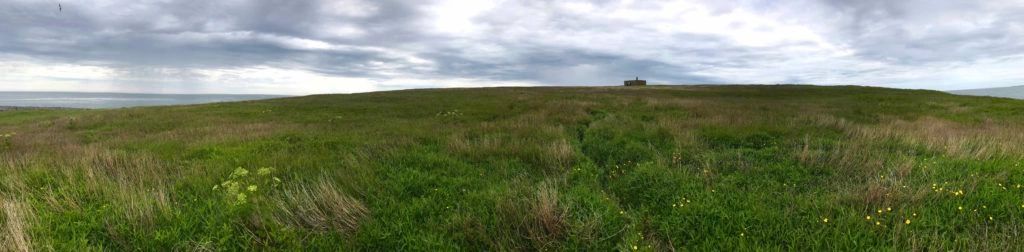
Halifax-based writer Harry Bruce later wrote in 1977: “A squall blew up Arundell’s vessel took shelter in the lee of a flat-topped, storm-tossed, and utterly treeless island called Outer Bald Tusket. It’s about four acres in area. Its abrupt, symmetrical cliffs make it look vaguely like a desert tableland, but any similarity between Outer Baldy (as the locals called it) and warm parts of the world end right there.”
Before it became Outer Baldonia, the island was a popular refuge for birds, including being an important nesting ground for several rare breeds.
All that changed when Russell Arundel landed there in that storm.
In the words of reporter Harry Bruce “Arundel saw something in Outer Baldy that no one else had seen. He actually liked it.”
And so Russell Arundel bought it, in 1949, for the grand sum of $750.
He began construction of what he called a castle – though most people might describe it as a fishing lodge. It measured 20 feet by 30 feet, and was constructed of stone.
Russell Arundel issued a Declaration of Independence for the Principality of Outer Baldonia which was published in the Montreal Standard newspaper:
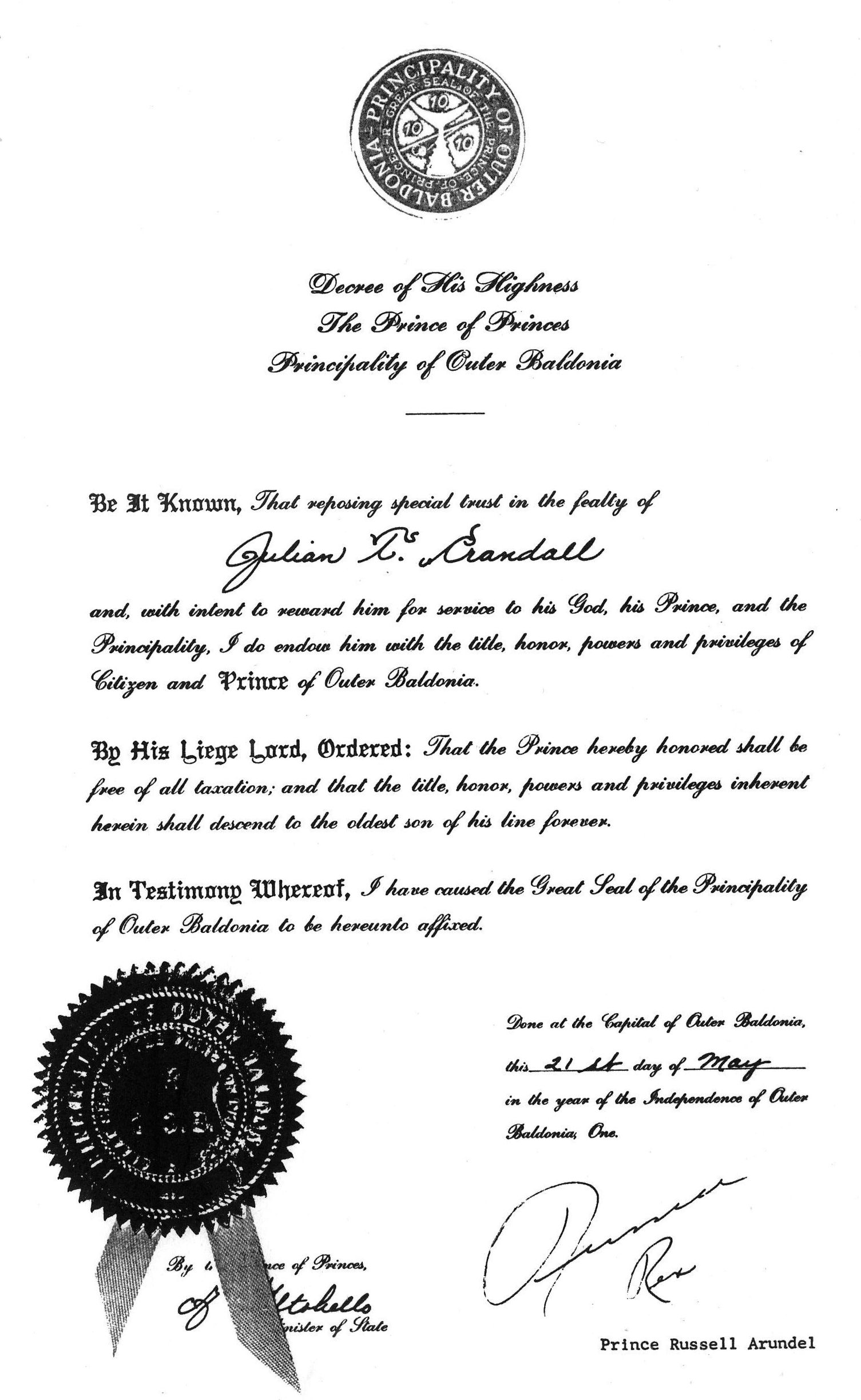
“[We hold these truths to be self-evident;] That fishermen are a race alone. That fishermen are endowed with the following inalienable rights: The right to lie and be believed. The right of freedom from question, nagging, shaving, interruption, women, taxes, politics, war monologues, cant, and inhibitions. The right to applause, vanity, flattery, praise, and self-inflation. The right to swear, lie, drink, gamble, and silence. The right to be noisy, boisterous, quiet, pensive, expensive, and hilarious. The right to choose company and the right to be alone. The right to sleep all day and stay up all night.”
“Know ye! That these rights being inalienable an self-evident and contrary to the social customs of the world, making fishermen a race separate and apart from other races…”
The Moncton Transcript’s travel reporter Fraser Robb visited his friend Ronald Wallace, who was the new “Ambassador Extraordinary and Plenipotentiary of Outer Baldonia to Canada.”
He reported that “a long legged brunette … is now chief advisor to the Ambassador.”
The chief advisor in Outer Baldonia was a three year old Irish setter named Mike whose hobbies included barking at the squeaking sound that the reporter’s fountain pen made when he wrote.
The ambassador told the reporter with a shrug: “There was just a little sense in the message Arundel was trying to sell – the idea of a country free from interference from outside and a minimum of government involvement in personal lives.”
The Principality of Outer Baldonia devoted a remarkable amount of time, energy, and money into all the trappings of a nation state.
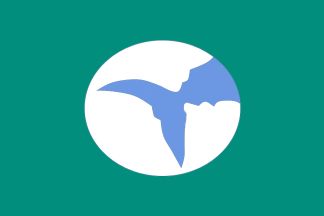
They developed a flag featuring, a blue tuna in a white circular crest set on a blue-green background.
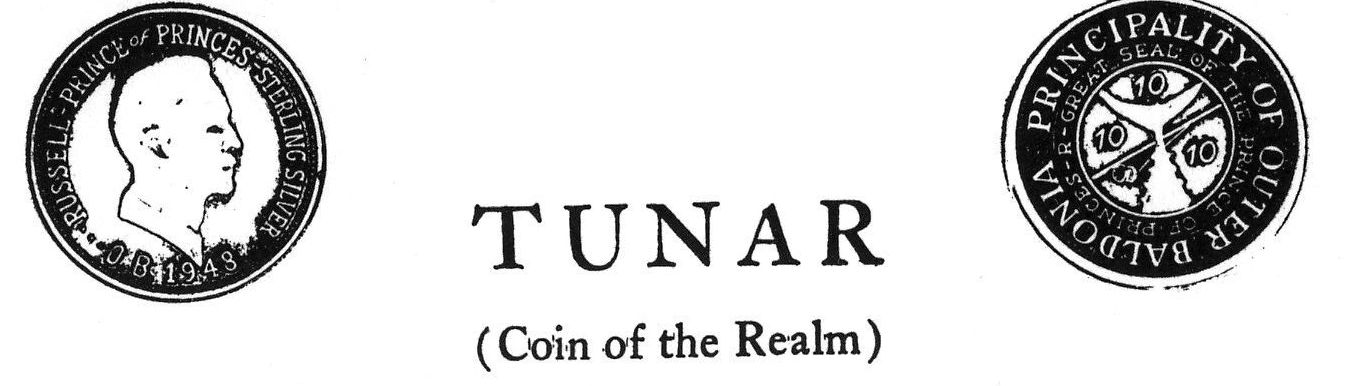
They boasted their own currency, called the Tunar, having gold and sterling silver coins minted boasting on one side the head of “Russell the First, Prince of Princes.”
They also boasted paper bank notes, which started at 25,000 Tunar, which featured the scowling face and enormous ears of William J Fleming The Good, Prince of Princes, who was, it seems, an entirely fictional person.

The intricately designed Tunar notes bearing the slogan “War on Poverty” were declared to be worth more than the American dollar. In fact were declared to be the most valuable currency in the whole world. All this declaring of course came from the Princes of Outer Baldonia.
The Tunar coins could actually be rather valuable on their own, since they were minted with pure gold. Later they would become considerably more valuable as collectors items.
The dates on the money began in the year one O.B., which was 1948.
Twenty years later Arundel explained the years to the Argyle Lodge: “The calendar used is not Gregorian but is Baldonian, so, since the year of Outer Baldy’s transformation in 1948, the calendar now reads OB 20. Please! Oh no, do not mistakenly write it 20 B.O. since that transposition connoted something most unpleasant if you believe your TV.”
Outer Baldonia even had its own army, the Knights of the Blue Fin, who, in the words of their the Prince of Princes Russel Arundell: “should war or threat of war come to Outer Baldonia’s shores we stand ready to stamp it out.”
They were defended by a fleet of eight star admirals. That’s a very impressive amount of stars, as American admirals can only get up to four stars. The admirals were the local Nova Scotian fishermen guides, who, for their part, don’t seem to have had much in the way of opinions on the whole saga.
The Principality of Outer Baldonia also counted among its citizens some very big names, like Prince Alben Barkley and Prince Harry Trueman. You might recognize those two princes from their day jobs as the Vice-President and President of the United States.
The first official recognition for the Principality of Outer Baldonia came from the Chesapeake and Potomac Telephone Company when it listed “Outer Baldonia, Principality of” in its phone book.
It was actually Russell Arundel’s phone number.
The first ever inquiry it received came from the National Geographic Society, who wanted to know they country’s exact longitude and latitude.
Ronald Wallace –that was the ambassador with the long legged brunette as his advisor– later remarked in the year O.B. 28 that he still had “a file of official Baldonian letters, stamps and “legal” papers that look like they came out of the London foreign office or the office of the Queen’s secretary.”
By the time of that interview, the former Ambassador of Outer Baldonia had left the world of imaginary politics to move into the realm of real world politics. He had at the time of the interview been elected as Halifax MLA for the Liberal Party, and would later become Halifax’s longest serving Mayor. He remarked to a reporter: “I was just looking the other night at a picture, the official ambassador’s picture, which shows me looking at a globe of the world [wearing] a suit with a rose in my lapel and wearing glasses. I don’t even wear glasses!”
–
Neither the governments of Canada or of Nova Scotia ever seemed to have an opinion on the new breakaway nation, choosing to ignore the whole strange story completely.
Despite the tight lips from the government, the Canadian media were firmly in on the joke. They would play around with including breaking news reports from Outer Baldonia in their newspapers, like this 1956 report in the Evening Times Globe:
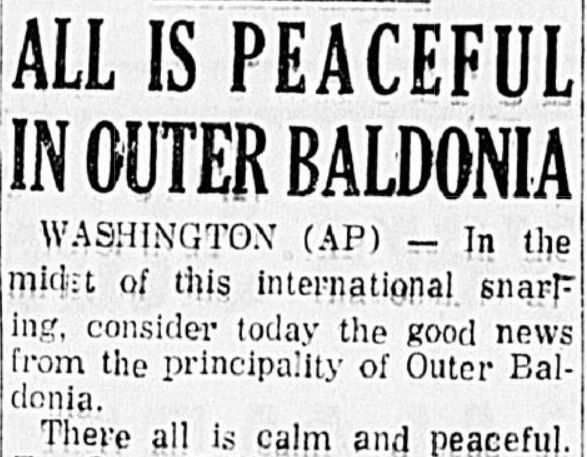
“In the midst of this international snarling, consider today the good news from the principality of Outer Baldonia.
All is calm and peaceful.”
While all may have been calm and peaceful to the outside world, there are indications it may have been stressful for its ambassador, Ronald Wallace, who later reminisced to a reporter:
“I’ve had calls from Arundel at two in the morning. He’d be sitting in a New York nightclub with friends when he’d suddenly excuse himself saying he had to call his ambassador. Then he'd get me on the line and ask some ridiculous question like how he was going to get a plane to take a 500 pound tuna back to the States.”
In 1952 a West German publication called Industrikurier announced to surprised Europeans that a part of Canada had declared independence and was now an independent country.
This kicked off a bizarre time for Outer Baldonia’s international relations.
That German publication had readers in Moscow, which was then part of the Soviet Union. They took note of Outer Baldonia, and they most certainly did not like what they saw.
The state run Moscow Literary Gazette published an article written by Lyudmila Chernaya, a highly respected cultural historian, author, and researcher into Fascism. She detected in the political philosophy of Outer Baldonia a hint of Fascist ideology.
She wrote “Mr. Arundel …a typical imperialist businessman… has set himself the aim of turning his subjects into savages. The “Master of Baldonia” granted his subjects the unrestricted right to tell lies, to be rude, the right to not answer questions, the freedom to go unshaved … in a word the right not to adhere to the ethical and moral laws which have been established by mankind.”
She worried that based on its monarchy, and its deliberate lack of laws, its banning of outgroups –notably women– that the country was following a trajectory that would lead to Russell Ardunel turning not into a “prince of princes” but into a “fuhrer.”
She was hopeful for the mackerel fishermen who were the original inhabitants of Outer Baldonia though, writing “Of course, Mr. Arundel will not succeed in turning the peaceful fishermen into cannibals. Much bigger adventures of a similar kind have ended in utter failure.”
Her entire story was, however, based on a misunderstanding – there weren’t any original inhabitants. There were no mackerel fishermen.

The island was uninhabited except for about 20 wild sheep. And, as Ronald Wallace, that Ambassador with the long legged brunette advisor, later reminisced, the kingdom did establish protections for its sheep population, telling a reporter his most poignant memory of Baldonia “was the sign that used to greet visitors to the island paradise [that read] “fishermen are not to pet the sheep.” ”
But Lyudmila Chernaya did highlight an important point:
Outer Baldonia’s Declaration of Independence had completely banned women from its country.
Russell Arundel shrugged off the ban, to one reporter, saying simply “We wanted the one place in the world where we could get away from them.”
The move to ban women wasn’t necessarily popular with all of the Princes though. Arundel mentioned that he had to battle back repeated mutinies from other princes who wanted women to be allowed into Outer Baldonia.
Russell Arundel did, however, offer to lift the ban on women in Outer Baldonia just for Lyudmila Chernaya, remarking sarcastically: “getting out of Russia though will be her own problem.”
She ignored his invitation.
The story of the Soviet criticism was widely covered in Canada, and for his part Arundel thought it was pretty funny, remarking to a Canadian Press reporter “The Russians caused all the fun by taking it seriously.”
Arundel later realized, however, that the Russians had been playing a joke on the West.
Much later, in 1977 he reminisced to the Canadian Press that: “One Sunday afternoon, the summer Nixon left office, I was up fishing at my lodge in Maryland next to Camp David when the secretary of defence, James Schlesinger, and four prime ministers of the Russian cabinet and their aides invaded my place. They came in and grabbed the fishing rods from our hands, fished up and down the stream, had a ball, and we all ended up good friends. Brezhnev himself couldn’t come because he had to go somewhere with Nixon.”
He remarked of the Russians: “they came to make fun of us.”
All of this begs one question: who exactly was Russell Arundel and how on earth did he have all this time, money, and high-profile connections?
Canadian newspapers kept referring to him as “a soft drink bottler.” While this wasn’t exactly inaccurate, it was about as incomplete as describing Elon Musk as a guy who likes cars.
Russell Arundel was the founder and president of a little startup called the Pepsi-Cola Bottling Company. Pepsi is today one of the world’s largest corporations.
He certainly had quite the life. According to his later obituary in the Washington Post, he started as a newspaper man in Chicago.
In the 1920s he moved to Washington DC to work for a Republican Senator.
In the 1930s he was appointed by Democratic President Roosevelt to the commission that built Mount Rushmore.
And in 1943 he was one of the founders of a little company called Pepsi.
Pepsi had a bit of a problem though – at the time the United States was restricting the use of sugar.
In 1947 he gave $20,000 to a young new Senator from Wisconsin.
The money was not given to his campaign fund but to the Senator personally.
The young Senator from Wisconsin then passed a bill lifting restrictions on sugar use in the United States.
Soon after, that young Senator, whose career had been completely unremarkable until that point, turned his mind to his reelection. He reinvented himself as a crusader against so-called “unAmerican activities.”
That young Senator from Wisonson was Joseph McCarthy, one of the most grotesque and destructive characters in American history.
Suddenly Russell Arundel found himself in the spotlight for giving McCarthy that $20,000.
According to the Washington Post “Mr. Arundel was questioned by a Senate panel that was investigating the fitness for office of Sen. Joseph R. McCarthy. The questioning was about a $20,000 note Mr. Arundel had endorsed for the senator … [which he called] a minor financial transaction for a friend.”
Legally it was likely a prudent defense strategy to call Joseph McCarthy a friend rather than admitting he possibly paid bribes to a Senator, but it alienated him from a lot of people.
It was around this time that Russell Arundel disappeared into his flight of fancy that was Outer Baldonia. It didn’t even seem like he spent that much time on the island itself, but, as he remarked to a reporter: “I think that way 24 hours a day.”
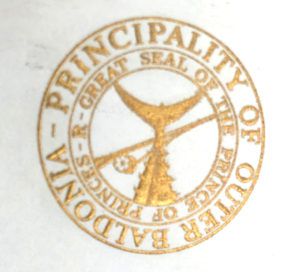
He designed and had built whimsical things like Outer Baldonian gold watches and cufflinks, flags, seals, and coats of arms, at a time when his personal stock was low, when few people wanted much to do with him.
After that dark era was over, America collectively chose to try to forget about McCarthyism, and Arundel found his public image rehabilitated.
He never lost his fondness for the little island though, continuing to be the Prince of Princes of Outer Baldonia until the late 1970s when he passed away.
When becoming a Prince of Outer Baldonia, it was stated that the title was hereditary, and would be passed on to sons.
However, as he grew sicker and sicker with the illness that would soon end his life, Russell Aundel decided to end the Principality of Outer Baldonia.
The island itself was an important breeding grounds for birds, and for the price of one dollar, he gave it to the Nova Scotia Bird Society.
The island remains a bird sanctuary today, and the only signs that it was once the Principality of Outer Baldonia are the stark ruins of the stone walls and fireplace of the castle that was once the tiny nation’s capital.