As a huge crowd of well-heeled European royals and elites watched, formidable rowing teams from the great nations of Germany, France and Britain gathered on the Sienne for a famous race. They were joined by four “strange” New Brunswick men in pink hats representing a brand new country called “Canada” which had only been formed a week earlier.
The Manchester Guardian newspaper wrote: “Among the strange-looking people whom this regatta has brought together not the least strange were a certain crew of four sturdy New Brunswickers … With their flesh-coloured jersies [sic], dark cloth trousers, leather braces, and bright pink caps, they were in striking contrast to their neat competitors.”
Since the four New Brunswickers’ arrival in Paris, a veritable lake’s worth of ink had been spilled by European newspapers commenting on their signature hot-pink hats. The Europeans were baffled at the strange style which modern Canadians know well: toques.
It wasn’t just the upstart Canadians’ fashion choices that befuddled the Europeans though; the four Saint John men beneath those pink hats were unlike their rowing competitors. The European racers were virtually all aristocratic elites drawn from top universities like Oxford.
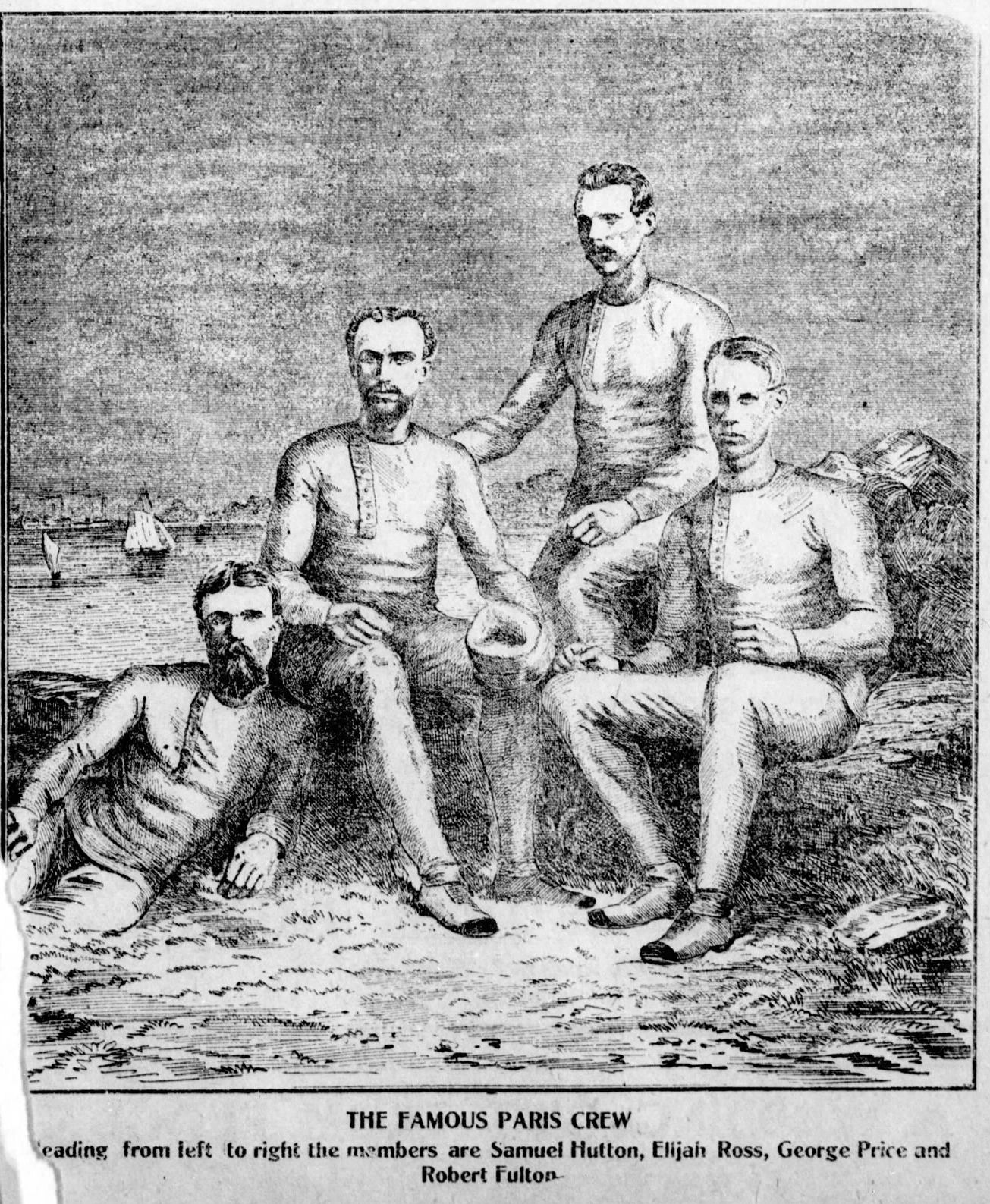
![The Paris Crew were described in detail by The Montreal Gazette newspaper: "Robert Fulton, stroke, is 25 years of age, stands 6ft. 1 in., and weighs 168 pounds. His complexion is swarthy brown, and his face bears the impress of indomitable energy and pluck. His shoulders are broad, chest is well developed, and loins spare. In fact he is in every way beautifully proportioned, and would make a capital model for a sculptor. Elijah Ross, No. 3, is 5 feet 11 in. in height, weighs 158 pounds, and is 25 years of age. He too is of a dark complexion, and is a decidedly handsome man. His muscular development is immense, and his whole appearance is that of a well trained athlete. Samuel Hutton, who pulls No. 2 oar, is of a dark complexion, and has dark brown hair. He is compractly [sic] made, possesses a very considerable development of chest and shoulders, and exhibits every appearance of great strength. From his countenance we should judge him to possess more nervous energy than any of his comrades, and that he is not one of the slow, dogged kind, but rather given to going at things with a view to finishing them in a hurry. He is 25 years of age, stands 5 feet 10, and weighs 158 pounds. George Price, bow oar, is the veteran of the crew, being 30 years of age. His height is 5 feet 10, and he weighs 154 pounds. His expression of countenance is stern, and indicates a dogged perseverance. Unlike the rest of the crew his complexion is light, and notwithstanding long exposure to the sun his skin retains its natural colour." (New Brunswick Sports Hall of Fame)](/wp-content/uploads/2026/07/002-the-strange-men-in-the-hot-pink-hats-5638ad65.jpg)
The New Brunswickers, by contrast, were distinctly working-class. Three of the rowers – Robert Fulton, Samuel Hutton, and George Price – were fishermen. The fourth, Elijah Ross, was a lighthousekeeper, a career which surely must have seemed impossibly alien to the Parisians.
The four men were in a strange situation, one which was so unique that it only happened a handful of times before in human history. While they were away, their nationality changed.
They had departed the colony of New Brunswick. While they were off in faraway Paris, their home became a province in a brand new country called Canada.
Only eight days after Confederation, on July 8th, 1867, the four New Brunswickers became the first to represent Canada on the international stage.
Fulton, Hutton, Ross and Price were already locally famous towers in Saint John. They had some international experience, having competed in New England, that was a far cry from the World’s Fair in Paris.
They weren’t exactly considered global players on the rowing scene by any stretch of the imagination.
They had been pushed to compete in Paris by ordinary Saint Johners. The citizens of their hometown had raised the money to send their local heroes to the World’s Fair, fundraising a whopping $4000 for the trip.
In one of its final independent acts before joining Canada, New Brunswick’s pre-Confederation colonial government kicked in a further $2000 towards sending the rowers to Paris.
With the money for their trip secured, the four rowers set sail for the 1867 World’s Fair.
The event was hosted by France’s Emperor Napoleon III, who bragged in an official press release that: “There is no place like Paris for such a meeting. Whatever other city may lay claim to the title of metropolis of the world, none can certainly dispute Paris the vaunt of being the capital of Europe.”
On the day of the big race, the French Emperor himself was looking on. Alongside the Emperor was, according to the New York Times: “An extraordinary concourse of crowned heads. Crowned, and turbaned too.”
The audience would have been worlds apart from anything the four rowers had experienced before in Saint John. There rowing was considered to be a distinctly working-class sport, the kind of thing any self-respecting elite wouldn’t be seen at. Rowing spectators in Saint John had a reputation for drinking, betting, and sometimes even getting into fights.

As the four men from Saint John got into their boat on the day of the big race, the Paris crowd murmured concern.
The boat was a style they’d never seen before. It looked precarious and flimsy. It sat so low to the water that there was genuine concern among the onlookers that even the smallest of waves might sink the Canadians’ boat.
The spectators’ concerns weren’t unfounded; the New Brunswickers’ boat had been specially constructed to go exceptionally fast over flat, calm water.
If they big day had been windy, they almost certainly would have been in trouble.
However, the day of the big race was completely and entirely windless.

In the end, the race was far from a Hollywood-photo finish. In fact, it wasn’t even close.
From the moment the race began, the Canadians used their “strange technique” of short fast rows to instantly pull well ahead of the other teams.
Their “strange” low boat zipped over the calm water, pulling far ahead of their competitors.
The well-funded European teams were left far behind.
As the Canadian team neared the finish line, the other teams were so far behind that the four New Brunswickers let go of their oars and – in possibly the most egregious insult to the Parisian fashionistas – took off their “strange” hot-pink toques that had been the subject of so much comment and waved them to the crowd.
They then crossed the finish line, entering the history books as Canada’s first winners of anything.
The scale of their victory was such that the same reporter for the Manchester Guardian who had called the New Brunswickers “strange” went so far as to write that: “either English oarsmen or English boatbuilders should reconsider the first principles of their arts.”
It took ten days for the news of their historic victory to make it across the Atlantic to the citizens of the brand-new country called Canada.
The shocking upset-victory by the plucky Canadians was “hailed with enthusiasm from one end of the newly-created Dominion to the other,” wrote The Toronto Daily Mail newspaper.
The Toronto Globe (now the Globe & Mail) wrote that the win “thoroughly brings home to the broad mass of our people that our bold Maritime friends are now our fellow countrymen in name and fact. It is a glorious responsibility that is upon the Paris crew. To be the first to uphold the strength, skill, pluck and honor of our country’s athletes.”
Even American observers celebrated the Canadian win. In fact, the American newsmedia heaped praise on their neighbours, while scorning the Europeans for seeming so shocked at their defeat. The New York Times penned a front-page editorial declaring:
“Canadians lead the world in boating, and their triumph on the Sienne is only a repetition of those they have so often won in their waters and in our own. They come down to “the States” only to easily overcome our best clubs, and then tell us, sometimes, for our satisfaction, that they have better men left behind.”
The four young Saint Johners returned home to find they were dubbed with a new nickname: “The Paris Crew.”
When they returned to Saint John, “The Paris Crew,” as the winning team was nicknamed, received a hero’s welcome.
The city’s enthusiasm was two-fold; naturally, Saint Johners were proud of their hometown lads’ winning Canada’s first victory at anything. Secondly, though, recall that rowing was primarily a sport Maritimers bet money on. Many ordinary Saint Johners had bet on the Paris Crew’s implausible win and had suddenly come into large sums of money.