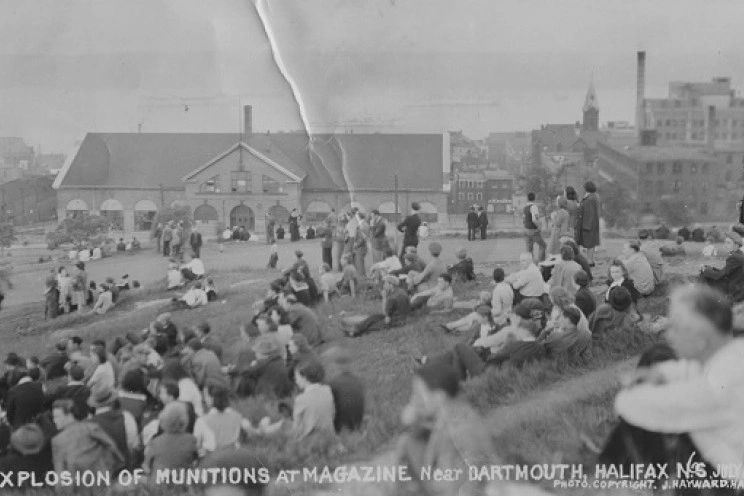
The 1917 Halifax Explosion, which occurred during the First World War, remains to this day the most deadly disaster in Canadian history.
In 1945, during the Second World War, there was a Second Halifax Explosion, or, more accurately, a series of explosions, as an out-of-control fire raged in an ammunition depot. Fire crews were joined by ordinary Haligonians as they desperately tried to keep a raging fire from reaching a massive stockpile of explosives…
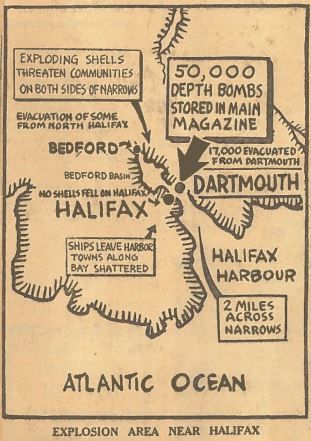
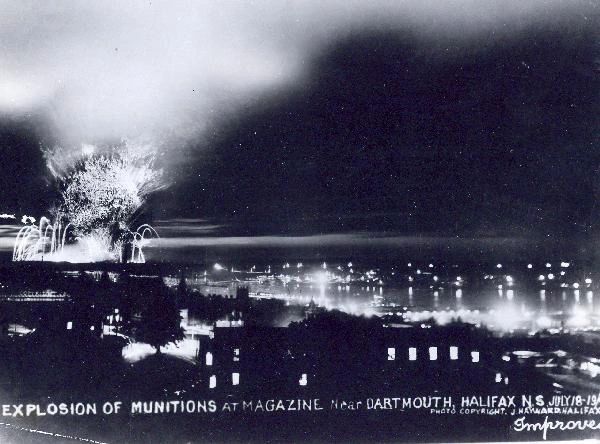
“The first explosion was at a naval jetty where ammunition was stored for shipment,” typed reporter Mel Sufrin from Halifax on July 18th, 1945, as a fire raged in the city’s mutination depot.
“The naval magazine lies on the northshore of the Bedford Basin, about four miles in a straight line from the northern tip of the city of Halifax. Since 1942 it has been the storage place for naval ammunition, shells, propellents, and depth charges. The area of the magazine is a huge one, stretching for more than a mile along the basin and back into the scrub country to the northeast.”
The reporter typed: “Further explosions [erupt] as the fire spreads to other stores of explosives … [I hope that] the fires will not reach and explode the main naval magazine in Halifax harbour…”
Meanwhile, another reporter named A. D. Merkel, wrote the following day that: “Apparently the fire started in one of the barges tied up at the south jetty during supper time. It might have been caused by spontaneous combustion.”

“It was first noticed by … Patrolman Henry R. Clarke, of Harrow Ontario, on guard duty at the warehouse. He telephoned the armament depot in Dartmouth.”
The phonecall was received by the switchboard in Dartmouth, which was operated by the Wrens, which is short for the Women’s Royal Naval Service. According to an account of the events which Leading Wren Eileen Bowen wrote for the Canadian Press:
“Marjorie Kwalheim, tall and blond, to whom explosions are familiar after working three years as a switchboard operator in the cordite plant at Transcona, Manitoba, took the first call for a fire truck. She put the call through [but] before the truck had even left the depot the first explosion rocked the building.”
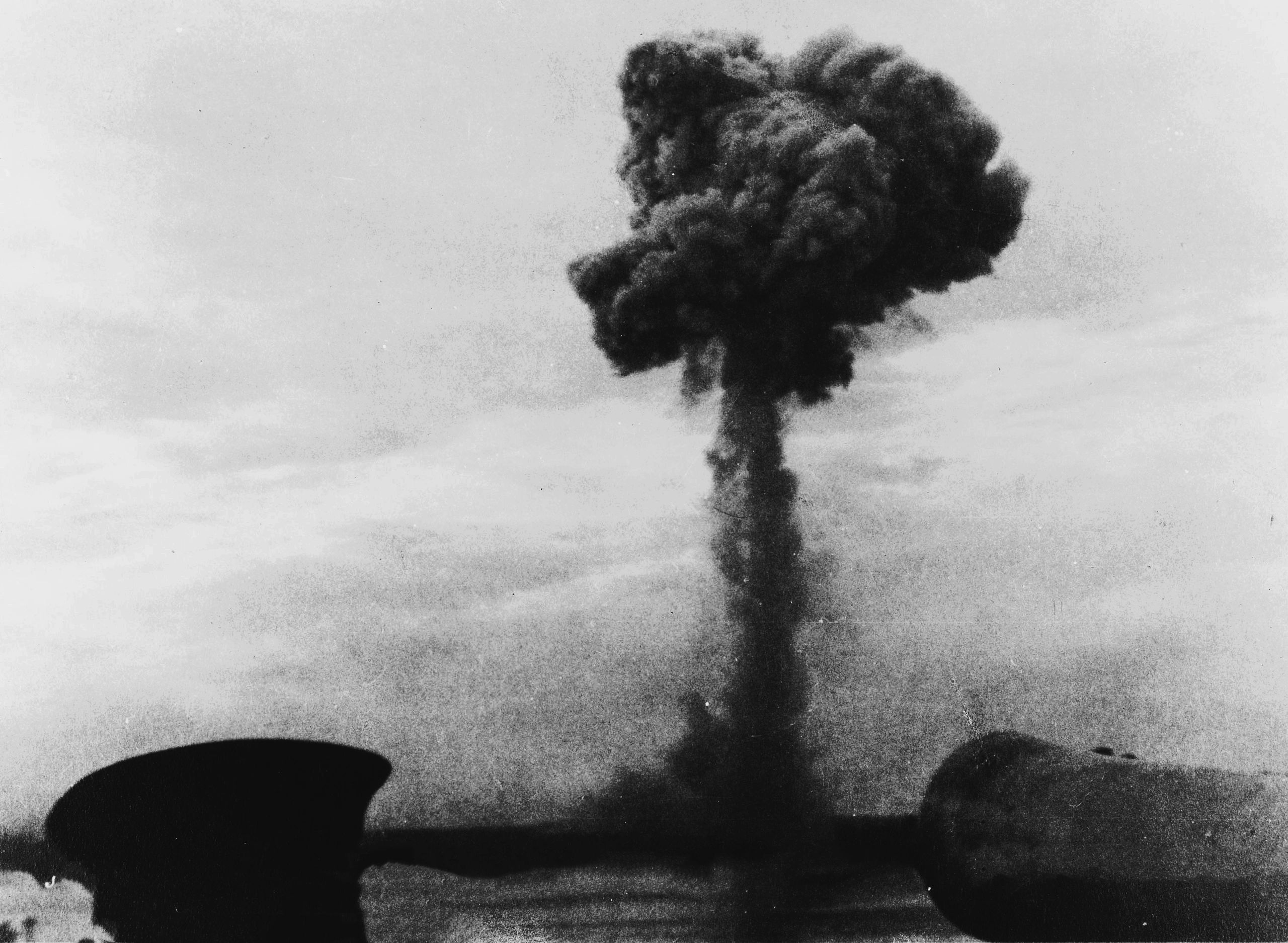
The great explosion sent an enormous mushroom shaped plum hundreds of metres into the air above Halifax.
Seventy-one days earlier, on May 8th 1945, Nazi Germany had surrendered. Although there was a buoyant, celebratory mood of victory all across Canada, the war was still being fought on in the Pacific against Imperial Japan. For Halifax though, the war was thought to be over, and after years of fears of Nazi U-Boats, they had finally thought they were safe.
However, German submarines were not the only things that Haligonians had been worried about for the past half-decade long war.
During the war Halifax had acted as a shipment point for democracy, with enormous quantities of powerful explosives manufactured across Canada passing through its ports on the way to Europe.
Since the war had ended barely two months earlier, a backlog of explosives had been piling up in the city’s munitions depot. And not those munitions depots were on fire.
The entire city was at risk. The first explosion was merely an early warning, and it was closely followed by other, smaller explosions as the fire gained strength and raced towards the central explosives storage site.
When it heard of another Halifax Explosion, the Moncton Daily Times wrote “Canadians all across the country must have shuddered as they heard the news and recalled the tragic horrors and vast destruction in the catastrophe nearly 29 years ago. We hope and pray for the Nova Scotian capital … the situation is highly alarming because the blasts will certainly continue…”
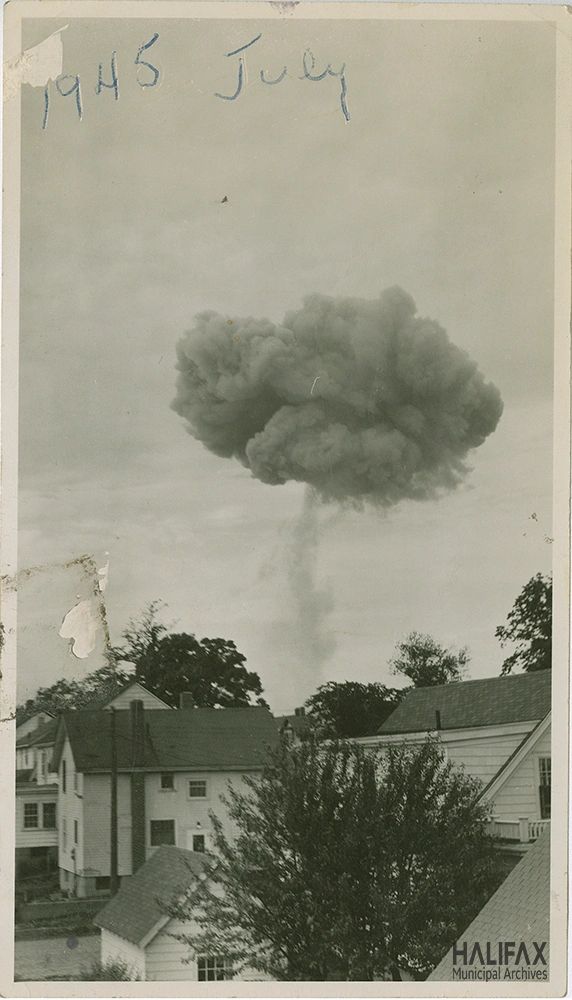
Reporter Mel Sufrin wrote from Halifax that: “The great blast and the recurring minor explosions set a chill through the hearts of Haligonians who saw their city almost wiped out by an explosion 28 years ago. That was on December 6, 1917, when an ammunition slip blew up in the harbour, causing more than 1600 deaths and thousands of injured. Many residents of Halifax still bear scars from that blast in 1917 which has always been referred to as ‘The Great Halifax Disaster.’”
It would require quick action to halt the flames before the whole munitions depot exploded, which could cause another catastrophic Halifax Explosion.
The man in charge of dealing with the crisis that was rapidly spiralling out of control was Captain O. C. S. Robertson, who reporter A. C. Menken described as “A giant of a man, his face and arms bronzed in the sun, his lean and athletic frame clad in trousers and sweater, with a naval cap his only badge. … Winner of the coveted George Medal for having taken a burning ammunition ship out of Halifax harbour during the war, and commanding officer at H. M. C. Dockyard, he had been on the job from the first.”
At the time that the first of what would be many explosions that night had erupted, Captain Robertson had been dining at the Nova Scotia Hotel in downtown Halifax with Lt. Commander William Schlater, who wrote:
“At 6:35 PM the city of Halifax was rocked by the blast of a tremendous explosion from the direction of Bedford Basin which shook even the solid structure of the Nova Scotian Hotel, more than five miles away.”
“Captain O. C. S. Robertson who was dining in the hotel at the time left immediately and ordered a speedboat from the dockyard to take him to the scene of the explosion. I accompanied him.”
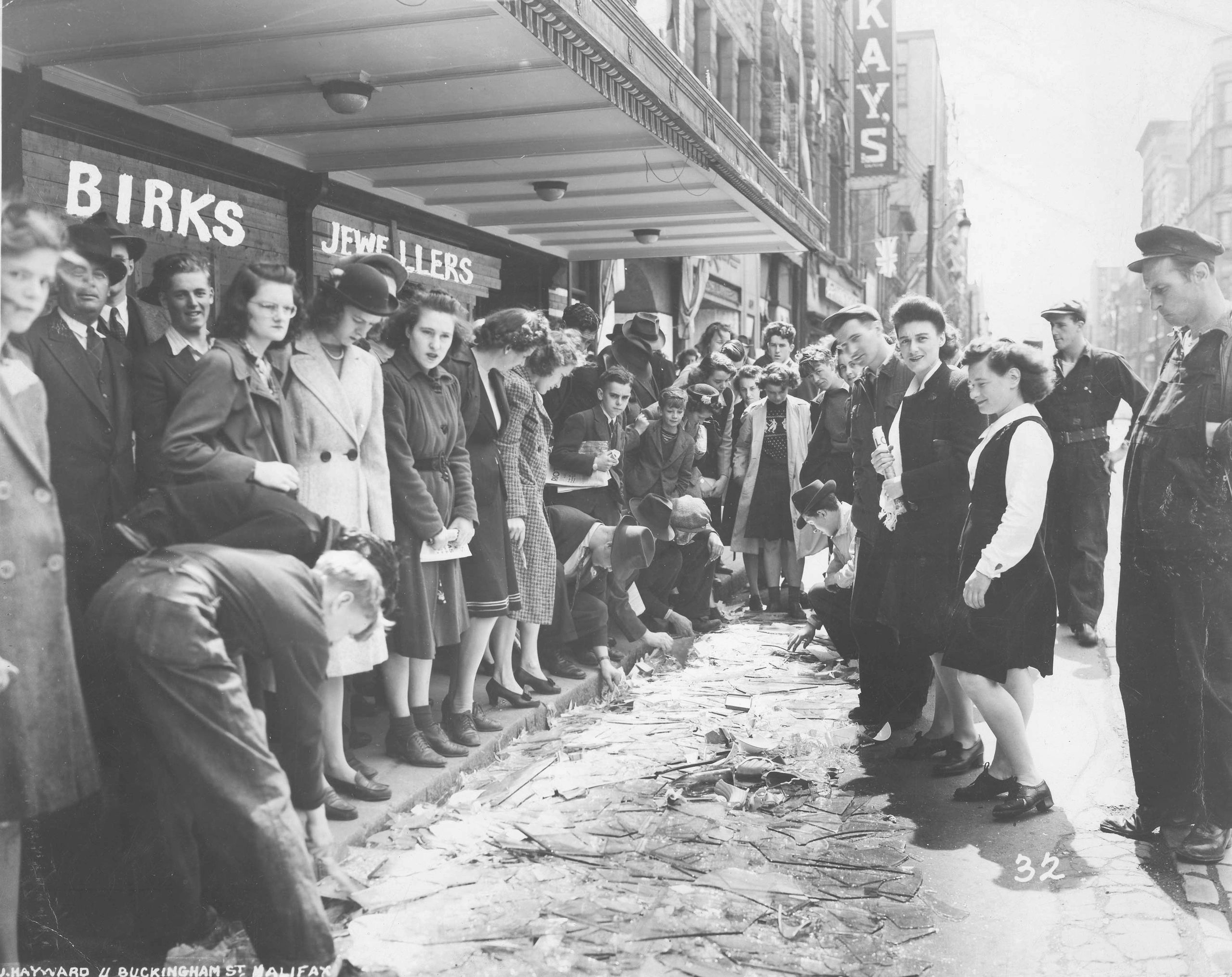
Schlater continued: “Approaching Bedford magazine area it was observed that many windows near the Narrows were smashed and broken. Rounding Turtle Head it was observed that fires were burning and intermittent explosions were rocking the area at the south east of the magazine. The wooden jetties there had been blown out into the harbour and a stream of naval craft and sick bay attendants were speeding towards the area.”
“Captain Robertson and I found the pier littered with debris. As we proceeded up the road … it was observed that all the buildings had been gutted by the first explosion. Great holes had been torn in the bric buildings, and ammunition boxes lay scattered in the path taken by the blast.”
“Three firetrucks and naval firefighting parties were already on the scene, endeavouring to contain the fire.”
“[Two firefighting boats] attempted to contain the fires from seaward … but explosions of developing intensity drive them back as the sea was showered with shells and debris from the exploding magazine.”
“The fire was obviously spreading … I witnessed the burning of Breast and many fierce destroyer actions in the English Channel and the Bay of Biscay last year and can say the intensity of the explosions was worse than anything I have ever seen in battle,” wrote Lt. Commander William Schlater.
Shlater continued: “[As] the naval firefighting crews pressed forward into the danger area … Captain Robertson decided it would be advisable to evacuate all civilian and naval personnel in Halifax and Dartmouth.”
Reporter Mel Sufrin wrote that: “As soon as the first terrific explosion, people began filing from their homes… There were no signs of panic.”
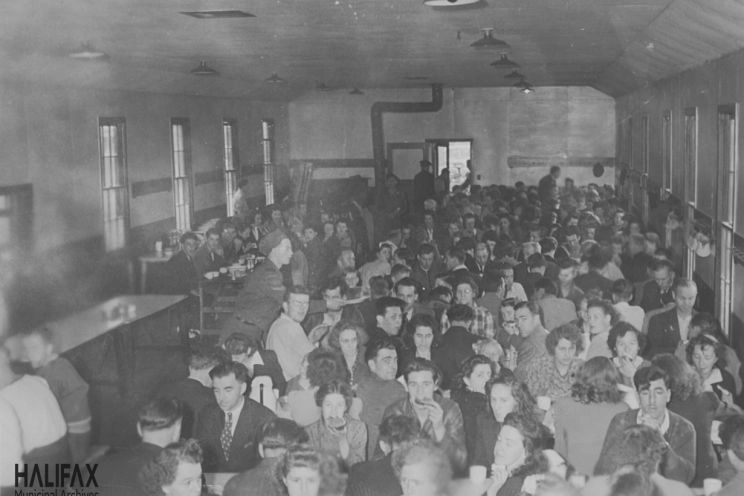
Suffrin's report continued: “Every truck, military and civilian, in Dartmouth was pressed into service to move people from the danger areas surrounding the magazine. Cars loaded with men, women, and children and household goods streamed by … About 2000 residents of North Dartmouth were moved to the army’s artillery centre at Eastern Passage … Military District 6 ordered food for the evacuees.”
The reporter continued: “…Every few minutes the air is split with a loud blast and the earth for miles around shuddered under the concussion… Between 4000 and 5000 people were moved to the Cole Harbour district, and police said they would remain in open fields. …From the distance of about two miles from the depot, small explosions sounded with the rapidity of machine gun fire… In the Preston Road District of Dartmouth 4000 more Dartmouth people were staying in the open.”
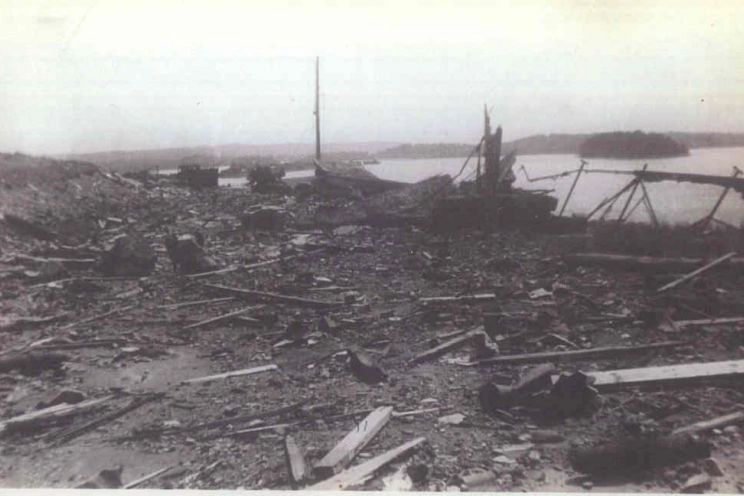
“In the clear view of the Bedford side of the basin the flames, stretching for hundred of yards could be seen reaching 150 feet into the air. …Fire boats which were rushed to the scene early tonight were withdrawn when it was found that the blaze was uncontrollable. … Periodically, pillars of flames shot high into the air as new explosions were set off.”
Meanwhile, back inside the Dartmouth communication centre, Leading Wren Eileen Bowen wrote that: “Wren Ruth Kidd, auburn-haired and petite, was visiting friends in Dartmouth on her off day afternoon when she heard the first explosion and ran towards the armament depot.”
“I could hardly make my way through the crowd of people evacuating their homes,” she said.
“She knew the [switch]board would be unusually busy. Wren Marjorie Kwalheim said that:” “From then on, the switchboard lit up like a Christmas tree.”
“The two girls worked from the time of the first explosion all night during the blasts until 11 o’clock the next morning.”
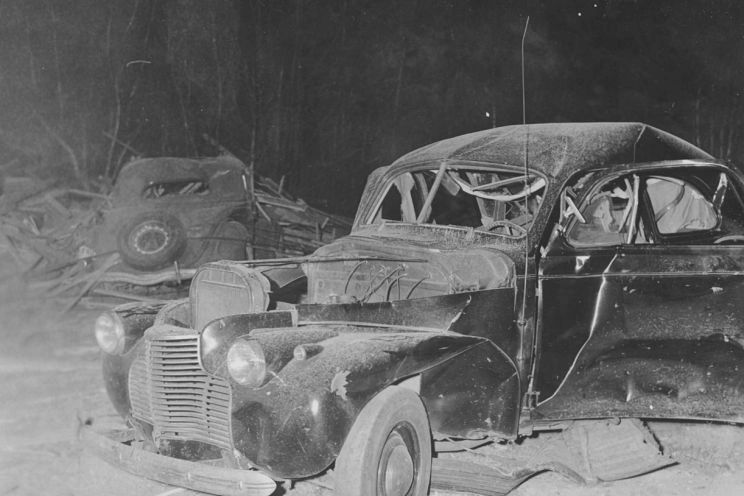
Back outside of the telephone centre, reporter Mel Sufrin wrote: “Blasts continued to rock the area, with a detonation at 12:20am which was even louder than the first one. It was thought at first that this was the main explosives storage going off, but naval officers said it was not.”
Meanwhile, inside, according to Leading Wren Eileen Bowen: “The two Wrens took turns at the switchboard, working with helmets on.”
One of the two Wrens added: “which are awkward things to work with when you have headphones on.”
Leading Wren Bowen continued: “All during the hectic night people came into the depot seeking shelter from the thunderous blasts and wanting help finding relatives lost in the melee.”
“After the heaviest explosion at 4 in the morning, the lights went out and the two girls worked on by flashlight, putting calls through from crouched positions on the floor. Plaster covered the switchboard like snow and they were covered with dust and grime. No windows were smashed in the depot but strong, thick, steel doors, 25 feet high, were mangled like tissue paper.”
At some point during the night an abrupt –and risky– change in firefighting tactics occurred at the site of the raging fire. Efforts were made not to attempt not to fight the fire, but to instead flood the main ammunition depot with water.
It’s actually not clear how coordinated the effort amongst those fighting the fires was. In the dark of night, as explosions rang out around them and black acrid smoke covered everything.
It’s also not entirely clear who was on the site at that point anymore leading the effort to flood the main munitions depot.
During the complete chaos and darkness that night, hundreds of ordinary Haligonians had chosen to not run away from the fire, but instead to join the effort to save the city.
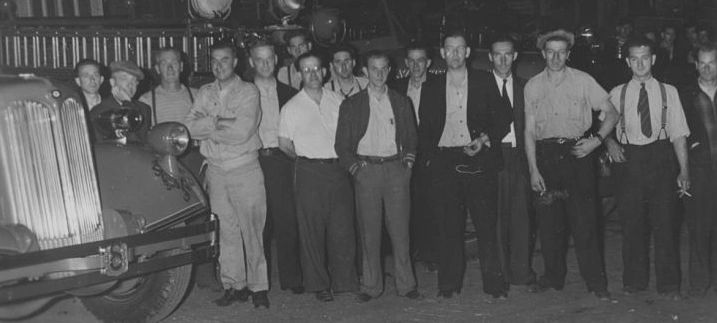
According to an extremely detailed write up called Bedford Magazine compiled by H. Millard Wright: “The newer magazines, most of which had been built since I939, were flooded by volunteer fire parties to avert the possibility of further explosions. These newer magazines were located in the area to the northeast. The blaze had started in the southwest corner and was gradually forcing its way to the new section when it was finally checked.”
It seems that the city was saved from a second catastrophic Halifax Explosion by the efforts of a mysterious group of unknown people who made the decision on their own to flood the ammunition depot. And it seems that the people who flooded it were ordinary citizens of Halifax.
During the next day the battle against the flames continued. Two more especially great explosions rang out.
However, by the evening of the 19th, reporter Mel Sufrin wrote, that: “From the air early tonight the explosion scene looks innocuous enough. Clouds of heavy greyish smoke were still rising from the north end area, but furthest away from Halifax.”
At this point, Haligonians began to collectively relax.
By the next day, even as the fires still smouldered and smaller explosions still rat-a-tatted away in the distance, a Canadian Press reporter wandered among Haligonians and observed that “with the tension over, … little knots of people gathered on street corners and in offices, sharing their spiciest explosion stories.”
“One bruised individual will give windows a wide berth next time he hears an explosion. As he leaned out to watch the pyrotechnic display … down came the window with the gentleman’s neck under it.”
“Open doors will also hold a particular terror for a Halifax woman. As she paused in a doorway an unexpected explosion banged the door shut, sending her a considerable distance into the hallway.”
“And there are laments too, for belongings which were destroyed. One woman told of the loss of … a half-dozen smashed eggs.”
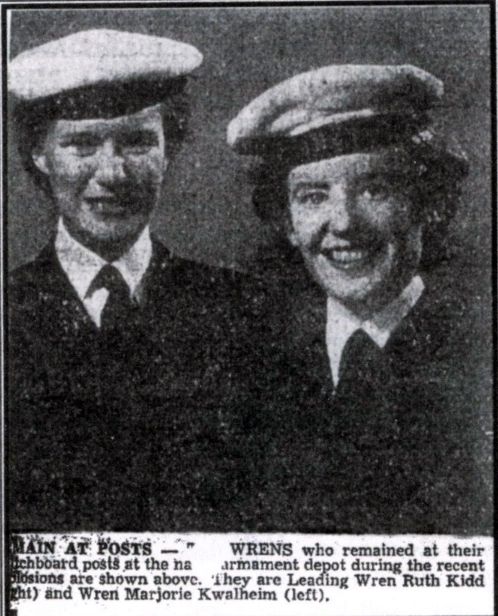
Even in the heart of the explosions, as they busily worked away all night doing the all important job of keeping the phone lines open, the two Wrens Ruth Kidd and Marjorie Kwalheim later recounted that:
“We would have rather been working than anything else,” said Kidd in a later interview.
“We were too busy to be nervous. And we were in contact with the magazine the whole time so we knew what was going on,” added Kwalheim.
“We had a radio on most of the night and kept putting calls through and ducking down on the floor to the sounds of Straus waltzes,” remembered Kidd. “From now on, I’ll never hear the music of ‘Danube, so blue, so blue,’ without thinking of that night.”
Two days later, reporter A. D. Merkel was taken on a tour of the scene of the explosion by the Naval authorities. He found that:
“Everything within this immediate area is a waste with craters showing at frequent intervals. But the ground is so littered with live ammunition that it is impossible to traverse. … A substantial portion of the live ammunition housed within the razed area did not explode at all,” wrote Merkel.
He noted that although the city had been lucky, the munitions depot had actually been specially designed with several safeguards in place to try and prevent a catastrophe like what happened 28 years earlier.
“The magazines were protected by earthen embrasures of reinforced concrete designed in such a way to pilot air inside one end and out the other leaving the walls and roof intact and the ammunition undetonated. This is precisely what happened.”
Though the safeguards had worked as intended, they were not foolproof – as the fact that the explosions ever happened in the first place so clearly showed.
On July 19th, even as the explosions still rang out in Halifax, E. L. Cousins, who was the wartime administrator for all of the Atlantic Canadian ports, did an interview with the Canadian Press in which he defiantly stated:
“The blasts in the magazine are the threat under which Halifax has been living the last six years," E. L. Cousins, wartime administrator for all the ports in Atlantic Canada explained.
"… in a single month of this war as much as 5,000 tons of high explosives had been handled across Halifax docks and sent on their way to European battlefields, because it was the only Canadian port at which they could be handled,” cousins continued.
“As a result of the blast, the people of Canada may now realise, perhaps more clearly than they have in the past, the strain under which the citizens of Halifax have been carrying on since the war began six years ago. Thousands of Haligonians knew of the heavy explosive shipments and they did not know when some disaster might occur.”
“The danger was continuous and there was no averting it, but the city, as a national port, took this in stride. There was no complaining nor any demand that the shipments of explosives be handled at some other, isolated, and less congested port.”
“It was looked upon as part of the war effort and that Halifax, … [made] this [its great] contribution to [the war effort.]”