
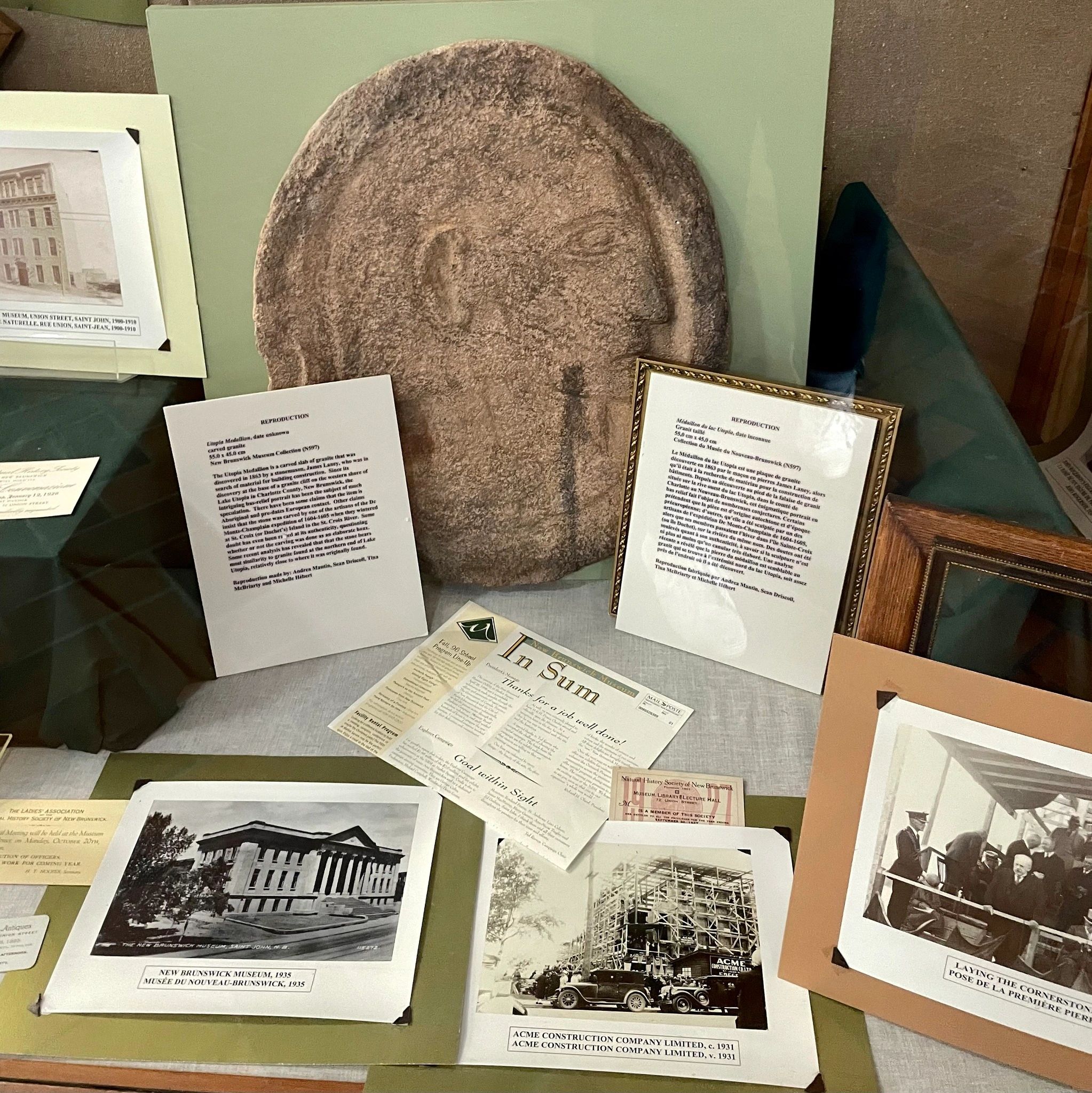
In 1863, a recent Scottish immigrant was wandering through the stark and desolate area above Lake Utopia, looking for rocks to build a fireplace when he made an astonishing discovery. When he wiped a thick layer of moss off a large flat stone, he discovered that carved upon it was an intricately detailed human face. Speculation that it was an ancient Egyptian artifact quickly spread…
According to the Daily Telegraph newspaper, the man, a mason named James Laney, brought home the 22-inch stone with the strange face carved on it, which weighed 50 pounds, “but his wife refused to allow it to remain, saying that it glowered at her.”
Decades later, his daughter recalled: “Father took it to town. A friend of his got it and took it to the museum … he took it because Mother did not want it in the house.”
Almost immediately, the mysterious carving, known as The Lake Utopia Medallion, caused a sensation in the nearby big city of Saint John.
On February 18th, 1863, the Morning Freeman newspaper wrote, “on the precise character of [the face] there is much question. The facial lines are not those of the [Indigenous people] of the present day, and resemble much more the lines of Assyrian or Egyptian profiles as represented in ancient sculpture.”
The newspaper went on to wonder if “other remains of the civilized people who once inhabited this continent may be found there.”
The St. Croix Courier newspaper, while more circumspect, came to the same curious conclusion writing: “It seems such a work could not be done without metal tools; yet the [early French] pioneers of Acadia found no metal tools in use among the natives. Unless the carving is of recent date, it is difficult to escape the conclusion that it is a relic of either an extinct people or of a prehistoric settlement of Europeans here.”
Several scientists accompanied Laney back to where he found it. It had been propped up on the edge of a cliff at the entrance to a sharp, rocky mountainous region, naturalist William F. Ganong later described as “a somewhat uncanny, repellent, and dangerous-looking place.”
The area had red columns of granite rising into the sky, which Ganong remarked resembled “an ancient altar-temple.” The largest column of all was named “Cleopatra’s Needle,” which E. J. Russell described for the Canadian Illustrated News as “containing not less than 100 tons of granite without a flaw … fit to form the sarcophagus for a President of the United States or a Prime Minister of the Dominion.”

They found the spot where the Medallion was discovered, covered in a thick slow slow-growing moss and lichens. It was clearly quite old, and the particular type of wear on it would be difficult to fake. The general consensus of the scientists then, and remains today, that The Lake Utopia Medallion is genuine.
The stone itself was granulite, which is one of the hardest rocks to work with, bearing a crystalline structure. Even a highly skilled craftsperson using the finest metal tools available would have struggled at that time to carve such an intricately detailed face. Upon closer inspection, the wear on it, from rain falling on the upturned face, indicated it was several hundreds of years old, not several thousand, as had been first suggested.
Everyone was at a loss as to who would have dedicated the enormous amount of work, time, and energy to carving the stone, and perhaps most mysteriously … why.
The Smithsonian Institution tried to get a hold of the stone to put in the United States National Museum, but by then it was safely in the hands of the New Brunswick Museum, where it remains today.
The news of the mystery spread as far away as England, though the London press wasn’t as keen to indulge in speculation about ancient peoples as New Brunswickers were.
The London Illustrated News wrote in July that “When it was shown to the [Indigenous] who frequent the neighbourhood, they at once pronounced it to be the portrait of a chief, and said it was very likely the chief himself was buried near the spot. They thought it was many hundred years old.”
It is unclear who – if anyone – the London newspaper interviewed about that, because the Medallion was found on a flat rocky cliffside outcrop; a location that would make burying someone there all but impossible.
The newspaper went on to note Peskotomuhkati had a very high reputation for being talented artists, saying: “Passamaquoddys are very skillful in their representations of animals, we have seen some very beautiful specimens … these figures would do credit to any professional artist.”
While it was true that Peskotomuhkati had lived around the lake they called Mes-kee-qua-gum for centuries, they themselves were also perplexed by the mysterious stone.
Saint John historian Clarence Ward reported in 1861: “The Passamoquoddy who have seen it are quite at a loss to account for the fashion and the quantity of the hair represented on the head, since from time immemorial it was customary for them to shave or pluck out all their hair with the exception of the scalp-lock.”
The hair was so ubiquitous that in 1914, Charlotte County historian James Vroom flatly stated: “for a [Peskotomuhkati] with the top of his head shaved and with long hair cut off so squarely is quite out of the range of imagination.”
The London press did, however, note that about 20 miles away from where it was found had been the site of a short-lived French fort in 1604, the first European colony in North America.

Other suggestions of who the face depicted stretch credulity. Geologist Dr. A. Leith Adams recalled that “when a drawing of this sculpture was displayed at the Boston Natural History Society, some members pronounced it a very modern imposition, and asserted it to be a likeness of The Great [George] Washington!”
Over the years, more hypotheses have been suggested, which were less than credible, from Egyptians, to Phoenicians and even aliens.
Even if we disregard some of the more dramatic suggestions –like aliens visiting Lake Utopia New Brunswick, to carve a face in a rock– the more plausible suggestions to who the mysterious carver may have been are still rather flawed, though.
It would be exceptionally unusual, stylistically speaking, to be an Indigenous work, Peskotomuhkati or otherwise. The Peskotomuhkati artwork the London newspaper spoke highly of earlier, consisted of patterns or familiar animals, cut into soft stone. To shape such an unusually hard type of stone as the Lake Utopia Medallion out of flint tools, and then to later polish the profile of the face, would be – while not impossible – would have been difficult and time-consuming beyond the realms of most people’s patience.
Vikings are another oft-suggested possibility. It wouldn’t have been impossible for a Norse visitor to carve the head, but it may have been impossible –stylistically speaking – for a Viking carver to not surround the stone with runes explaining what it meant, and crediting the artist. Vikings were remarkably consistent in their carving styles, and this isn’t a good fit.
In 1921, Dr. William F. Ganong, the finest historian New Brunswick ever produced, delved into the mystery with his typical obsessiveness, poring over every existing document even peripherally related to the Lake Utopia Medallion, and interviewing anyone still alive who had encountered it.
He obtained a fragment of the stone and two other fragments of similar stone, one from Lake Utopia and another from St. Croix Island. He sent these to Dr. William McInnis of the Geological Survey of Canada to be tested.
McInnis declared that all three rock samples came from a particular geological formation of the granite belt that spanned from Lake Utopia to St. Croix Island. So this, at the very least, confirms a local origin, as opposed to say, Egypt, or, you know, aliens.
McInnins, however, wrote that though “all three are the same and may come from the same mass,” he went further and declared that “I should say that [the Medallion sample] and [the St. Croix Island sample] are the same.”
St. Croix Island is a tiny island in New Brunswick on the Maine border, and it is the site of the first European colony (since the Vikings). In 1604, 75 French colonists, including explorer Samuel de Champlain, arrived to settle there.
According to colonist Marc Lescarbot, who had joined the settlement in its second year, it “had numerous joiners, carpenters, locksmiths, masons (massons), stone-cutters (tailleurs de pierres), etc.” among its members.
There is evidence that these masons and stonecutters went a bit wild, carving intricate designs all over their buildings. When the British destroyed that French colony in 1616, they tried to completely erase it from existence, in the words of a Minister who accompanied the expedition: “even making use of pick and chisel upon massive stones, on which were cut the names of Captains, and fleur de lys.”
Those French masons and stone-cutters also carved intricate designs into rocks in nature. In 1827, quite a stir arose in Nova Scotia when a large and intricately carved compass, marked with the year 1606, was found carved into Granville Mountain, near Port Royal.
It seems that one unnamed and forgotten member of that first French expedition to settle in North America 418 years ago was someone who was not only capable, but also more willing to spend a great deal of time making elaborate stone carvings for no obvious purpose.
Perhaps it was art for art's sake.
Perhaps it was simply boredom.
It’s strange to suggest a mysterious historic find was created for no purpose but to avail that quintessential human feeling of boredom, but it does seem to fit.
After all, boredom was something that the French had in spades that first winter.
Their first experience with a Canadian winter was long and brutal. Ganong described it as “a dreary winter of enforced inactivity, which in turn suggests the idea that the medallion was probably carved as a means of passing the too abundant time by someone competent in stone cutting and imbued with an impulse towards artwork.”
Ganong declared that the origins indicated the head had meaning, but didn’t have any resemblance to either conventional religious portraits or royal insignia. He offered that it seemed to be “a complimentary representation” of someone the carver respected, and that the curious hairstyle was “the long locks worn by fashionable French men of that time.”
He goes on to suggest that “it might be Champlain.” This is tantalizing because there are actually no contemporary portraits of Samuel de Champlain made while he was alive, and we don’t actually know what he looked like. Well, there was one, but it was a self-portrait he doodled of himself in the margins of a letter. I’m not claiming to be an art critic, but, well… it’s a stick figure. So perhaps the Medallion is the only portrait of that important early explorer.
But perhaps it's a tribute to one of the carver’s 35 comrades who died that winter. Perhaps it's even a self-portrait of the carver himself. No great man, but a normal, everyday person who is otherwise completely forgotten in history.
As for how it got 25km from St. Croix Island to Lake Utopia, Ganong offers suggestions for that, too. He offers that while carrying the 50-pound medallion overland would be hard for the French, it would have been easy to move for the Peskotomuhkati people, with their fast canoes and their keen knowledge of waterways linking the areas.
Ganong suggests they may have found it after the French abandoned the St Croix settlement after that harrowing first winter to move to Port Royal, Nova Scotia.
He suggests they left it there not as a grave marker, but as a votive offering to the spirits of Porcupine Mountain. Early settlers remarked many times at the Peskotomuhkati practice of leaving votive offerings to the spirits of places that were important to them.
And the ridge of Porcupine Mountain, rising high above Lake Utopia, was an unusual-looking place.
When Ganong wrote in 1921, Porcupine Mountain still had a reputation he described as “a somewhat uncanny, repellent, and dangerous-looking place.”
Earlier, however, it was an even more spooky and mysterious place; it had a large flat red granite slab, and rising above it were several massive granite pillars rising into the sky, the largest of which was nicknamed Cleopatra’s Needle. Early settlers called it “the remains of an ancient and mysterious temple.”
Clarence Ward called it “a curious structure resembling an altar, built with large slabs of granite.”
Allan Jack, who went with the person who found the Medallion to see the exact spot where it was found for himself, wrote “there is a somewhat singular monument, standing on the summit of a hill near the canal, consisting of a large oval or rounded stone weighing estimates seventy five hundredweight, laying in three vertical stone columns, from ten inches to one foot in height, firmly stuck into the ground.”
The strange area was generally disliked by European settlers, who avoided it. In 1878, a group of locals assembled and combined efforts to tear the pillars down, throwing them into Lake Utopia on what Ganong called “an idiotic whim.”
More William F Ganong Investigation Stories:
Old Ned, The Lake Utopia Monster (Appears in Book One)
The Ghostly Fire Ship of the Baie des Chaleurs (Appears in Book Two)
The Mystery of Mount House


