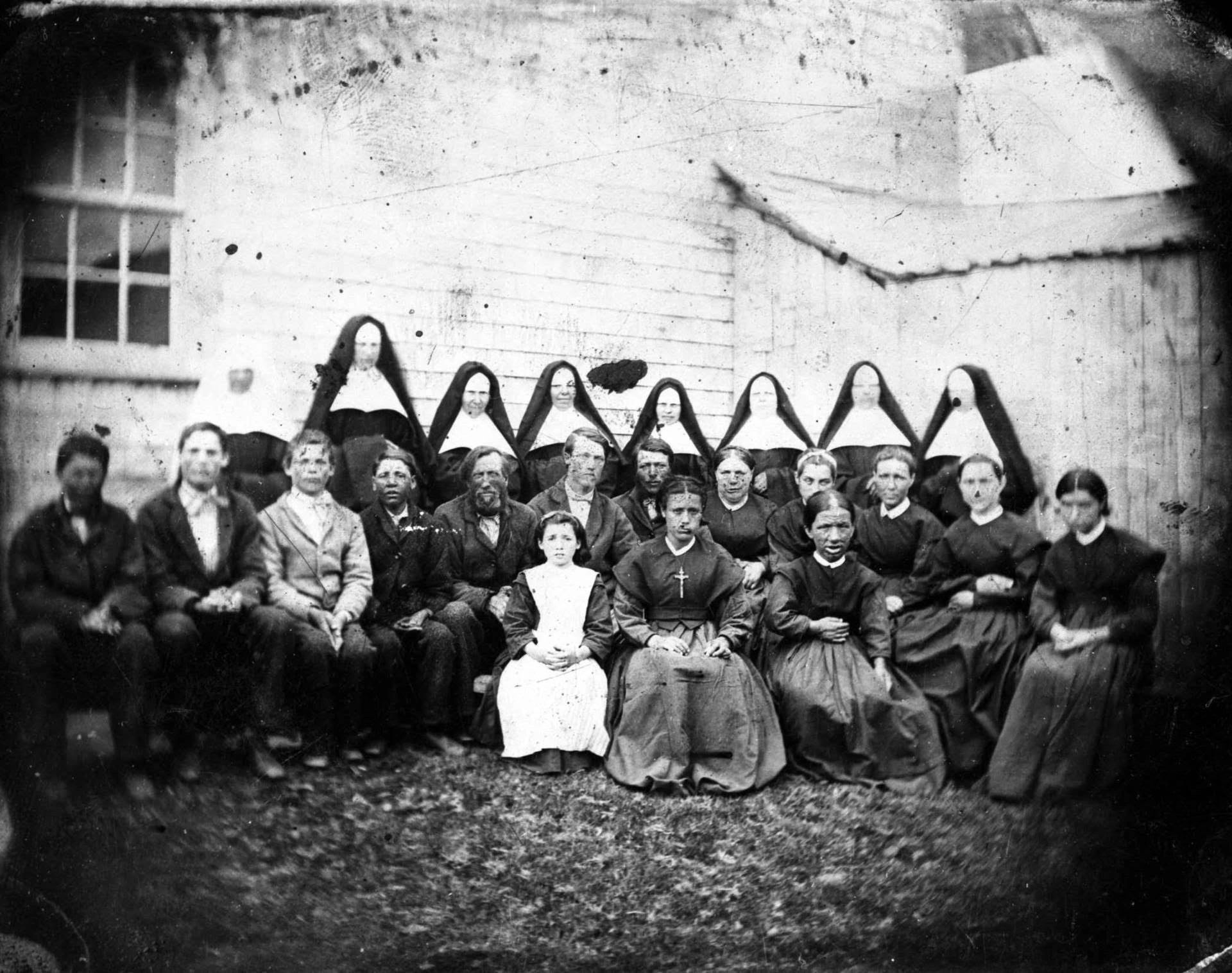
New Brunswick’s once was home to a leprosy colony. It was purportedly a hospital, however patients felt it was more like a prison. So the patients burned it down. Later, a second site became the site of important humanist reforms for the sick.
Leprosy has been with us since the beginnings of recorded history. Hippocrates, considered the “Father of Medicine,” wrote about the disease in 460 BC. There was also no cure for the disease, although some unusual ones were suggested: Hippocrates’ prescribed cobra venom.
Though leprosy was not contagious, the disease badly disfigured its victims, often leading to them becoming social outcasts. During the Middle Ages in Europe specific places for lepers were built – and even then were likely much less common than is generally assumed.
These places, sometimes now called “leper colonies” were called “Lazarettos,” named after Lazarus in the Bible.
In early New Brunswick, attitudes towards public health were basically that disease and death were effectively considered natural parts of living, and little was offered as health care. This began to change in 1833 when the province’s first Health Act was passed, largely to stop the spread of infectious disease arriving via Saint John’s port.
There had been documented cases of New Brunswickers with leprosy as early as 1817, but for the most part those afflicted simply continued about their lives. It was not, after all, contagious.
However, in April 1844, spooked by news of twenty new cases of leprosy in the Tracadie area, the government appointed a three man Health Board and gave them £1000 to build a lazaretto on Sheldrake Island, thirteen kilometers south of Chatham (now Miramichi).
The Board overseeing the colony was not run by people with a medical background, counting Joseph Cunard, a wealthy shipbuilding industrialist, among its members.
Eighteen lepers voluntarily arrived at what they understood would be a hospital. Instead they found armed guards and six foot high fences surrounding the Lazaretto.
Annoyed by the poor living conditions and treatment, many swiftly escaped, going home. The Board of Health decided they ought to be brought back forcefully. Soon after the lepers returned, many of the Lazaretto’s often makeshift buildings caught fire.
The fires were almost certainly set by the inmates.
Only five years after its establishment, the Sheldrake Island Lazaretto was abandoned after all the inmates escaped.
In 1849 a brand new Lazaretto was built in Tracadie, and 31 lepers were placed in it, by force.
An 1861 letter written by Reverend Ferdinand Gauvreau bitterly described how a group of seven constables violently took one of his parishioners who had leprosy from his home. The family had barricaded themselves inside to prevent the constables from removing their father, the sons armed with muskets and the wife and daughter armed with hot water.
“[The constables’] legal constitution invests them with the full power of entering by force any house or dwelling known or suspected to shelter any persons afflicted with leprosy,” Gauvreau wrote. “Undismayed by [the family’s] threats, curses and maledictions, the constables broke the door open and rushing on the defenders and seized their firearms, and … assaulted the females into the cellar which they closed up.”
The letter continued: “The Leper reaches the Lazaretto, his prison. He gazes upon the high staked yard surrounded in all its extent with menacing iron sikes; he sees its doors furnished with heavy locks to shut him up at night like a felon; his heart fails him at the sight of the many means taken to secure his person. … what crime has he committed to make him a prisoner?”
Dr. Charles-Marie LaBillois had been hired from Quebec to run the new Lazaretto.
Rather bizarrely, the Board of Health had not set aside a salary for Dr. LaBillois, and refused to pay him. Nonetheless, he cared for the leprosy patients, and by all accounts his care was vastly better than what came before.
Despite this, a document from 1850 listing the rules for patients seem awfully restrictive for a hospital:
“1. All persons affected with leprosy shall be confined to the same enclosure.
2. The diet of the patients shall be regulated as occasion may require.
3. Directions shall be given by the board as to the extent patients may go beyond the walls for air or exercise.
4. No person shall be allowed to enter the ground[s] … or have any communication without the sanction of the Board.”
5. Any persons who shall be guilty of a breach shall for each and every offense forfeit and pay a sum not exceeding forty shillings.”
Dr. LaBillios’ was controversial; while all agreed that he had improved conditions, patients and their families chafed at the restrictions.
More controversial, however, was that Dr. LaBillois announced that he had cured several patients of leprosy, for which there was no cure at the time. A later investigation by the doctor who replaced him, Dr. Robert Gordon, accused LaBillois of admitting non-lepers “to make people believe there had been cures.”
However, his defenders, like Secretary of the Board of Health James Davison, argued his hygienic reforms had vastly improved the lives of the patients.
Dr. LaBillois, for his part, argued that the Board was placing people in incarceration-like circumstances when they didn’t actually have leprosy. He stated that many patients sent there actually had syphilis.
After his departure, 212 patients and their family members signed a petition trying to get Dr. LaBillois to return. He never did, and was never paid for his work. It appears that conditions deteriorated after his departure.
Letters describing conditions survive. One reads “One of them is in a dying state. He could not live more than a day or two. It is very distressing to see the dying man in the same room with the others.”
In 1868 seven women arrived to overhaul the Tracadie Lazaretto, dramatically improving the lives of its patients. They were nuns from Montreal, belonging to the Religious Hospitallers of Saint-Joseph. Everything from diet, to exercise, hygiene to ventilation was dramatically improved by the Sisters.
Eleven years after the seven sisters arrived, the federal government took over the Tracadie Lazaretto, investing more money and ensuring better care for patients.