This is the second part of a two part story – click here for part one!
Houdini’s 1896 Maritimes Tour was set to conclude with an extended, several weeks long residency was scheduled in another big city, this time Halifax. It would feature some devastating low points, followed by a life changing high.

Many artists at that time found that Halifax was the worst city to perform in in the Maritimes. One unnamed actor with the King-Handley Company complained to the New York Mirror “on this round globe of ours, we fondly hope and steadfastly believe there is no such dull, unprogressive dormouse of a town as Halifax, Nova Scotia!”
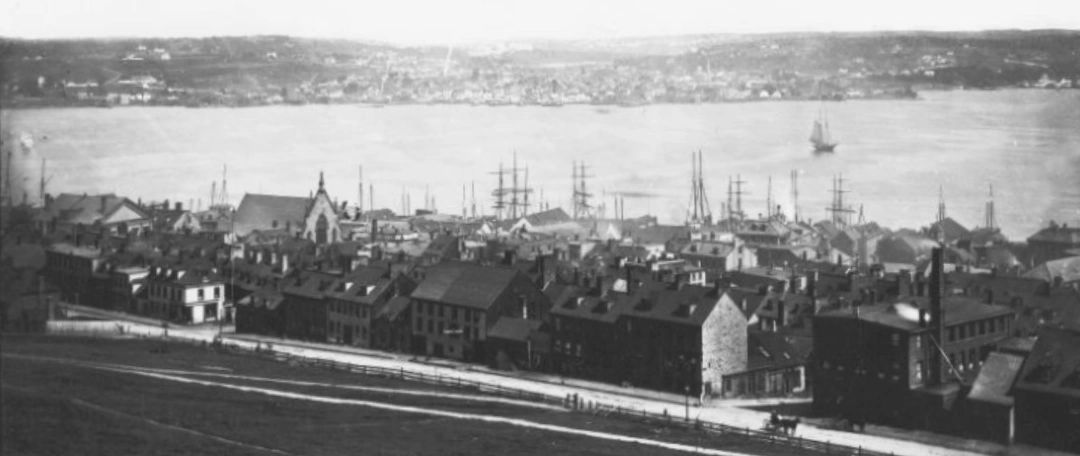
At the time, the dour industrial seaport of Halifax seemed to always be covered in heavy smoke from its factories, dreary fog, relentless rain, and grey skies. According to Bruce McNab's wonderful book The Metamorphosis: The Apprenticeship of Harry Houdini, it didn’t stop raining once in the entire two weeks Houdini spent in the city.
Halifax had a notorious criminal underworld, was filled with thieves, and was prone to violence at the best of times.
Entertainment wise, Houdini found that he would be facing stiff competition – the day after he arrived a massive circus came to town. An astonishing 21,000 Haligonians gathered in the rain to watch the circus parade through their city.
There was a heavy police presence with officers posted on every corner during the parade – years before, using a different circus parade as cover, a gang had robbed a downtown bank.
The Houdinis discovered that Halifax was in a state of absolute chaos that Summer – even by its own lofty standards.

A new set of underground pipes were being laid, and workers would blow up parts of the ground on main downtown streets, right in the middle of the day, even as people were sitting around on Summer patios and restaurants, and the explosions were sending dirt and stones flying everywhere, and even smashing windows.
There was also an exciting new fad that Summer called “striking” where bicycle riders would race down the steepest downtown streets at full speed, leading to people walking the streets to have to jump out of their way before getting hit by the barrelling biker.
The Houdinis went for a walk as soon as they got to Halifax and were greeted by witnessing a wild chase by police on foot. A local petty criminal named Walter Townsend, had stolen $5 from a little girl, and was now being chased through the city by police.
The Houdinis watched the police and the criminal racing through the packed downtown streets, past restaurants and cafes. The police caught the thief outside of a restaurant and beat him up on the sidewalk outside, as the crowd of diners inside all cheered, while the Houdinis watched in astonishment.
Unable to afford the fancy hotel in Halifax, which was simply named The Halifax Hotel, Houdini checked into the Charles House Hotel on Hollis Street, which is still standing today.

It was certainly not the finest hotel in the city, but at least it had a unique upside that most of the city did not at that time – it smelled good. It was right around the corner from the Moirs candy factory, and the air around that area was said to always smell like caramel.
The Houdinis’ first day in Halifax was Natal Day. The holiday brought in large crowds for the show that Marco the Magician and Houdini played. That day was also the Houdinis’ second wedding anniversary. The couple had actually had a whirlwind love-at-first-sight meeting, followed three weeks later by their wedding.
They strolled along the Halifax waterfront together, bought some strawberries, and ate them together in the Gardens – in the rain.
It seemed like things were going well in Halifax.
The next day was Election Day – the 1896 Canadian Federal Election. Elections were always a chaotic and emotional time, and this one was especially so in Halifax because a local man, Charles Tupper, was running to be Prime Minister.
Seemingly oblivious to the tense mood gripping the city, Harry Houdini showed up with a gaggle of reporters at the police station, asking to see the Chief of police.
He hadn’t made an appointment or informed the Chief that he was planning on using their police station as a stage for a media publicity stunt to try to advertise himself.
Despite the remarkably tone-deaf timing, Houdini got lucky because 54-year-old Chief John O’Sullivan, a tall, grey-haired, Irish immigrant who was normally rather stern and a consummate professional policeman, happened to have a weakness for the performing arts.
O’Sullivan loved the theatre. He often personally guarded the Halifax Academy of Music on big nights to keep the audience safe – though many thought this was a ploy to get free tickets.

The police chief was fascinated by this short little New Yorker claiming he could escape the Halifax police’s finest handcuffs.
Gamely, Chief O’Sullivan put a set of police handcuffs on Houdini.
It took the magician 32 seconds to escape from the cuffs.
Now definitely interested, the Chief then put three pairs of handcuffs on Houdini’s wrists and then handcuffed the handcuffs together with a fourth set.
Houdini turned his back and worked on the trick. It took him two minutes to get all four sets of handcuffs unlocked.
Now thoroughly fascinated by the strange saga unfolding before him, Chief O’Sullivan went away to his office and returned with a massive set of ancient handcuffs from the British Navy, which the Halifax Herald described as “the old ones used in days long ago.”
As the reporters watched on, Houdini struggled with the strange ancient handcuffs. The Morning Chronicle wrote the Chief’s challenge “bothered him considerably,” while the Acadian Recorder wrote “Houdini said he had never been so badly shackled before.”
Harry Houdini needed a clue. He asked Chief O’Sullivan how the strange ancient locks worked. After the Chief explained the strange locking mechanism, it took Houdini only two and a half minutes to figure out how to open it, even though the Chief still held the key.
Chief O’Sullivan gave him the handcuffs as a souvenir, and for decades later what he called “The Nova Scotia Leg Irons” would remain a major part of Houdini’s act performed all around the world.
After that, Houdini asked the Chief to strip him down to his underwear and lock him in a prison cell in the police station’s basement, and leave him there, and he would escape.
Now, the Halifax papers all covered this next trick in detail. I could read quotes from those. But I’ve got one better. Harry Houdini actually wrote his own news article –pretending to be the reporter for the Halifax Chronicle– and sent this longer, and much more embellished article to other newspapers back in the States, which they in turn published, as a way to promote himself!
So here is what Harry Houdini, pretending to be a reporter, wrote about Harry Houdini’s escape from the Halifax Police Station. The title for the article he wrote about himself was “A slippery prisoner”

“A strange young man was arrested this morning by Officers Pring and Killen, at the instigation of Manager Clark of the Academy of Music, who claimed the stranger was a dangerous criminal.
After being brought to police headquarters, Chief O’Sullivan securely handcuffed and shackled his limbs together, producing a pair of recently purchased double lock handcuffs, joined the leg shackles and handcuffs together. It certainly appeared as if the prisoner was secured.
Nevertheless, five minutes after, the chief, wishing to question the unknown man, sent for him when the startling feat became known that the prisoner had escaped handcuffs, shackles and all.
As the only exit from the cell led through the Chief’s office it is certainly a Mystery how the prisoner had escaped. Chief O’Sullivan was in a quandary when a messenger boy entered and delivered a neatly done up parcel addressed to the Chief of police. On being opened the parcel was found to contain handcuffs and shackles which were linked together like a huge chain and also contained a card with the inscription: Compliments of the mysterious Harry Houdini, good for one box at Academy of Music – come and see a good magician!”
Aside from the obvious parts that Harry had exaggerated, the factual difference with the Halifax news reports was that instead of sending a note, Houdini actually phoned the police Chief from his hotel, asking for his clothes back.
Also omitted from Houdini’s article but mentioned by the real press was that during the time when everyone was distracted, Walter Townsend, the guy who got tackled in front of the Houdinis for stealing $5 from a little girl, actually did a real jailbreak and got out of prison while the police had been busy with Houdini’s tricks!
Though Houdini’s time in Halifax seemed to get off to a fantastic start, with newspapers brimming with positive press, the very next day he was instantly forgotten when another magician came to town. Herrmann The Great was then considered the most famous magician in the world, and compared to him Marco the Magician, who Houdini was still performing with, was a cheap knock off.
Even worse, Herrmann The Great was in Halifax for a full four week residency.
Things quickly got much worse.
Completely overshadowed, the beleaguered theatre company performed to audiences only a fraction of a size of even Saint John’s meagre attendances.
Meanwhile bills for hotels, printing, advertising, meals and paying employees mounted. Marco The Magician was desperately struggling to pay his bills. While he was still paying the Houdinis and his little crew of three stagehands, unbeknownst to them all, Marco The Magician was racking up huge debts.
In the middle of one of their sparsely attended shows right in his own hometown of Halifax, Marco The Magician’s performance was interrupted by police officers mounting the stage.

Right on the stage, right in the middle of his show, right in his hometown, Marco The Magician was arrested for non-payment of debt, and was told by police that his magic company was being shut down.
Even worse, the police were seizing all of the crestfallen magician’s gear to sell to pay his debtors.
Marco The Magician hung his head as the police led him off the stage, still wearing his bright red outfit and long black cape with a large popped collar.
Harry Houdini later said that this specific moment was his lowest point in his life.
It seemed that no matter how hard he tried, everything he did ended in failure.
He decided to quit.
If he was looking for a sign to give up on his dreams, seeing the man who gave him his last chance to make it arrested on stage as he performed was as clear as he could get.
It was finally time to give up on his dreams of making it in showbusiness, and to go home to New York City to work in the tie factory.
He later said that he even went as far as to try to sell his own beloved magic show equipment to someone in Halifax. They turned him down though.
Nobody wanted Houdini’s magic equipment, just like how nobody wanted to see Houdini’s magic shows.
Harry and Bess Houdini packed up to go back to America. Back to a life in the old tie factory.
As they were in their hotel room packing up, Harry Houdini received a postcard.
It was from the once great White Mahatma himself, Samrin Baldwin, and it read simply: “Your work is so cleverly done that you perhaps will succeed where others have failed.”
Harry would hold onto that postcard for the rest of his life.
Harry and Bess discussed it and decided to delay their return to America. Not for good, mind you, just a little bit. They had one last thing to do. Well, two, actually.
The tour of the Maritimes that Marco The Magician had booked and invited them on when they were at their low point, stuck in New England, still had two dates left that were already booked, in Dartmouth.
With Marco The Magician now bankrupt and in jail, all his magic equipment seized by creditors, he obviously wouldn’t be performing the two remaining shows that were booked.
But Marco had been good to the Houdinis. He had given them a job and helped them when they were bankrupt and stranded in New England. They wanted to repay him the favour.
They decided the show must go on, and that they would play the final two shows of the tour!
They took the ferry across the Harbour to Dartmouth.
Even though it was a clear windless day, Harry still managed to get seasick anyway, once again throwing up over the railing even on the short trip.
If Halifax was rough back then, well Dartmouth was rougher. The Houdinis would have been greeted at the ferry by what police complained were “chronic loafers who made it their life’s duty to hang around the Dartmouth ferry from dawn to dusk.”
They would have been greeted by the then rather infamous smells of Dartmouth: drying fish, burned sugar from the refinery, acrid industrial smoke, all mixed with a strong smell of soap from the nearby soap factory.
The two final shows of the tour were booked at the St. Peter’s Catholic Church on Maple Street. Their performance was sponsored by the Catholic Total Abstinence Society.
It was just Harry and Bess now. They had no stage crew to help them set up, and very little equipment.

They went out into the street of Dartmouth and hired up some young boys they found hanging out to help them build the stage and get set up for the shows.
One of them, John Martin, would grow up to become a historian and author.
He later recounted that as well as paying him and his friends to help the Houdinis set up the stage, they also asked them where to find the most prominent people in all of Dartmouth.
The boys thought about it and brought them to the homes of what the young kids felt, in their opinion, were the most important people in Dartmouth: a local police officer, and the town dog catcher.
The Houdinis offered to bring those two most prominent men in all of Dartmouth on stage as part of their act if they helped promote the show.
On a Monday evening, Harry and Bess Houdini stepped onto the stage at Dartmouth’s St. Peter’s Church. It was a monumental night in their life – their first time as headliners on an international stage.
As they walked out onto the stage and gazed across the room, they found the room was packed. It was a sold-out show. Based on word of mouth from the Dartmouth celebrities and the little boys they’d hired, they sold out their first headlining international show.

Decades later, one of those little boys who had been spotted by the Houdinis in the street and hired to set up the show, John Martin, mentioned his experiences at the show in a footnote of his book ‘The Story of Dartmouth’:
“Houdini gave four performances here. One evening Street Supt. Bishop and Policeman Daniel Brennan bound him hand and foot, and then lifted him into a trunk which was securely roped and locked. The men then hauled the trunk behind the right wing and retreated. My eldest brother, tending the curtain at left wing, says no one else was in sight. Houdini’s lady assistant advanced towards the footlights and clapped three times with her hands. At the third clap, Houdini walked out on the stage.”
Encouraged by their sold out shows in Dartmouth they tried to book another show!
BUT the church was already booked for what was always a guaranteed sold-out show in Dartmouth – a pie eating contest.
So they lengthened their stay in the Maritimes, booking themselves new shows in places like Springhill and Truro.
But they once again encountered the small crowds they had before their Dartmouth triumph.
So they went home back to America.
Soon after they received a letter from Samri Baldwin, who they’d met in Saint John. The White Mahatma was doing a comeback tour! He wanted the Houdinis to open for them – this would be a big break playing in front of big audiences in larger venues!
But at the last minute Baldwin got sick and the tour got cancelled.
So the Houdinis did a little tour of their own through the American Midwest. They were playing tiny bars, often for as little as a dime per show.
During this tour, in Minnesota, a full year after their Maritimes tour, a famous promoter saw them. After the show he told Houdini to drop the little card and coin tricks and focus on the escape acts, and in return he’d promote him.
Harry agreed, and almost immediately, after well over a decade of relentlessly pursuing his dream, despite failure after failure, rejection after rejection, and setback after setback, he became an overnight smash sensation all over the world.
*
Four years later, Harry Houdini was being carried through the boulevards of Berlin by an enormous cheering crowd of a particularly enthusiastic audience that he’d blown away with his magic show.
In a moment of triumph, as he was being carried down the street of a major European capital city, now a bonafide international celebrity whose name was known in households all around the globe, he thought back to that disastrous tour of the Maritimes, only four years earlier.
That night, when he was back in his opulent and expensive Berlin hotel room, Houdini wrote a letter to an obscure and forgotten Halifax man named Michael Dooley.
That letter Houdini wrote is lost, but Houdini held on to the reply he got back from Michael Dooley, who had once performed under the stage name Marco The Magician.
The letter reads: “Your letter expresses more gratitude to me [than I deserve] for what little favour I may have done for you … it shows what I knew all along, that you have a good heart and it is in the right place.”


