The Vikings called it the Kraken. The Bible called it Leviathan. But today we think these fearsome, mysterious sea monsters were giant squids.
By the 1870s, the very existence of sea monsters was completely dismissed by scientists.
All that changed the day a little Newfoundland fishing boat was attacked by a giant squid.
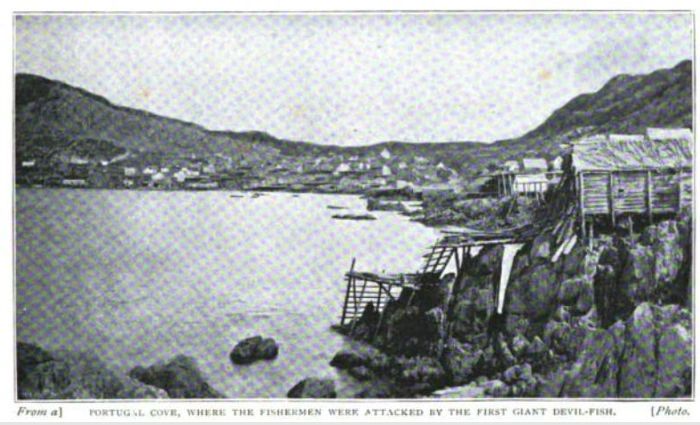
It was October 25th, 1873, near Bell Island, in Conception Bay, Newfoundland. Fishermen Theophilus Picot, and David Squire, who were accompanied by Picot’s 12-year-old son Tom, spotted a large dark spot under the water near the surface.
Reverend Moses Harvey, who was later credited with bringing the giant squid to the world’s attention, described what happened next:
“Supposing it to be a portion of a wreck they rowed towards it, and one of them struck at it with his boat-hook.
"Instantly the seemingly dead mass became animated."
"It reared above the waves, presenting a most ferocious aspec, and displaying to the horrified fishermen a pair of great eyes, gleaming with rage, and a horny beak, with which it struck the gunwale of the boat. "
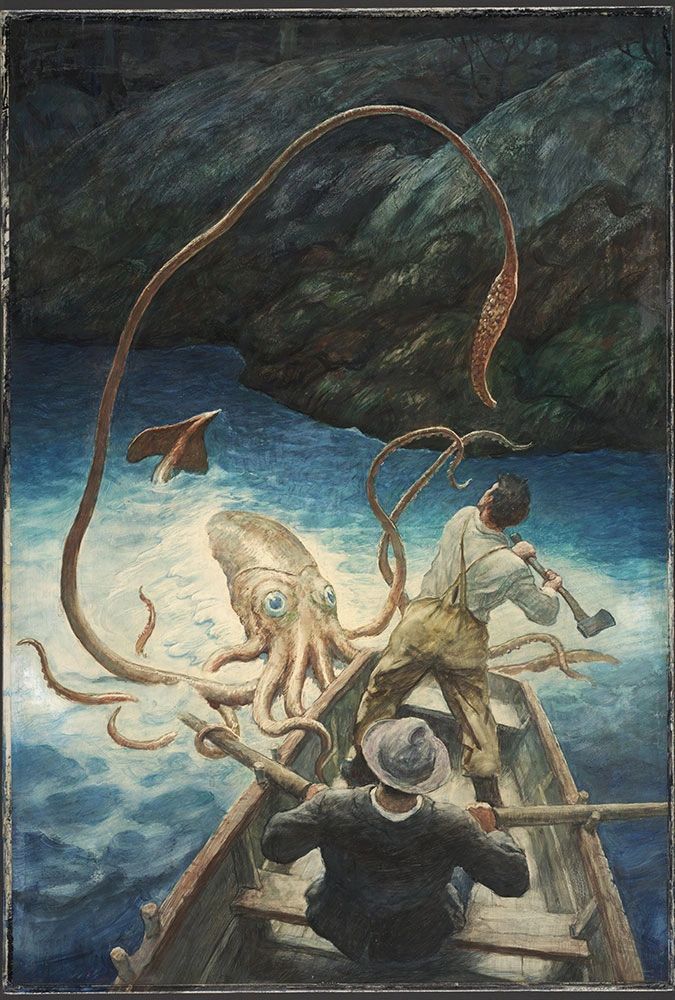
"The next instant a long, thin, corpse-like arm shot out from the head, with the speed of an arrow, and coiled itself round the boar. It was immediately followed by a second arm, much stouter but shorter, and both, in some mysterious way, glued themselves to the boat which presently began to sink. "
"The terrible monster then disappeared beneath the surface, dragging the men and the boat with it. The terror stricken fishermen were completely paralyzed and thought their hour had come. The water was pouring into the boat as it sank lower and lower … "
"Quick as lightning however the boy Piccot … seize[d] a small tomahawk that fortunately lay in the bottom of the boat, [and] the brave little fellow dashed forward and with two or three quick blows cut off both arms [that] lay over the edge of the boat. … Then the huge slimy mass seemed to slide off and … disappeared.”
The story would soon capture imaginations all over the entire world.
By then, sea monsters like the giant squid were thought to be nothing but old legends and myths.
From the moment that humans built boats, they worried about what lurked in the deep, dark, cold, and mysterious waters below their fragile little ships.
The Odyssey is one of the very first pieces of Western literature ever … or at least that still survives today. It was composed as an epic poem, some 2700 years ago by Homer, a blind bard from Ionia, in modern-day Turkey.
The Odyssey features a sea monster named Scylla who lives in a cave in the waters off of Italy, and eats sailors:
“she’s a grisly monster, I assure you.
…
She has twelve legs, all writhing,
dangling down and six long swaying necks,
a hideous head on each,
each head barbed with a triple row of fangs,
thickset, packed tight—
armed to the hilt with black death! ”
…
Scylla’s no mortal, she’s an immortal devastation,
terrible, savage, wild, no fighting her, no defence—
just flee the creature, that’s the only way.”
Through the ages, we have lots of tales of sea monsters, all through time, and across
every culture. Europeans definitely didn’t have a monopoly on sea monster stories.
The first sea monster story in Newfoundland was probably what Mi’kmaq called the Jipijka'm [pronounced chih-pitch-kawm]. They were described as huge, scaly, dragon-like serpents with long teeth and a single big horn.
The mid-1800s were the Victorian Era, an exciting and heady time of scientific progress.
Continents from sea to sea were being linked by steel railway lines.
The world was being connected by undersea telegraph lines that allowed texts to be sent instantaneously around the world.
The world had been mapped.
Everything except the North Pole and Antarctica had been explored – and they were racing to complete those!
For the scientific and rational people of that time, old myths like sea monsters were a thing of the past.
It was by then agreed on by the scientific community that all sea monsters –including so-called “giant squid”- were not real.
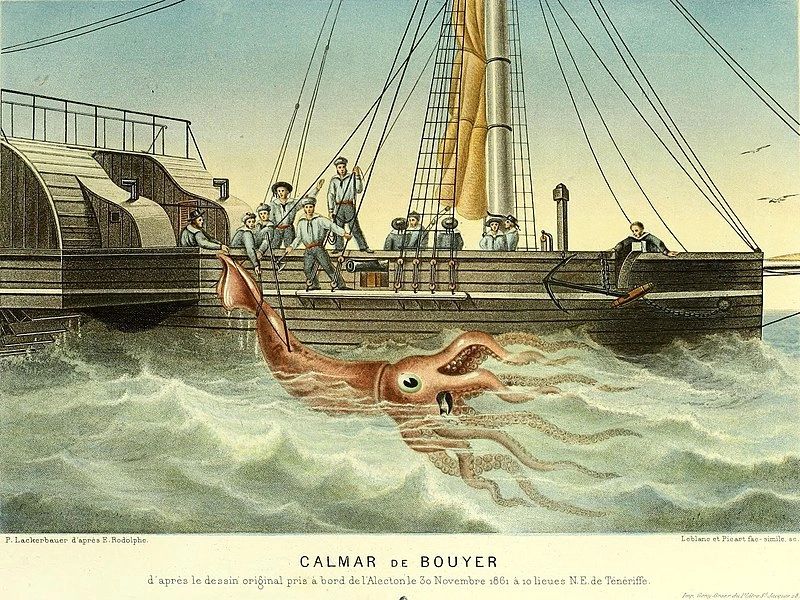
But then, in 1861, aboard a French warship called the Alecton that was sailing near the Canary Island in the Atlantic, a sailor called out that there was a giant sea monster underneath the ship.
The ship’s Captain Bouger instantly decided to attack it. He ordered his sailors to fire harpoons at it to try and haul the beast onto the ship.
The giant squid managed to escape, but before it did the French did hack off a bit of a tentacle, bringing it back to Europe to study.
And by a bit I mean, a bit relative to a giant squid – the piece of tentacle actually weighed 14 kilograms!
Author Jules Verne definitely read reports of this incident, and it would form the basis of his famous book 20,000 Leagues Under The Sea.
In that novel – which, of course, is a work of fiction – the characters discuss that real event:
"The most astonishing event, which proves that these gigantic animals undeniably exist, took
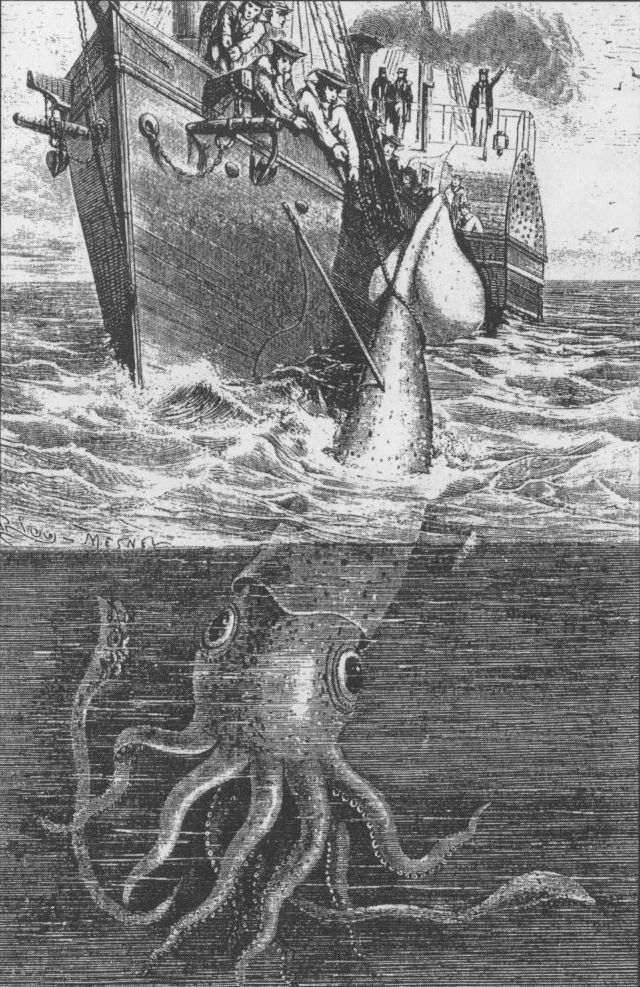
place a few years ago … In 1861, … the crew of the gunboat Alecto spotted a monstrous squid swimming in their waters. Commander Bouguer approached the animal and attacked it with blows from harpoons and blasts from rifles, but without much success because bullets and harpoons crossed its soft flesh as if it were semiliquid jelly. After several fruitless attempts, the crew managed to slip a noose around the mollusk's body. This noose slid as far as the caudal fins and came to a halt. Then they tried to haul the monster on board, but its weight was so considerable that when they tugged on the rope, the animal parted company with its tail; and deprived of this adornment, it disappeared beneath the waters.” …"What an awful animal!" he exclaimed.”
Despite the Alecton bringing back a piece of the giant sea creature, by the time they got to Europe, it was badly decomposed. While Jules Verne believed the story, most people thought it was made up.
But I mean, can you blame them, really?
Because let's be honest, that 1873 story of a giant squid attacking a fishing boat in Newfoundland also sounds made up.
However, that 12-year-old boy, Tom Picot, came to shore with real, hard evidence; the two tentacles that he had hacked off of the giant squid that had attacked their boat.
The evidence, however, was quickly disappearing.
When he got to shore, Tom Picot fed the smaller tentacle to his dog.
Reverend Moses Harvey would later be devastated when he heard about that, writing:
“How it made my heart ache to think of the loss to science inflicted by ravenous dogs! I called to mind the mischief wrought by Sir Isaac Newton’s dog Diamond, but it seemed nothing to this!”
(He was comparing Tom Picot feeding the tentacle to his dog with how Diamond the dog knocked over a candle and set fire to 20 years' worth of Isaac Newton’s notes working on his theory of gravity.)
Regardless, the 12-year-old boy still had some evidence: a 19-foot-long tentacle he’d acquired after his boat was attacked by a sea monster.
But what on earth is a 12-year-old boy going to do with a 19-foot-long sea monster’s tentacle.
Tom Picot consulted the local village priest, asking him what to do.
The priest had no idea what to make of the bizarre incident, but he thought he knew of someone who did.

Reverend Moses Harvey later wrote: “The clergyman of the village … recommended him to bring it to me, as I was [in his words] “crazy after all kinds of strange beasts and fishes.” ”
Reverend Moses Harvey was well known for his particularly inspirational sermons, and people came from far and wide to see him speak every Sunday.
He wasn’t just a Reverend though.
Back then lots of scientists took jobs as Priests, Ministers and Reverends. It paid decently well, it was a respectable job, and it left them with a lot of time to pursue their science work.
Reverend Moses Harvey, who was originally from Ireland, was definitely highly educated and was an extremely prolific writer, publishing an estimated 900 papers during his life. He had a degree from the Royal Academy of Science in Belfast, and another from Montreal’s famous McGill, the most prestigious University in Canada.
And so off 12-year-old Tom Picot went, carrying with him a coiled-up 19-foot-long tentacle that he had cut off of a giant squid that had attacked him.
He was headed to the capital and only large city in Newfoundland called St. John’s, to find Reverend Moses Harvey.
“[The] Next day, Tom presented himself at my door in St. John’s, asking “Would [you like to] buy the horn of a big squid?” He told me the whole story in a few brief words, merely remarking, in a casual way, that I think I had done for the big squid. How eagerly I closed the bargain might be imagined. Tom went away a happy boy with the reward I gave him.”
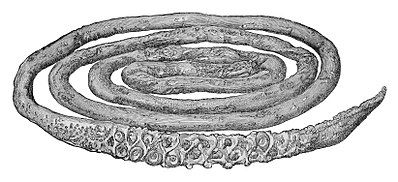
“He was not happier than myself, however, for now I was the possessor of one of the rarest curiosities in the animal kingdom. … the veritable arm of the hitherto mythical devil-fish, about whose existence naturalists had been disputing for centuries. I knew that I held in my hand they key of the great mystery, and that a new chapter would soon be added to Natural History.”
After a quick examination of the tentacle, Reverend Moses Harvey made his way to Conception Bay, the site of where the squid had been found.
He was, believe it or not, going there to check if Tom’s dog had finished eating the other tentacle. I assume he’d never seen a dog eat before…
When he got there he was disappointed to find the dog did in fact eat the whole second squid tentacle. “How I mourned the irreparable loss!”
While he was there he ran into Tom’s dad Theophilus Picot and David Squire, the other fisherman who was in the boat.
“I found the two fishermen but partially recovered from the terror of the scene through which they had passed. They still shuddered as they spoke of it. What most impressed them was the … parrot-like beak that suddenly leaped from the middle of the head as if eager to rend them and the large green eyes gleaming with indescribable fury.”
Reverend Moses Harvey stuck around Conception Bay for a few days.
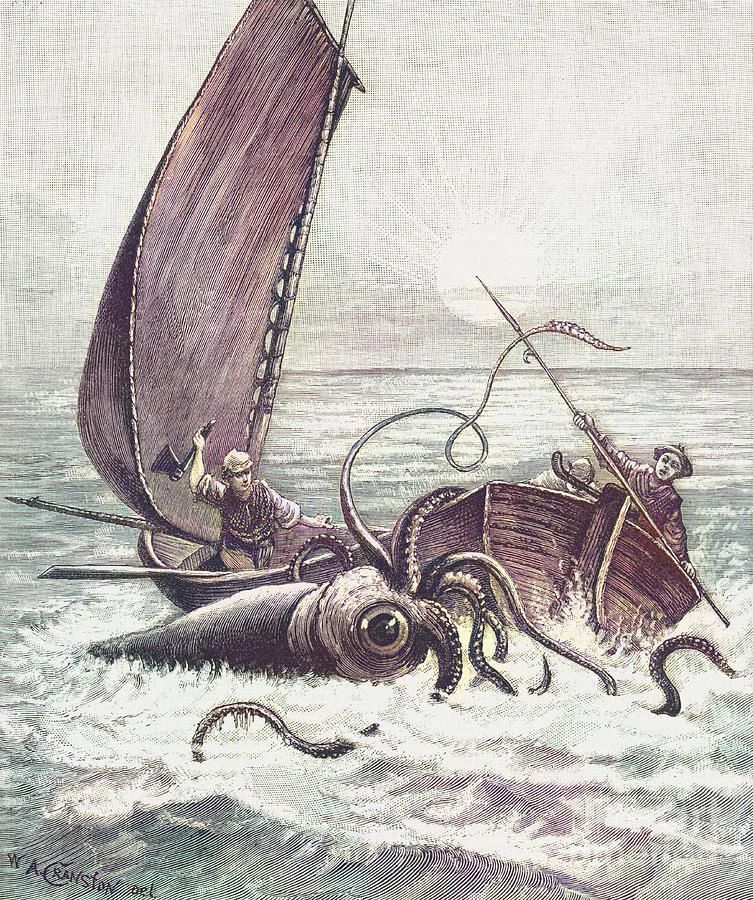
He noticed “for several days men were afraid to go out in their boats, dreading to encounter another sea-demon, or perhaps, apprehensive that the same monster might be waiting around to avenge his lost arms which he had unceremoniously been deprived of by Young Tom’s rough surgery.
The fishermen have a tradition among them about big squids being seen, but the oldest inhabitant had never seen or heard of such a monster in Conception Bay.”
He was waiting around Conception Bay in the hope that the rest of the squid might wash up on the beach. When Tom said I think I had done for the big squid [use same audio] he meant he thought he’d mortally wounded it.
While he waited, Reverend Moses Harvey studied that 19-foot-long tentacle that he had by now been dragged over a fair amount of Newfoundland.
“A lengthened study afterwards of these Giant Calamaris convinced me that this must have been one of the largest specimens; that in fact the body must have been from 15ft to 20ft in length and the long tentacles each 35ft to 40ft. This would give 70 to 80 feet between their tips when extended with a head 4 feet across The weight of the whole mass could not have been less than 1000 to 1200 lbs.”
“Fact beats fiction any day. The fabulous “Kraken” of the old naturalists has been thrown into the shade by Megaloteuthis Harveyi,” wrote Moses Harvey.
Yes, Moses Harvey did, in fact, name the giant squid’s scientific name after himself.
After a few days, he went back home to St. John’s, disappointed that the rest of the wounded squid did not wash ashore.
Harvey wrote: “what became of it can never be known. Most likely it retired into the depths of the ocean to die alone, otherwise, it would have been attacked and devoured by its fellows. Sympathy among devil-fish could hardly be looked for.”
Reverend Moses Harvey’s disappointment was short-lived.
“Imagine my delight when, one day in November, some three weeks after, I received the welcome news that a big squid had been captured by some fishermen at Logie Bay, some 3 miles from St. John’s."
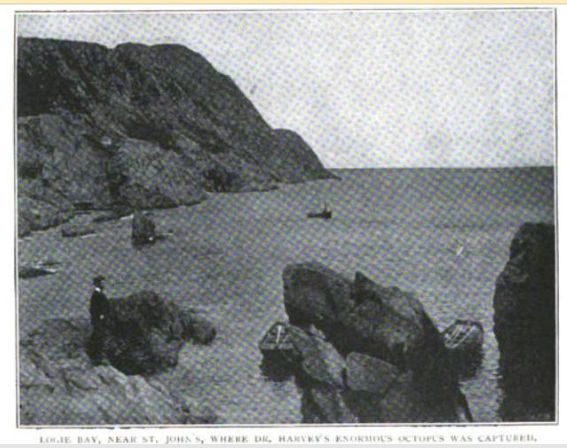
Hurrying with all haste to the place, I was barely in time to save the uncanny monster from being cut up and mixed with bog and earth for manure!”
“The men gave me a graphic account of the capture. Four of them were engaged in a boat hauling in a large herring net. They found it unusually heavy as they drew it towards the boat and concluded that they had a specially fine haul of herring. As the mass came nearer the surface, however, they were startled at its violent convulsive movements, which threatened to burst the net or carry it away. When the contents of the net came into view, they were horrified to see a pair of large cruel eyes glaring at them, and a confused mass of ghastly white arms wiggling in the meshes of the net and struggling to get free.
The men were now thoroughly alarmed, and thought of letting the net go altogether; but finally they decided on killing the struggling monster. One of them drew his fish-cutting knife and … severed the head.”
Just like he’d done with Tom Picot, Reverend Moses Harvey offered to buy the dead giant squid, much to the surprise of the fishermen:
“I speedily completed a bargain with the fishermen, whom I astonished by offering them 10 dollars to deliver the beast to my house. They evidently thought me “cracked” for paying away so much money for a nasty brute which nearly cost them their lives. To allay their curiosity and make them be more careful, I hinted that I wanted it as a present for the Queen!”
As for the giant squid:
“To my great satisfaction, I found it was perfect, with the exception that in the struggle its head had been severed from its body and its eyes had been destroyed. I knew what I had in my possession was something all the museums in the world did not contain – a perfect specimen of a [giant squid.] My happiness was complete.”
Now Reverend Moses Harvey set about studying the giant squid and informing the rest of the world about it.
Despite how these rather enthusiastic -some may say slightly unhinged- quotes make him sound, he was actually a serious and well-respected scientist.
All of the quotes you’ve heard from Reverend Moses Harvey in this episode come not from those scientific journals, but from a lengthy retrospective he wrote 25 years later for The Wide World Magazine, whose target audience was adventure-seeking young boys. He definitely didn’t write like that when his audience was prominent scientists.
He had a big problem now. He had to tell all the great scientists that he had a dead sea monster, and had to somehow do so without sounding crazy and being ridiculed by his scientific peers … "Much in the same way as [Louis] de Rougemont was ridiculed and labelled a Munchausen by his critics in the newspapers and elsewhere for describing an octopus not even half the size as this.”
Louis de Rougemont, from Switzerland, had claimed that his lifeboat had been attacked by a giant octopus after his ship was wrecked in a storm near Australia.
His story was roundly mocked by the press.
And if you think we are vicious on social media today listen to what they did to Rougemont: he was invited to give a talk about his experiences to a packed sold-out theatre. When he took the stage, the organizers unfurled a banner above him that read “the greatest liar on earth,” and then the audience booed him off the stage.
Reverend Moses Harvey was worried the same thing would happen to him if he started talking about giant squids. But he had an idea on how to offer proof:
“The photograph, like George Washington could not tell a lie. Had I published the story without the attesting photograph I have little doubt that I should have been pronounced a Munchausen.”
This “Munchausen” the Reverend keeps mentioning basically means an outrageous liar who actually believed his lies. It’s from a then-popular German book by Rudolph Raspe called Baron Munchausen’s Marvelous Adventures, which involved the title character telling stories about things like how he rode a cannonball, went to the moon, and fought a 40-foot crocodile. Oddly enough, the author wrote that book by simply writing down the lies told to him by an actual minor German nobleman named Baron Munchausen who he kept running into at parties.
Now, Moses Harvey didn’t want to be called a Munchausen. So the Reverend needed a photograph as proof. But how do you even manage to take a picture of a giant squid at a time when cameras involved a lot of chemicals and a bunch of hard work to take a picture?
His extremely innovative solution was to drape the whole giant squid over his bathtub, or as he called it “my sponge bath.”
But back then, cameras weren’t mobile, so he had to transport the dead giant squid in his bathtub to a photography studio down the streets of St. John’s.
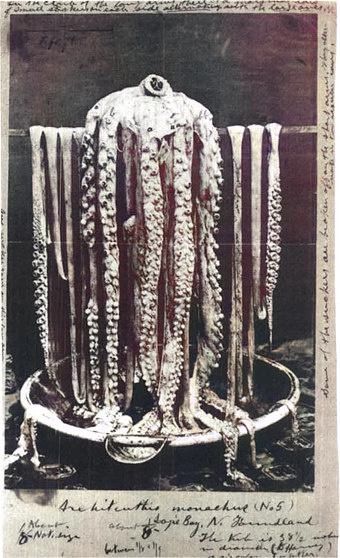
“The head, with attached arms, was carried in my large sponge bath, by a couple of men, to the photographic rooms. The result, to my great delight, was an admirable photograph showing the arms hanging down with their splendid array of suckers, the two long arms being looped on each end of the pole. The picture presented the picture of a beautifully executed embroidery.”
Now that he had proof: “I opened communication with a number of scientific men regarding my discovery. The sensation created in all quarters was immense.”
The Newfoundland giant squid attracted attention from all over the entire world.
The Smithsonian in Washington created a model of that very squid and hung it from the ceiling of its world-famous museum.
Top scientists from all of the most prestigious universities in the continent argued over who should get to study it.
Much to his astonishment, museums, and aquariums from all over the world, as well as famous circus showman P. T. Barnham, sent him orders to buy giant squids of their own. “They said spare no expense! They must have thought they were as plentiful as codfish!”
Reverend Moses Harvey sent his giant squid to Yale University because it was home to the most prestigious marine biology scientists in the world.
Soon after a third dead squid washed up, and the New York Aquarium bought it for hundreds upon hundreds of dollars.
But for Moses Harvey though, he was happy that his giant squid was accepted by scientists and believed it was real.
Twenty-five years after bringing the world’s attention to it, he wrote: “From being a mythical personage, the creation of an excited imagination, fit only to be a subject for a romance of the sea, my giant [no] has got a scientific name and an honoured place in the pages of natural history, and is now highly respected. ”


