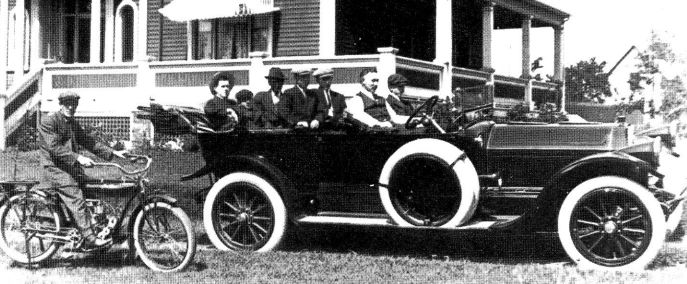
Prince Edward Island has a long history with the automobile. It is considered to be the first place in all of Canada to have one. And the only province to ban them.
– Listen to this story on the Backyard History Podcast!
– This story appears in the book Backyard History: Forgotten Stories From Atlantic Canada’s Past. Order a signed copy from the author here!
Canada’s first car – a steam-powered horseless carriage – arrived in PEI in 1866. It was imported from Philadelphia by Georges-Antoine Belcourt, parish priest of Rustico.
By 1908, PEI boasted a grand total of seven cars on the Island.
At the time, Ontario was opening its first production line for building a new Canadian car called The Russell McLaughlan. At the opening, Ontario’s Premier Whitney declared, "These vehicles are here to stay."
Days later, PEI banned cars completely.
The vote in PEI’s Legislature to ban cars wasn’t even close – they voted to ban cars by a margin of 28 to zero. It was the only place in all of North America to ban the car completely.
It seemed like one reason was that horses were scared.
Robert Jenkins of Mount Albion, for example, wrote to the Guardian on March 6, 1908: “… when driving through Bunbury as soon as my horse saw the automobile, he wheeled in his tracks and began kicking in the wagon. Those in charge of the automobile brought the machine to a halt, and it was only after I backed the horse past it that I felt safe to get into the carriage again. … Many farmers refuse to let their wives and daughters drive on the roads unless accompanied, and the pleasure of a quiet ride on our country roads will be rare if those vehicles are allowed to travel as they are now.”
While it would make sense that horses were scared of cars, Rudy Cronken makes the argument in his book called Ban The Automobile Instrument of Death that it wasn’t horses that were scared – but people.
Charlottetown’s Reverend Fullerton declared that people were staying away from church out of fear of encountering motor vehicles.

There was more to it than a fear of cars, though. D.P. Irving, the MLA who seconded the resolution to ban automobiles, in his speech urging the ban on cars, declared: "There will be no hardship inflicted by suppressing them. They are owned by men of wealth and leisure who force the public off the road."
The ban on cars was at least partly a swipe at the rich, specifically backlash aimed at a wider group of rich people who had inflicted pain on them.
In 1908, the GDP in Canada contracted a crushing 7.8%. The country was in a brutal recession, possibly the worst one ever, until the Great Depression. The event was called the Banker’s Crisis, and was largely the result of faraway Wall Street speculators’ stock market gamble gone wrong. Now, average people all over North American were suffering in the resulting economic crash.
Since cars were seen as something only the wealthy could afford, the ban was seen as a popular effort to attack the wealthy before PEI’s politicians hit the election trail that year.
This complete and total ban on cars on the Island would last five years, until 1913.
By then, on the mainland, cars were vastly more common, cheap, and affordable. This was leading to more tourism and the money that came with it.
Business people in Charlottetown complained that the ban was costing them $90,000 a year in lost tourism revenue.
Under pressure from the Charlottetown business community, the April elected officials narrowly voted to change the law to allow “motoring” on Mondays, Wednesdays, and Thursdays. Cars were still banned on Tuesdays, Fridays, Saturdays, and Sundays.
There was an immediate and heavy backlash, including farmers blockading roads in protest. Other forms of protest included farmers refusing to take their food to market.
Horace Wright of Bedeque summed up the mood at a 1913 anti-automobile meeting: "We're going to keep them cars out if we have to take a pitchfork and drive it through them!"
Only three months later, that very June, an island-wide referendum was held, where people would vote on whether or not to ban the car.
According to Edward MacDonald in “If You’re Stronghearted, Prince Edward Island in the 20th century,” the government suppressed the results of the referendum. He estimated that the results showed that 90% of Islanders had voted to ban the automobile.
The government came up with a compromise, where some parts of the island would ban cars, and other parts would allow them.
This led to some strange scenes, like when wealthy fox fur seller Frank Tuplin, who lived in Summerside, which banned the car, would load his car onto a train and take it to Charlottetown to drive it, because Charlottetown had not banned the automobile.
This curious hybrid ban would not last long, though. The entire world would soon change dramatically during the First World War, in every conceivable way.
Islanders’ opinions on the automobile shifted quite quickly during the war. With so many of their young men gone off, they needed help with farming.
Finally, in 1918, the government narrowly voted to completely lift the automobile ban.
The vote was a tie, with 14 MLAs supporting the car, and 14 opposing. The Speaker of the House broke the tie by voting for automobiles, and cars have been driving around PEI ever since.
In 1918, many rural Islanders saw a car for the first time.
Decades later, 86-year-old Cyril MacFarlane reminisced with Deborah Stewart about his first time seeing a car for her article called “The Island Meets The Auto”:
“I remember when I saw my first car. It came down this road and I was working in the field at the time. I stopped everything and saw the car go by. … I can remember the day just as if it were yesterday. … Yes, it was quite a sight! … But … I don’t know if we’re better off or worse [for having it.] … it used to be that there was more neighbourliness somehow.”
This story appears in the book Backyard History: Forgotten Stories From Atlantic Canada’s Past order a signed copy from the author here!