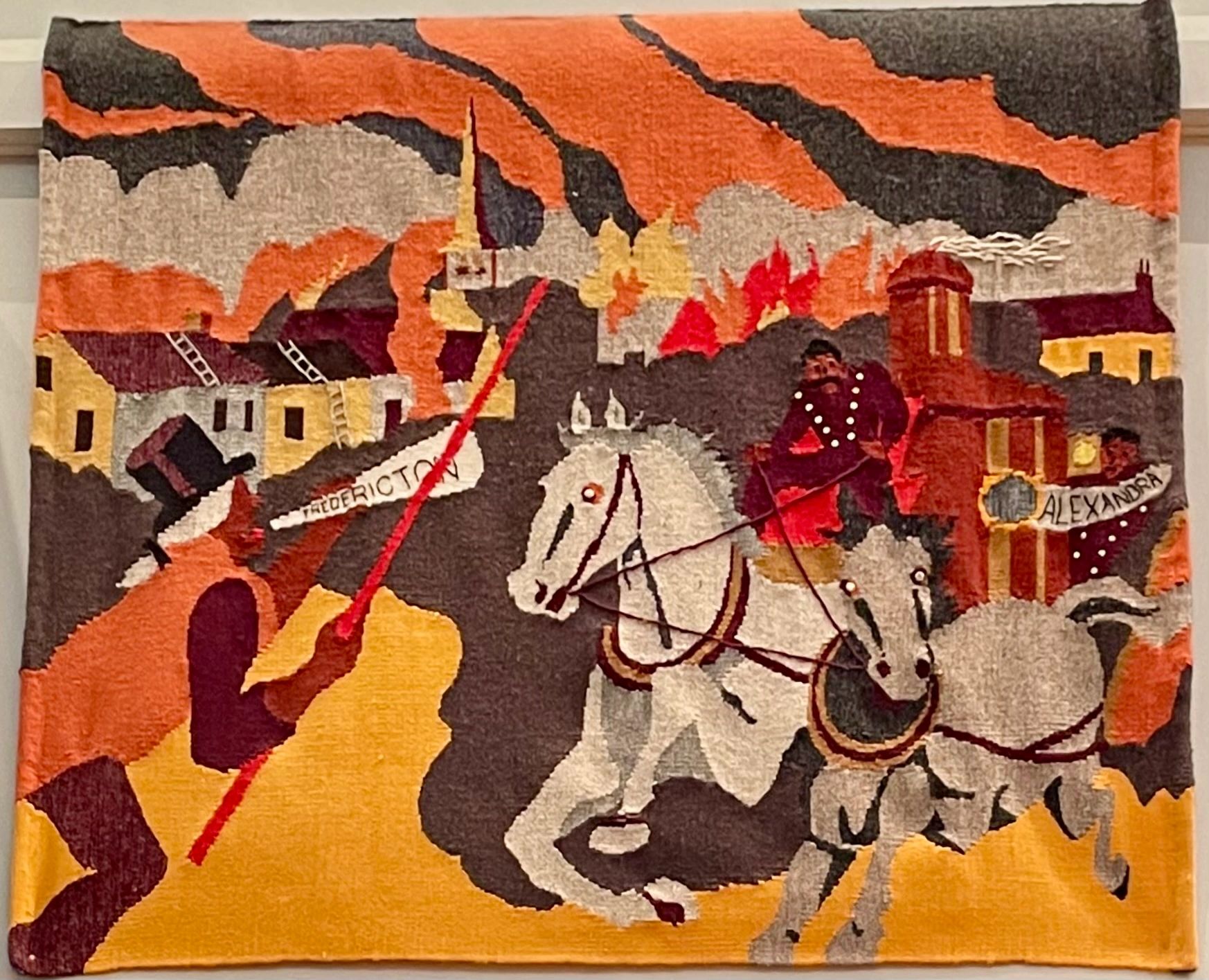
A man came thundering down the streets of Fredericton on horseback, shouting that “the most destructive and alarming forest fire ever seen” was fast approaching the city.
This is part of a trilogy on the Great Fire of Miramichi:
The rider was New Brunswick’s Surveyor-General. His own cottage was already within eyesight of the flames. This was bad news for Fredericton — it sat only a mile from town.
The Royal Gazette newspaper had recently warned that trouble was coming, noting that October “has been remarkably dry and warm … to a degree never experienced before.”
The military garrison immediately assembled and raced out of town towards the flames, joined by all of Fredericton's firefighters and fire engines. They were personally led by New Brunswick’s new Lieutenant-Governor, Sir Howard Douglas.
At just 49 years old, Douglas was considered shockingly young for such a post. Most of the province’s leaders were still the old Loyalists who had ruled for four decades. Some members of the Executive Council were quite literally twice his age!
(Douglas had been one of two men nominated for the post of Lieutenant-Governor. The other, a longtime member of the Executive Council, was 98 years old. The second man's name was eventually withdrawn after the British colonial authorities learned that he hadn't shown up to an Executive Council meeting in 15 years and could not find proof that he was actually alive!)
New Brunswickers didn’t quite know what to make of Douglas. He dressed in flashy clothes, wore a floppy hat with an enormous feather, and had an odd habit of bringing his teenage daughter along to official meetings and asking her for political advice. Once, he even forced the staid old political establishment to make a toast to liberalism itself. Earlier that very morning, he'd popped in unannounced in a Fredericton schoolhouse, sat in a chair among the students, and took in a class purely because he was curious what they were being taught.
But just 13 days earlier, Douglas had earned the public’s respect … and himself a reputation as a firefighter.
When Government House caught fire on September 25th, Frederictonians had watched in amazement as their new governor ran into the burning building to save important documents.
That act of bravery was why, when the forest fire came on October 7, 1825, people trusted his orders.
When Douglas, the soldiers, and the firefighters reached the blaze on the north side of the river, they discovered it was far bigger than they had imagined. Still, they set to work.
But before long, the Royal Gazette reported, a horrifying message arrived: “a report was brought by an officer … that a Fire had broken out in the Town.”
While all the military and the firefighters were away fighting the forest fire, Fredericton itself had gone up in flames.
It had begun all the way up York Street after high winds blew a smouldering cinder across the river onto the roof of a house. The home went up in flames in an instant and was completely consumed within mere minutes.
The fire bell rang.
With the military and firefighters out of town, ordinary Frederictonians raced toward the fire to put it out. By the time they arrived, it was too late. The fire had spread to neighbouring houses and even leaped across the road, leaving York Street engulfed in flames.
The fire was headed south, towards downtown. Frederictonians fell back towards the docks at the end of York Street to make a stand with buckets and shovels.
But the fire, whipped by winds, made a sudden, sharp turn away from the Frederictonians, racing down Queen Street instead.
Frederictonians debated their next move and how to intercept the fire, which had sprung totally out of control, when Lt.-Governor Douglas appeared with a handful of soldiers and firefighters who had raced back on horseback.
Perhaps in that moment, the Frederictonians wished he hadn't. Douglas promptly ordered everyone to retreat from the flames to make a better organized effort to fight the fire further away.
In an audacious gamble, Douglas ordered everything east of York Street — including not only private homes but even the hospital — to be abandoned. To have any chance of saving anything, he declared, they would have to work together.
Ditches were dug roughly between where the New Brunswick Sports Hall of Fame and the Historic Soldiers Barracks stand today. There, Frederictonians would make their last stand.
“The fire continued its ravages up both sides of Queen’s-street … destroying all that came in its way from the Military Hospital to Phoenix Square, that square with all the houses on it, and the houses along the bank of the river,” wrote the Royal Gazette.
“High winds blew the fire from one building to the next, until the third part of the city was a mountain of flame — cracking, roaring, tremendous in its fury," Rebecca Agatha Armour wrote about that day in her book ‘Lady Rosamund’s Secret.’
"Water was kept up in constant streams, having but little effect. Many sat down and cried … The stifling air and glowing heavens made the hearts of many grow sick and faint.”
But the citizens of Fredericton held the line, facing the fire down.
“By great exertions,” wrote the Gazette, “the progress of the flames was arrested. … within a few houses of the Barracks, its devouring career was finally checked.”
When it was over, one-third of Fredericton lay in ruins.
Yet, even in the face of the catastrophic damage, the next day the Royal Gazette printed a jubiliant special edition. It was filled with heartfelt notes written by ordinary Frederictonians expressing thanks to each other. Neighbours praised neighbours for their bravery in fighting the fire. Many singled out Lt.-Gov. Howard Douglas for praise, recalling that he seemed to be everywhere that day, for personally helping put out the flames.
But by then, Douglas was already gone.
That otherwise triumphant special edition ended with an ominously cryptic final line:
“Information has reached us from Miramichi this morning; there have also been burns there, but we are not yet in possession of the particulars.”
Sir Howard Douglas had immediately departed to personally investigate the chilling report.
Unbeknownst to the celebrating Frederictonians, the capital had not faced an isolated forest fire after all. They had stopped the southernmost reach of a disaster that had left nearly a quarter of New Brunswick in ruins — The Great Fire of Miramichi…