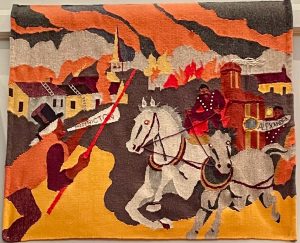
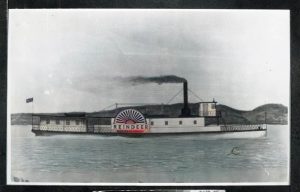
“If you're longing for fun and enjoyment
Or inclined to go out on a spree,
Come along with me over to Boiestown
On the banks of the Miramichi…”
Few hotels in New Brunswick have ever inspired their own folk song. But then, few hotels were quite like Duffy's.
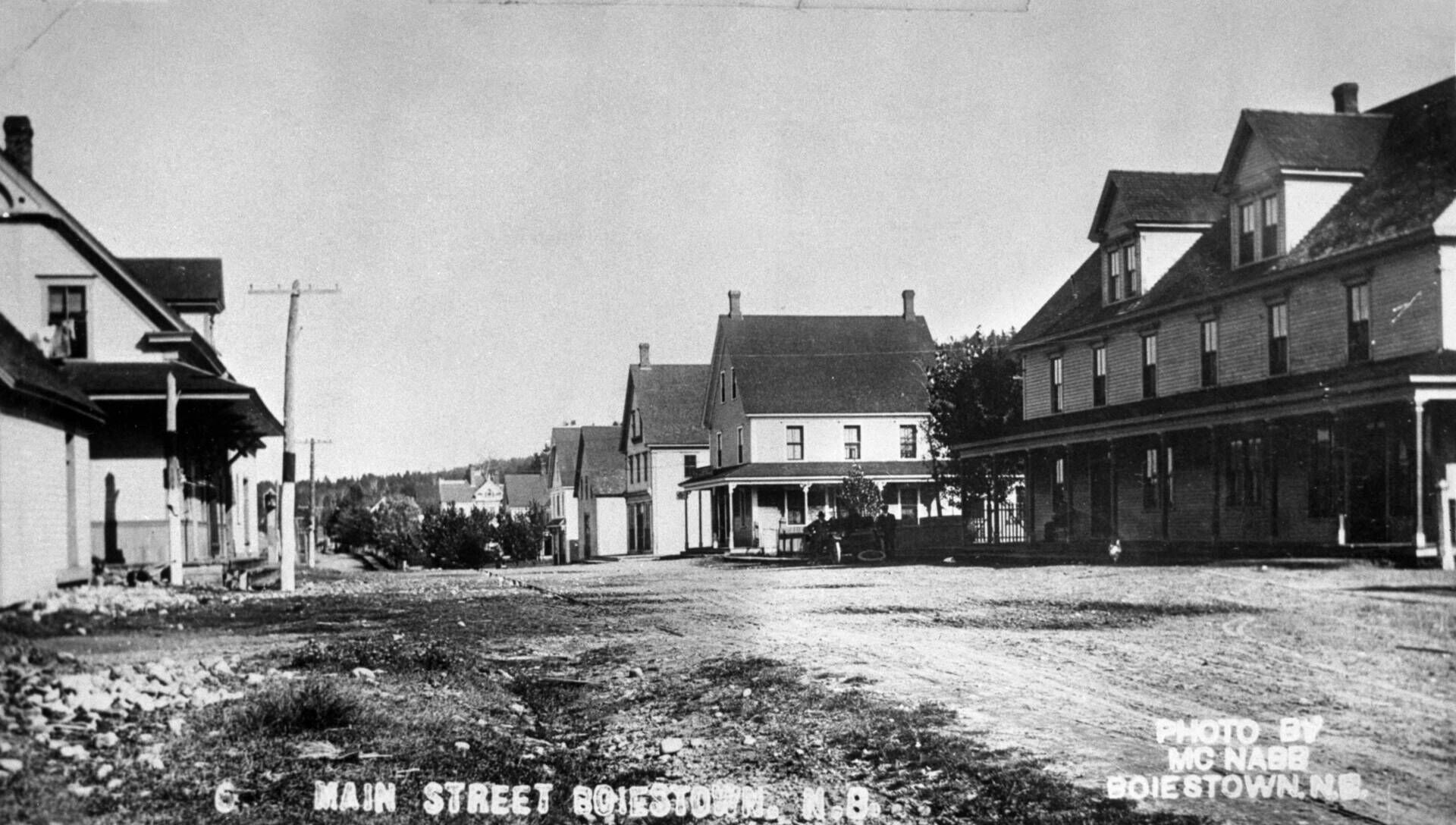
The song’s unnamed narrator hopped off a train from Fredericton on May 18th, probably in the year 1900. He didn’t arrive on the passenger train, but on a freight train, which tells us something about him. His boss, Edmund Kenney, put him up in Duffy’s Hotel, right across the street from the railway station in Boiestown, New Brunswick.
What followed was a night of chaos involving a series of drunken misadventures from one end of the district to the other. Scaring pigs in Tugtown, getting the dogs all riled up in Pleasant Ridge, and getting kicked out of Haysville. Then the narrator, along with a local character named Nicholas Delaney, crashed a house party at a mansion where, “we upset the chairs and tables/the windows and stove, too, they fell.”
After causing chaos around town, the narrator and the other curious cast of characters who boarded at Duffy’s retreated back to their hotel with a Shanghai rooster (Brahma chicken) they had inexplicably acquired over the course of the night, only to discover it had measles.
Folklorist Louise Manny wrote in her book ‘Folksongs of Miramichi’ that ‘Duffy’s Hotel’ was “a spite song … calculated to nettle all those mentioned,” though she conceded that “it is probably just a story of things that happened.”
It probably was.
Duffy's Hotel had a remarkable talent for generating stories.
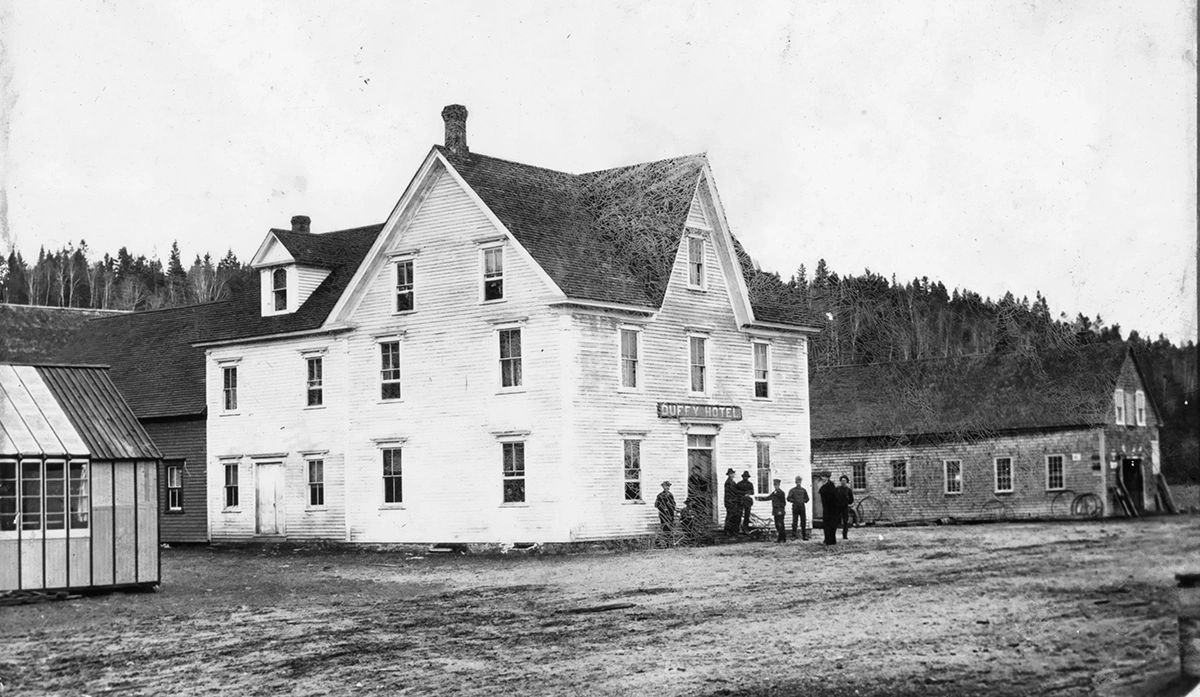
In January of 1894, someone wrote in to Fredericton’s Daily Gleaner newspaper to report what they evidently considered to be quite the scandal: they’d seen two reverends drinking with artists in Duffy’s Hotel. A week later, Reverends William Richards Jr and E. Bell wrote in to set the record straight. They had indeed been at Duffy’s, they confirmed, having “just escaped the storm,” where they encountered “certain painters who had been in the village.” Far from denying the allegations of drinking with artists, the reverends simply wanted it known that at Duffy’s Hotel, “the bill of fare was A1!”
The hotel also hosted the “Boiestown Debating Society,” which billed itself as: ‘the most brilliant debating society except for those that are better, according to the few guests capable of judging.’ Debate topics included: “Is the horse more beneficial to humanity than the cow?”; “the business viability of an evaporated (dehydrated) potato industry”; and “the possibility of an English Channel tunnel linking England to France.” (The crowd at Duffy's declared the tunnel "very objectionable on account of the extreme danger.")
By August 1893, the Fredericton Herald declared that Duffy's was "alive with agents, fishermen, tourists, and lumbermen." The railway had transformed Boiestown from a forestry village into a destination. Sports hunting and fishing were taking off, and Charles Duffy himself — a renowned salmon fisherman — and his brother William often guided hotel guests into the surrounding woods and streams.
American hunters were particularly eager. By the late 1800s, Maine had hunted caribou virtually to extinction, and American hunters were moving up to New Brunswick in great numbers to hunt. Fredericton tourism-promoter Frank Risteen wrote in the hunting magazine Forest & Stream in 1898 that “the visiting sportsman may locate at Duffy’s Hotel, right in Boiestown, and enjoy excellent caribou hunting on the plains not more than five miles away, returning to the hotel every evening.”
(That is the same Frank Risteen who, deep in the forests on a hunting trip, met a curious hermit who may have been The Real Dungarvon Whooper. That story is in Book 4.)
Locals in Boiestown did not much appreciate Risteen’s promotion, writing in to the Moncton Transcript newspaper to warn that “this invasion of canvas-backed foreigners” (meaning Americans) would wipe out the caribou in New Brunswick.
“I do not share in this view,” scoffed the newspaper’s editor.
Today, the caribou is, of course, extinct in New Brunswick.
For people who actually lived in the region, Boiestown was seen as a rather different tourism destination: it was a big draw for summer picnics. Its proximity to Fredericton made Boiestown an affordable and family-friendly day trip for people of all social classes.
Summer picnics were full-day package deals featuring a return train ticket, a meal and a brass band, all for the reasonable price of $1.
Surely one of Duffy’s Hotel’s busiest days must have been in August 1901, when a special train from Fredericton carrying "a thousand excursionists" arrived in the village. (A remarkable number considering the capital's entire population was only 7,000 at the time!)

Then, on March 24th, 1927, Duffy’s Hotel burned to the ground. The building was gone, and with it, slowly, the once popular song faded away. Almost.
Louise Manny tried to untangle the song’s history decades later. She soon found that it seemed that everybody in Boiestown claimed their relative had written it. Diplomatically, she decided to avoid tackling the question of authorship, concluding: “This song, apparently, was a joint effort.”
Manny found that most people in Boiestown were proud of the song and the shenanigans their ancestors had gotten up to. This included the Duffy family themselves, who felt the song was “great fun.”
There was, however, one exception. Nicholas Delaney's son, Bill, did not find the song about his father's antics nearly as charming as everyone else did.
This turned out to be irresistible to certain locals, including Sandy Calhoun. It wasn’t that he even liked the song; in fact, he “never thought much about the song about Duffy’s.”
Yet Sandy and several other Boiestowners took to writing in to radio stations all across the Maritimes to request ‘Duffy’s Hotel’ — “just to torment Bill.”
The CBC in Halifax turned out to be particularly receptive. Much to everyone’s surprise, Haligonians loved it. The song went into heavy rotation, finding an audience no one had anticipated in a city that had absolutely nothing to do with Boiestown or Duffy’s Hotel.
“Oh, Bill you know would just be snapping his teeth when he heard that,” Sandy Calhoun told Louise Manny with a laugh.
Duffy's Hotel
(There are many versions of this song. This version appeared in Grace MacMillan Spencer's book 'A History of Early Boiestown'. Listen to Mike Bravner sing Duffy's Hotel here!)
If you're longing for fun and enjoyment
Or inclined to go out on a spree,
Come along with me over to Boiestown
On the banks of the Miramichi.
You'll meet with a royal reception;
My ventures to you I'll relate
On the 18th of May I arrived here,
From Fredericton. Came on the freight.
I'm employed with a man, Edmund Kenney,
A gentleman who you know well;
J. P. for the parish of Stanley,
And he put up at Duffy's Hotel.
One night I went out on a party;
I tell you, t'was something immense,
We collared a shanghai rooster
And he cost us just 17 cents.
He was sick with the croup and the measles,
They said he was too poor to sell,
But I guess he made hash for the boarders
That put up at Duffy's Hotel.
One night I went out to a party
Along with the rest of the boys.
We got full of peely island;
I tell you we made plenty of noise.
We frightened the pigs up in Tugtown,
Caused the Pleasant Ridge dogs to yell;
And when we got kicked out of Hayesville
We struck'er for Duffy's Hotel.
One night I went out on a party
'Twas held in the mansion below.
A row was kicked up in the kitchen,
I tell you it wasn't too slow.
We upset chairs and tables
The windows and the stove, too, they fell.
This row was kicked up by Delaney,
A boarder at Duffy's Hotel.
Well friends, I must big you good evening
For fear you will think me a Turk.
If I linger 'round here any longer
Some fellow might give me a jerk!
I'll go back to the scenes of my childhood,
In peace and contentment to dwell;
Bid adieu to the kind of entertainment
I met at Duffy's Hotel.