You're cruising down a New Brunswick road, windows down, thinking about lunch, when suddenly — there it is. A giant concrete potato, rising out of the earth like some sort of carbohydrate monolith. No sign, no explanation. Just you, the road, and Mr. Potato Man.
The Big Potato (as Mr. Potato Man is commonly known) calls Maugerville, NB, home. However, oversized roadside attractions like this are scattered all over New Brunswick.

From Doaktown’s Bruce the Moose to Campbellton’s statue of Restigouche Sam the salmon; from Nackawic’s Giant Axe to Plaster Rock’s Giant Fiddleheads; from Harvey’s Giant Fiddle to Saint-Quentin’s Giant Maple Leaf, Caraquet’s Giant Conch, Blackville’s Giant Fishing Fly, and so many more — our province is packed with surreal oversized icons that are equal parts folk art, tourism bait, and town pride.
Several of these concrete colossi all came from the same man: Winston Bronnum.
Born in New Denmark, NB, Bronnum was carving animals out of wood as far back as he could remember. His teachers weren’t fans — he was kicked out of Grade 3 for carving a horse into his desk.
After serving in the Royal Canadian Air Force during the Second World War, he spent some time in Ontario. By 1951 had earned enough recognition to work as a full-time artist. His preferred medium was still wood, despite his school’s earlier disapproval.
Like many artists, he struggled financially at first. The Canada Council repeatedly turned down his grant applications. “They said, ‘You’re too young, you’re not responsible,’” Bronnum later told journalist Barbara Scott. “I never forgot it.”
Determined to make it anyway, he took his talents on the road — literally. He carved live at Bill Lynch's travelling circuses. His flair landed him gigs at iconic venues like the Canadian National Exhibition in Toronto, the Royal Winter Fair, and even the Waldorf-Astoria Hotel in New York.
When he returned to New Brunswick in the 1950s, he opened a studio in Fredericton. At this point, he was still carving wood. In 1953, he carved life-like models of potato varieties, which so impressed the federal government that “The Bronnum potato samples will be used by inspectors and potato men to show farmers how to select their tubers,” reported the Telegraph-Journal. (What exactly “potato men” were, they didn’t say.)
Then came disaster. In 1954, a fire destroyed his Fredericton studio. His tools, carvings, and a three-year stockpile of wood all went up in flames.
So he pivoted to an artistic medium that was much less flammable: concrete.
One of his earliest giant roadside creations was Mr. Potato Man, which he built for his old wartime flying buddy Karl Harvey. He used 75 bags of concrete to build the Big Potato for Harvey’s roadside vegetable stand. Both the stand and the statue can still be found on Route 105, just outside Fredericton.
Years later, by the 1970s, he had built a wildly successful concrete-animal-statue industry for himself. “Now he is one of the best-known sculptors of wildlife in Canada and the winner of more prizes than he can remember,” wrote reporter Jackie Webster. She went to visit him at his studio/amusement park located just outside of Sussex: Animaland.
“At Animaland, he is in the unique position of doing exactly the kind of work he wants to, and the results are happy for everyone,” wrote Webster as she arrived at its gates. There she spotted “a somewhat broken down, but still gallant, albino aquine, which has become a New Brunswick Institution:” Blowhard.

“The heart and spirit of the unusual horse shine plainly through,” wrote Webster. “Old Blowhard has been called a ‘comic caricature’ in tourist blurks. That’s not true. Anyone can see he was once an equine of great capability and promise, just somewhat down on his luck at the moment.”
While Blowhard was stylized, other animals were “remarkably lifelike.” Webster watched as a visiting tourist screamed at the sight of a skunk, only to discover it was one of Bronnum’s statues. Later that day, she saw the same tourist scream again after trying to pat what she thought was another statue — a white bunny — only for it to hop away.
Bronnum told Webster that most of his massive, expensive creations began the same way: with no sales plan and no buyer. Just a gut feeling, and boundless optimism.
“If I wasn’t optimistic, I’d never get anywhere,” he said. “You get a gut feeling for something, and there is only one way to go and that’s ahead. That’s how you make things happen.”

Just then, a tourist from Fredericton wandered over and said he’d bought one of Bronnum’s hand-carved wooden lamps years ago — for only $18.
“They’d sell for $200 now,” Bronnum laughed. “If I had the time to carve them.”
Bronnum passed away in 1991 at just 62. Animaland sat abandoned for years but was reopened in 2016. His statues can once again be visited along Route 117.
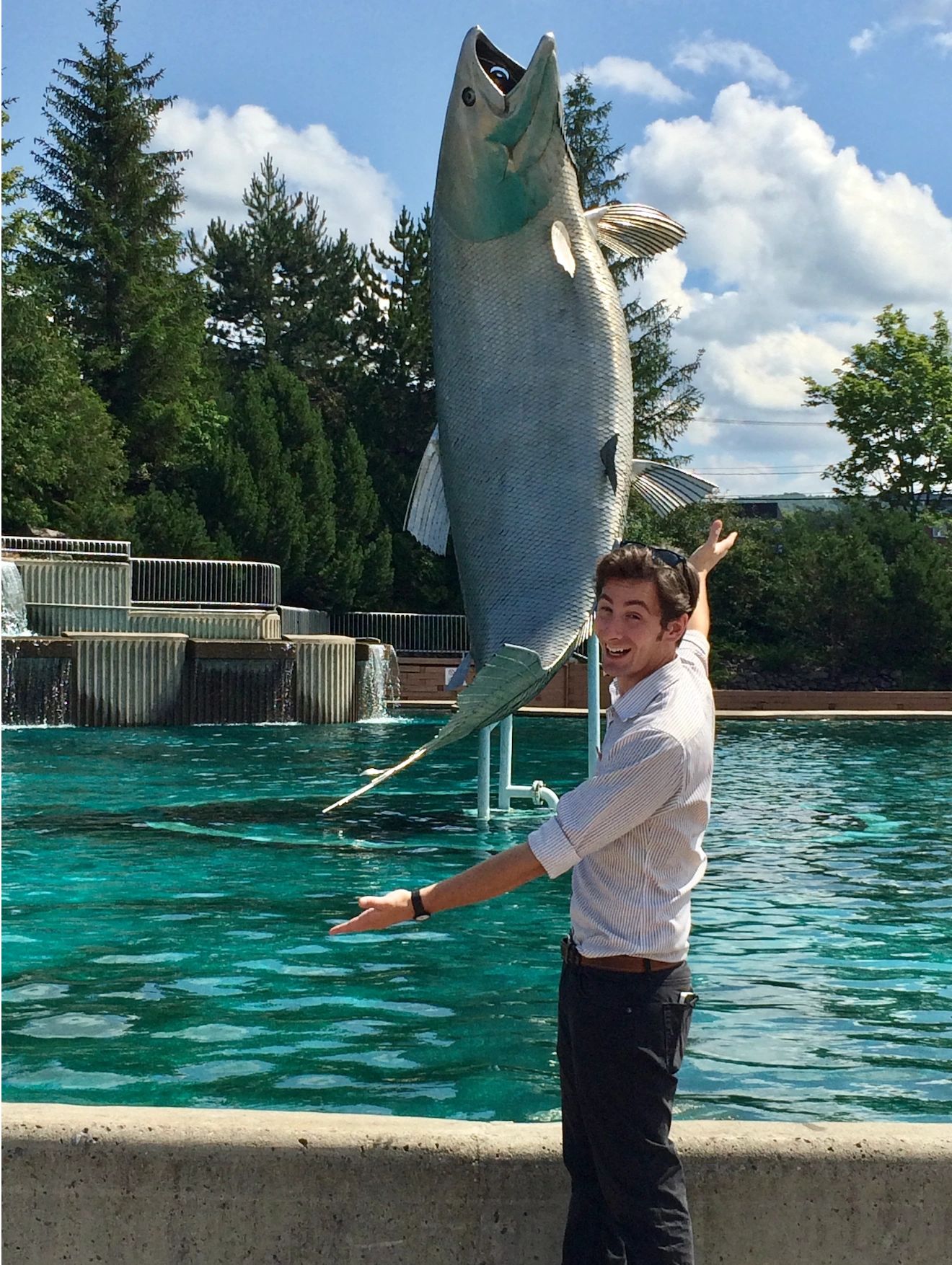
New Brunswickers likely know Bronnum’s work through Shediac’s Giant Lobster. It had, in turn, been inspired by yet another local attraction — Restigouche Sam, the giant silver salmon in Campbellton.
After Campbellton’s Rotary Club unveiled the statue in 1985, Shediac’s Rotary Club got jealous and decided to build their own oversized sea creature. It’s eyewatering pricetag — $400,000 — was paid for with proceeds from bingo.
When the Telegraph-Journal asked him why it cost so much, Bronnum just shrugged. “People think an artist works for little or nothing,” he said. “This lobster is going to end up in the Guinness Book of World Records as the biggest lobster sculpture in the world.”

He was right. At nearly 11 metres long, the Giant Lobster still welcomes an estimated half a million visitors a year.

So the next time you’re cruising down a rural New Brunswick highway and a giant potato looms into view, don’t just laugh and keep going. That lumpy giant tuber — or lobster, or moose, or axe — is part of a bigger story. A story of small towns, big dreams, and the kind of cheerful ambition that shaped a province’s landscape in concrete.
Yes, the reporter who interviewed Winston Bronnum in this article, Jackie Webster, was related to THE Websters: