One decade before becoming a province in Canada, in 1857, a 94 page booklet was printed and widely distributed in Europe to prospective immigrants in Scotland, England and Ireland. Its goal was to honestly show what daily life was like at the time.
At that point, the ship ride across the Atlantic would take an average of 36 days. New Brunswick had passed a law requiring ships carrying immigrants to bring enough water and food to last 70 days. Ships were also legally required to keep providing food, water and shelter to immigrants for 48 hours after arriving.
However, these laws were difficult to enforce, and certainly did not stop poor conditions on the immigration ships.
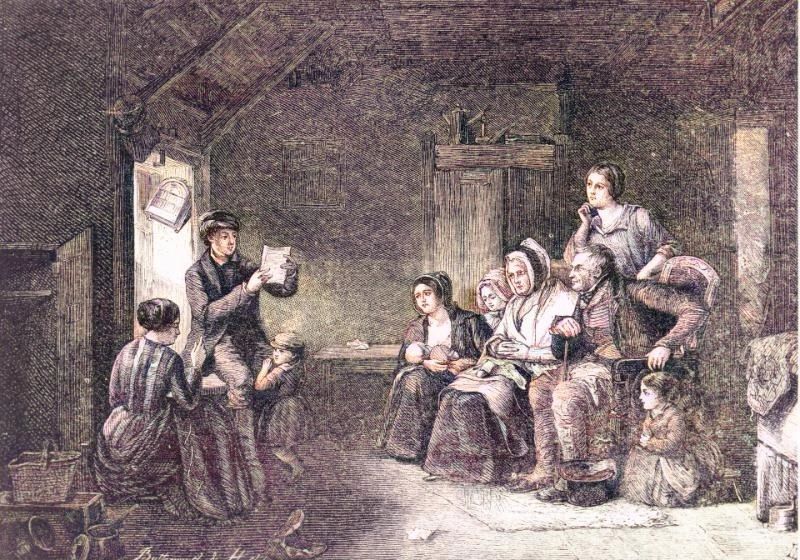
John Jackson was bound for Saint John from St. Lewis, Ireland in 1850 with his sister, Salley. On the ship over, both caught a fever. Immediately after arriving in the Port City, he paid for her to go to the hospital, while he “took a chance by myself.”
He spent three weeks ill in bed before going to the hospital to look for Salley.
He learned she had died only three days after arriving in New Brunswick.
“When they told me she was dead,” he wrote in a letter to their parents “I was sent to the hospital for ten days, and took to my bed for three weeks.”
Upon arriving, the immigrant had to pay the immigrantion tax of 2s. 6d. They would also have to pay an eye watering £75 bond to the government, which was reimbursed if they stayed 3 years. Even the Hand Book suggests this bond was usually waived. The reality was that many immigrants were arriving with very little money at all, and certainly not nearly enough to pay such an enormous sum of money.
The pamphlet omitted that once they arrived in Saint John the immigrant would often end up living in the rough parts of the city which were dirty, overcrowded and unsanitary.
John Jackson, after recovering from his sister’s death, certainly didn’t describe Saint John that way though. He wrote home saying: “this is a fine country. You get farm shares here and it’s very easy to labour in this fine country. Everything is very cheap here; beef one cent per pound, butter 14 cents … a man can live very easily with a family.”
However, mindful of what happened to Salley, he cautioned his family back in Ireland: “I would like to encourage you to come to this country but fear that if something happen to you family in your journey I would never forgive myself.”
Immigrants were encouraged to move to rural areas because “for the last two years farmers have suffered from an inadequate supply of agricultural labourers and female domestics.”
A lengthy list was provided of jobs that needed workers, including manual workers and tradespeople, unskilled labour, women workers, and even child labourers. “Boys from 12 years of age are greatly in demand by farmers and mechanics,” the Hand Book noted.
Women were expected to work as well, being particularly sought after to do domestic work in smaller towns, where they often would work as servants.
The work available varied widely though, and some women experienced a degree of mobility, freedom, and opportunity they wouldn’t have in Europe.
In a 1853 letter to her brother in Fredericton, Mary Maddox proudly recounted how their recently arrived younger sister was faring: “I want to let you know how Bridget lives. She is a tailoress and makes nothing but fine coats. She pays her board and rent for me as well and also society bills. She helps with two societies to help the poor.”
The Hand Book’s author, Moses Perley, described New Brunswick’s education system with pride: “Few countries in the world, in proportion to population and income, devote so large a sum to the education of the rising generation.” He noted that in 1853 the province was home to 744 schools, attended by 24,127 students, or as he called them, Scholars.
The Hand Book explained to prospective immigrants how money and banks worked – at that time New Brunswick had its own currency, the New Brunswick pound. He noted that the interest rates for savings held in banks was 5%, while there was a legal cap on interest rates lenders could charge which could not go higher than 6%.
Some intriguing details about how New Brunswickers lived are included. Maple syrup –something the Europeans wouldn’t have heard of– was described as “like molasses, but far superior.” The Hand Book remarks that most people would mix raw maple sap in hot beverages, much like how people today use sugar, saying “all classes of society daily make use of it in coffee and tea.”
New Brunswick’s fauna and flora was quite different back then, too. The Hand Book listed off the plentiful wildlife in pre-Confederation New Brunswick. Some of the animals it says were common aren’t found here anymore, like wolves, elk, and caribou.
Notably, it is stated that “the passenger pigeon visits the Province in great numbers.” Those birds which once travelled in massive flocks numbering into the millions are now extinct.
As for that stereotype of early settlers arriving to carve out a farm in an untamed forest, well that was actually strongly cautioned against: “endeavouring to make a farm in the wilderness will be almost certain to waste his means. No immigrant should undertake to clear land unless he has the means to support his family for 12 months.”
The immigrant didn’t expect it to be easy, though.
In 1837, Thomas Hughes wrote his son Laurence, who was immigrating to Fredericton from Newry, Ireland about what he might expect: “He must rise at 7 in the morning and attend to business up to 11 at night. He must be cheerful, humble, pleasant and agreeable. He must at every opportunity endeavour to improve himself. Keep clear of whiskey and give no credit.”
Thomas hoped Laurence would save up £100 working in New Brunswick and return to Ireland to buy the family a house in Belfast.
Laurence, like many immigrants, never returned to his old country, and never saw the family he had left behind again.


