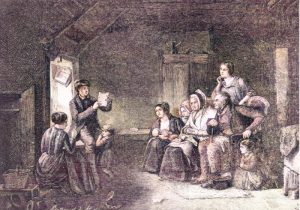
Sir James Alexander was a world traveler who had been from India to America, from Egypt to China. In 1844 he spent months traveling all over New Brunswick.
Alexander had come to New Brunswick to work. The British aristocrat was normally financially carefree, but due to an economic downturn at age 39 he had to get a job. He joined a crew of surveyors planning a road going from Halifax to Quebec.
He was arriving from Quebec, where he complained at length about the poor roads. Upon arriving in Madawaska, however, he discovered: “strange as it is to say, there were no roads at all … the River was the road, and the canoe the means of transport.”
Upon his arrival in “L’Acadie,” (what he called The Maritimes), he was given a surveyors outfit: a grey felt hat which he thought “looks like a Spaniard’s”, red flannel shirts, Breechcloth leggings (soft leather pants with soft moccasin-like feet attached, preferred by Indigenious peoples), boots, moccasins, a heavy overcoat, as well as a gun, knives, a tomahawk, matches, a lamp, veils to keep mosquitos at bay, a rolled up blanket, fish hooks, several red sashes.
Alexander made his way towards Grand Falls on “the noble stream” which was interchangeably “called the St. John’s or Walloostook River.”
He wrote that at Grand Falls the water “thunders over a precipitous into a deep basin seventy feet below, banks overhung with woods, vapour-clouds stretching across the river.”
“The Grand Falls are well deserving of a visit from the American tourist” he mentioned “and here will probably soon arise a city.” At the time there were only 5 houses there, including an inn named Costigan’s.
Inside Costigan’s he found “rough lumberman having a drink that turned into a spree … [they] talked loud, sang, drank, and tried their strength by putting a heavy stone in front of the door.” He noted that they all wore red flannel shirts, remarking “there is a virtue in the dye of red”. He also observed that they wore moccasins, which they would use as napkins when they ate.
On his way to Woodstock he met a woman who told him that for ten months of the year she would not see her lumberjack husband at all.
Departing the inn he stayed at in Woodstock, he overheard someone say: “I am glad that I am not a gentleman because the landlady charged him twice as much as she did me, for the same food and lodging!”
He went to Fredericton, home to only 4000 people, which he described as having “regular streets, and houses made of brick, excellent gardens, very pleasant and cheerful, whilst an air of quiet and peace prevails; in short, it is just the place where a susceptible bachelor might like to marry.”
Alexander then took a steam ship from Fredericton to Saint John – which he spelled “St. John’s.” Along the way he remarked “the banks of the river were rich and well cultivated with comfortable houses where sixty years ago there was not one.”
Though Saint John was by far New Brunswick’s largest city, home to 30,000 of the province’s 120,000 inhabitants, Alexander had few comments on it, other than to say it had “suffered much from recent fires.”
He spent much of his time in Saint John bickering with the owner of the hotel he stayed in, who doubled his room prices compared to other guests. In the end Alexander got his bill reduced, but the owner banned him from the hotel’s restaurant as revenge. “Rather absurd,” he snorted.
He described Sussex as having “beautiful wooded ridges, rich land, and abundant water.” Perhaps the water was too abundant – he noted that farmers drove large poles into the ground and around them “hay was heaped in stacks, to prevent it from being carried off by the periodical floods.”
As the survey crew traveled through Boundary Creek at night, their horses bolted, knocking them off the wagon. A local farmer tended to them by applying hot brandy to their injuries.
Alexander stayed for three days waiting out a storm in a village on the Petitcodiac River he called The Bend, which he described as “a civil place with civil people.” He jotted down the latitude and longitude of the inn he stayed at – it was exactly where Champlain Place Mall stands today.
Six men would accompany Alexander as he surveyed his way towards Miramichi, carrying 17 loads of equipment. They started their days at 5am and worked until 5pm, cutting a path through the bush the whole time. “The anxious inquirer may now ask how many miles we got over in a day,” Alexander wrote “and will doubtless be surprised to hear that a mile and half a day was considered a fair day’s work.”
“We were never free from some kind of flies or another,” he complained, noting that they could not button their shirt sleeves because their wrists were so swollen from fly bites. The surveyors smeared their faces in leftover pork grease to keep flies off. “They did not look very prepossessing,” Alexander commented.
Alexander wrote that many lumberjacks painted their faces black with tar to keep the flies off, but hinted that there may have been a racist subtext to that as well. He would recount several incidents in which he witnessed lumberjacks harassing Black New Brunswickers, including sneaking chewing tobacco into the tea of an old ladies’ church group, and putting hot coals down a man’s pants.
As they surveyed deep in the woods, sometimes people from The Bend would trudge vast distances to check on them and bring them food. They told Alexander that everyone in The Bend was praying for them. They seemed keenly aware that the road would turn their small village into the large, vibrant, central hub city that Moncton is today.
When Alexander’s crew finally emerged from the woods in Miramichi months later, the first people they encountered were a group of children picking blueberries. The kids ran away screaming at the sight of the beleaguered surveyors.