
Let’s take a look at how Maritimers celebrated Christmas 100 years ago!
By 1924, The Maritimes were finally emerging into the prosperity of the Roaring Twenties, after an exceptionally slow economic recovery from the First World War.
The optimistic and buoyant mood was reflected in the fashions. The hottest clothes that Christmas were bright pastel colours, which Hortense Saunders, fashion writer in the Telegraph-Journal, approvingly described as “having the charm of strawberries in January or any other unseasonable and highly expensive delicacy.”
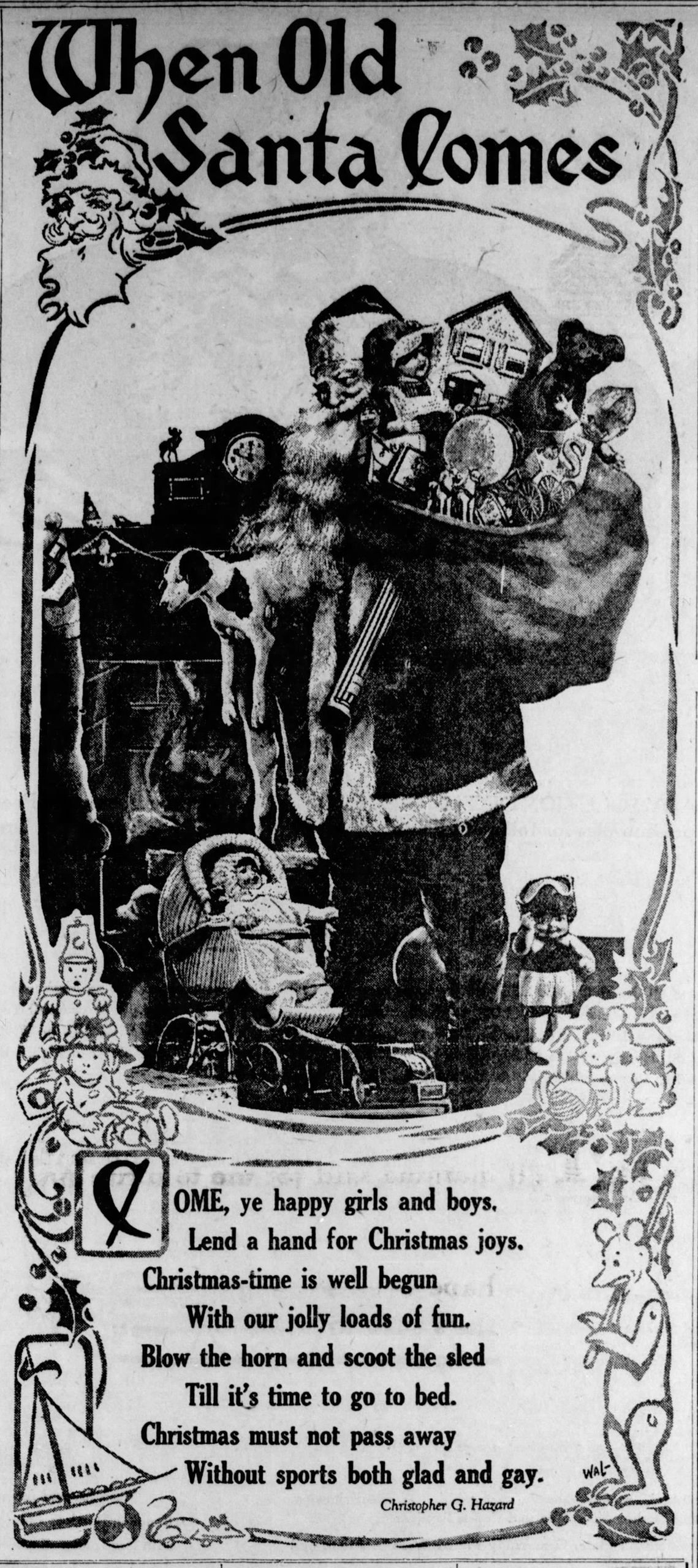
Of course, the most famous person dressed in red at Christmas was Santa Claus. Newspapers reported on Christmas Eve that he was on the move, having been spotted in a tiny town in Alaska where he “appeared on the main thoroughfare in a sled loaded with Christmas presents and drawn by a real reindeer.”
Inside of Santa’s sack 100 years ago was unquestionably the hottest children's toy of 1924: the bicycle.
Although bikes had been a huge fad for the preceding two decades, they had been largely for adults. The new idea that small bicycles could be marketed to children was a hit: kids had gone absolutely bonkers for bikes! Bicycles would remain by far the most asked-for children's Christmas present for years to come.
While kids wanting bicycles isn’t exactly surprising, the must-have gift for adults in 1924 will likely shock modern readers: dictionaries.
A North American dictionary shortage loomed over Christmas a century ago. Desperation for dictionaries reached such heights that stores ran pleading ads telling the public to stop asking for dictionaries because they had run out.
Dictionaries weren’t the main gift though. They were merely an accessory to the real craze of 1924: crossword puzzles.
The public’s passion for crossword puzzles was so great that the word games were considered a menace.
Religious leaders denounced crosswords.
Elected officials worried about crosswords’ effects on public morals.
“The world stands at a crosswords!” wailed the Telegraph-Journal.

The newspaper quoted librarian Charles McCombs declaring that dictionaries were banned for crossword use and were only allowed to be used for “legitimate reference purposes.” McCombs grumbled that the world was in “a deplorable state” when a library had to resort to such measures because of frivolous games like crosswords.
The Telegraph-Journal consulted psychologist Dr. A. A. Brill about the crossword craze. He felt that the phenomenon showed that, by 1924, technology had made life too easy. “We live in an era when man has things handed to him without effort,” explained the psychologist. “Things are all ready made. The mind demands exercise.”
Indeed, plenty of exciting new home technologies including ovens, fridges, electric heat, and stoves made life much easier that Christmas.
New Brunswick's government had been an early and enthusiastic adopter of electrification. By the Christmas of 1924, a vastly higher proportion of New Brunswickers would have enjoyed the benefits of electricity than anywhere else in Atlantic Canada.
Moncton, however, would have a dark Christmas that year. At 8:45 that morning, a tree fell on a key powerline, knocking out the city’s electricity. Power was restored at 2:45 that afternoon.
The return of lights, electric ovens and fridges right before Christmas dinner must have caused a wave of excitement across the city. Unfortunately, only fifteen minutes later, a second tree fell, knocking out the electricity again. Power was not restored in Moncton until the next day.
The Moncton blackout was caused by miserable weather that Christmas Day.
“Snow began to fall in a desultory way,” began a bizarrely-written weather report in the Telegraph-Journal, "by noon it made up its mind to become a real snowstorm … then by afternoon it decided it might as well turn to rain … making for a miserably sloppy Christmas.”
In Yarmouth, NS, there was a Christmas miracle during that storm.
Locals feared the worst when they spotted a tiny open fishing boat floating adrift as the snow fell. They assumed it belonged to Irving Driscoll and his young son, who had gone out to check their lobster traps on Saturday and had not been seen since.
When the anxious locals reached the boat, however, they found the father and son alive and well. They had suffered engine problems and had survived by eating raw lobsters.
In Halifax, residents made the most of the Christmas storm, pouring out of their homes and turning the icy streets into a giant slide “some two feet in width and 25 feet in length had been cleared of every vestige of sand and offered a wonderful opportunity for sliding,” wrote one newspaper.
A second, less fun, Halifax paper grumbled that the giant slide was “a wonderful chance to break a leg.”

Many Frederictonians would not have been dining on turkey that Christmas.
An unfortunate side-effect of the robust new economy was that the price of groceries had shot up dramatically. Fredericton’s Daily Mail newspaper gasped that “chickens sold as high as forty cents per pound; geese at thirty-five cents and turkeys were scarce at fifty cents.” (In today’s money, those turkeys would have cost more than $10 per pound.)
Despite the high prices, turkeys sold out everywhere, sparking a flurry of frenzied Frederictonians “rushing for Christmas poultry which was not to be had.”
Another exciting new technology was the radio, which was affordable enough by 1924 that virtually every Maritimer owned one. That Christmas evening, many gathered around the radio to hear a hockey game in a new league called the NHL. As they listened, the Montreal Canadiens trounced the Boston Bruins 5-0.
That Christmas night in Burton, NB, eighty-six-year-old James Guthrie announced that it was “the happiest night of my life.” For the first time, he was surrounded by his entire family, including his thirteen children (among them the celebrated war hero, Col. Percy Guthrie), his 25 grandchildren, and his 20 great-grandchildren.
The Guthries filled his home with laughter, warmth, and the joyous chaos of Christmas cheer.
After feasting together, James Guthrie retired to his room, fell asleep, and peacefully passed away — leaving this world on the happiest night of his life.
MORE CHRISTMAS BACKYARD HISTORY ARTICLES:
- Santa and The Flaming Christmas Tree Incident
- T'was The Night Before Christmas Maritimes' Connection
- Snapdragons: The Hottest Game of Christmas Past
- Before Santa Claus There Was The Queen of the Fairies
- Christmas 1868 In Their Own Words
- The First Christmas In North America
- A Halifax Christmas Murder Mystery
- Santa's First Appearance In The Maritimes
- Claus-trophobia & Santa's Other Misadventures


