
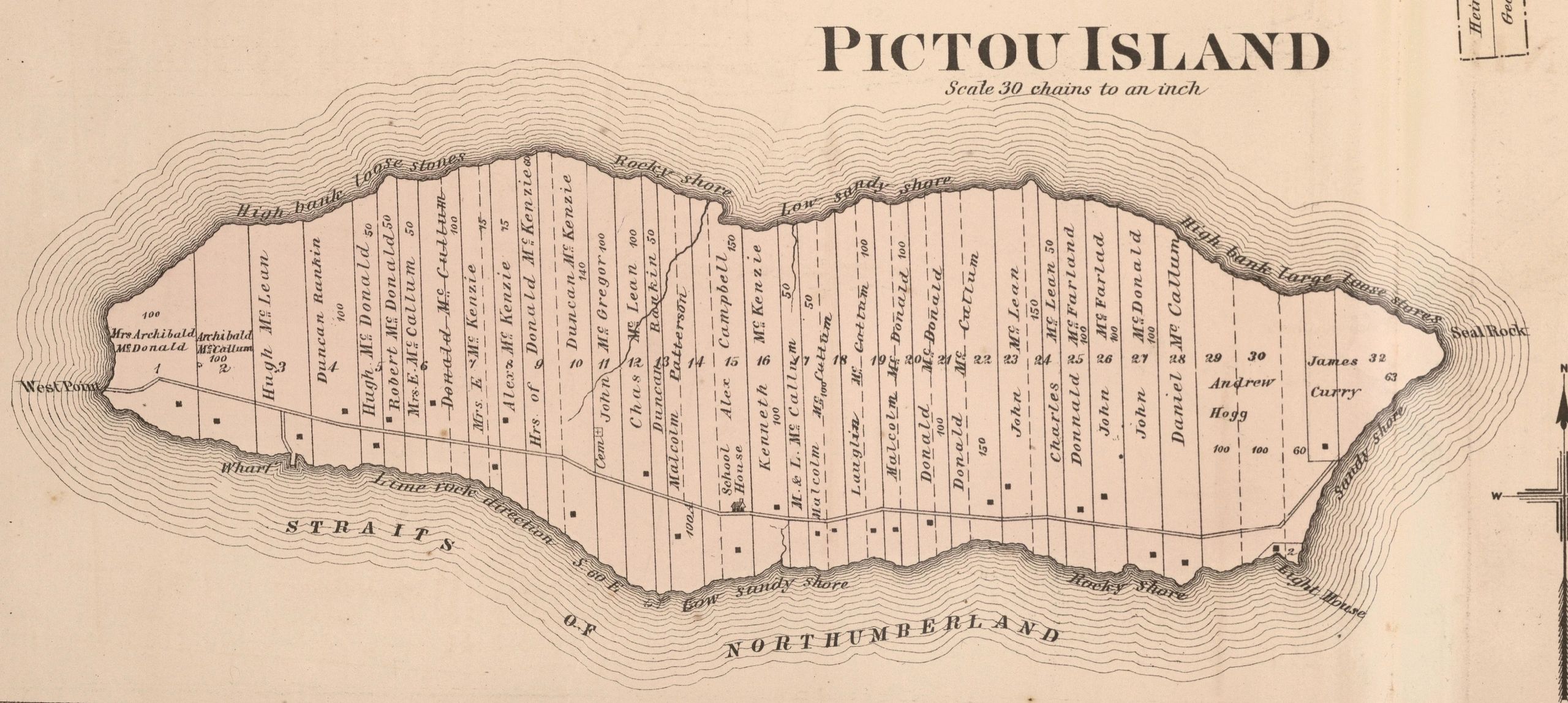
Pictou Island, Nova Scotia, is so isolated that even today it still does not have electricity. It once hosted a theatre production, though, albeit in the most dramatic of possible circumstances. After a comedy troupe’s ship had gotten stuck in the ice, they’d trudged to the island to seek shelter…
As storm clouds gathered on February 25th, 1907, passengers boarded the Stanley, a winter ferry departing Georgetown, on Western PEI, bound for Charlottetown.
The forty passengers climbing onto the ship made up a remarkably diverse group with little in common. They included the Abegueit hockey team, the Jere McAuliffe Comedy Company, numerous lumberjacks and “six young ladies.”
Just as the ferry set off, a fierce winter storm blew in. “There was such a gale blowing that one could only see a few yards from the steamer,” Comedy Company member Col. Willard G. Stanton later told the Moncton Transcript.
It had been an unusually long and cold winter, and much of the Northumberland Strait was frozen. The Stanley was blown badly off course, soon finding itself trapped in the ice.

Surrounded by piles of ice, the ferry, which had been planning on following PEI’s coastline as it made its way from one part of the island to its capital, instead drifted off into the Northumberland Strait.
When dawn’s light broke the next day and they surveyed the scene, the captain was horrified. The ice had piled up so high that it had, according to the Halifax Evening Mail newspaper, “almost laid her on her beam ends, breaking all the rail on the port side … the situation became serious.”
The saga would later capture headlines from Ontario to British Columbia. There, newspapers reported the tale as a desperate battle of men and women in a horrific situation, fighting for their lives. They compared it to the disastrous voyage of Norwegian explorer Dr. Fridtjof Nansen, who got stuck in the Arctic for three years.
Those Western newspapers, though, also reported that the events had occurred in New Brunswick. They had, of course, actually taken place on PEI and an island in Nova Scotia that is close to New Glasgow, suggesting that Canadians didn’t necessarily know much about The Maritimes’ geography, let alone how its people deal with crises.
Those who were there told a very different tale. The plucky Maritimers were totally unphased by the ice piling up over the boat. “Some got skates from their trunks and were playing hockey and having a good time generally on the ice,” recounted Col. Stanton.
The passengers set up a makeshift bar, Stanton said, “and we had a great time!”
The ice showed no sign of relenting, and they had to spend Monday night on the ship.
Tuesday rolled around, and they were still stuck. “We got a gramophone working,” said Stanton, “and afterwards got one of the crew up with a violin and were dancing until midnight. … we had races on the deck, up one side and down the other … even the ladies participated!”
A third day rolled around. The comedy troupe organized a mock trial, with all the passengers participating in the makeshift production. “It was comical,” said Col Stanton, “to see some of the rigs the passengers got up for the occasion.”
Then things got bad. The ice began to move in, squeezing the ship. It looked like the Stanley would be crushed between sheets of ice.

Several miles off in the distance, they could see the isolated Pictou Island. It was, according to the Saint John Evening Telegraph newspaper, “about two miles long and about 100 yards wide. About twenty families live there, and it is not likely that the accommodations were at all adequate for the sudden influx of population.”
They would have to make a perilous crossing of the Northumberland Strait to reach safety.
They stripped the beds of all their sheets and blankets, piling them high atop the young ladies who then got into the ship’s rowboat.
The lumberjacks, hockey team and comedians then dragged the boat five miles over rough and jagged ice to reach the safety of the island.
It took six hours to make it to firm land. Col. Stanton recalled that “it was a hard tramp … over iceflows that would make your snowbanks look like bunkers on the golf links!”
The comedy troupe managed to maintain their sense of humour, though, deciding that their precarious ice crossing reminded them of the vivid scene in Harriet Beecher Stowe’s novel ‘Uncle Tom’s Cabin’ where the slave Eliza escapes with her baby from her captors and their dogs by hopping from block of ice to block of ice until she reached safety.
“If we were to put on Uncle Tom’s Cabin,” quipped Col. Stanton, “there’s not a man or woman in the company who would not be able to play with startling realism the role of Eliza!”
“That is,” he added, “all except myself. I had mine! While on the way from the Stanley to Pictou Island … I fell down one side of [the ice sheets] into the raging main and came up on the other side of another one. I was mixed in with the scenery for a few anxious moments, I can tell you!”
As the curious convoy crossed the ice, they were spotted by the people of Pictou Island. By the time they made it to shore, they were “welcomed by a number of families, who provided [hot food] and shelter for them,” wrote the Evening Telegraph.
They ended up spending the next seven days and nights on little Pictou Island in the company of the local families, most of whom fished for a living.
To thank the locals for their generosity and hospitality, the comedy troupe decided to put on a show. Never before had any kind of theatrical performance been held on Pictou Island.
The performance would be held in the island’s only public space — the post office. The comedians had left all their costumes, props, and scenery aboard the Stanley, so, much to their chagrin, they had to perform in their street clothes.
On the Monday — a full week since their ship had gotten stuck — the performers gave what the Moncton Transcript called “the first-ever theatrical performance ever given on Pictou Island.”
Several of the hockey players and lumberjacks were missing. Not seeing any sign that anyone had noticed they were missing, they set off to walk back to the Nova Scotian mainland by themselves.
Finally, two days later, on March 10th, an icebreaker arrived to collect the marooned passengers from Pictou Island.
Col. Stanton praised the comedians for braving the treacherous frozen waters, reminding readers that normally actors “don’t care too much about ice unless it’s in champagne!”


