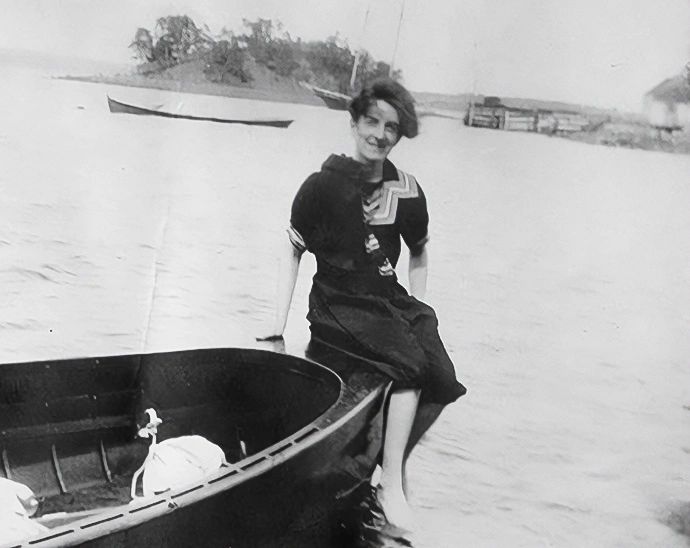
For seventeen years, Clara Dennis avoided going home. When she finally returned in 1934, she did so with great trepidation. Though her homecoming was on her own terms — she had by then made her name as an internationally famous travel writer — she soon found herself haunted by her hometown of Halifax.

She had left home right after the Halifax Explosion.
Her signature writing style placed her at the centre of her stories, which she typically told in the first person — travel stories of a young woman going on adventures alone all over the world. Yet she rarely revealed much about herself in her writings. Her large and devoted fanbase of European readers was almost certainly quite surprised when she casually revealed that she had been a Nova Scotian all along.
It had come up seemingly out of the blue in an article when she remarked, “I chanced upon a map of Nova Scotia. What a warm glow came over me at the sight of the familiar, odd-shaped little Province by the sea — my own, native land.”
Seeing that map got her thinking.
“How little I really knew about my own Province. How much I did not know. Then and there was born the resolution to seek to find Nova Scotia.”
She decided to embark on a solo road trip through Nova Scotia, which she would later turn into the international bestseller ‘Down In Nova Scotia’.
But writing the book meant returning to Halifax — and confronting her past.
Clara Dennis had grown up there in a life of relative privilege, with successful parents who had wildly different — and very public — political views. Her father was a Conservative senator, while her mother was a high-profile progressive reformer and fighter for women’s rights.
Clara’s idyllic youth came to an abrupt end on December 6th, 1917.
That day, the ringing of the fire bells had caught her attention. She stopped in the street and watched as a horse-drawn fire engine raced towards Halifax’s harbour. In the distance, she spotted a burning ship.
“It was a wonderful sight,” she remembered. “Beautiful, blue-green flames leaped high and grey smoke billowed overhead. No one would have dreamed that those blue-green flames would presently release a tremendous power for destruction.”
“But it was so. Even while they looked on, a terrific explosion occurred, plunging a city into death and a continent into tears.”
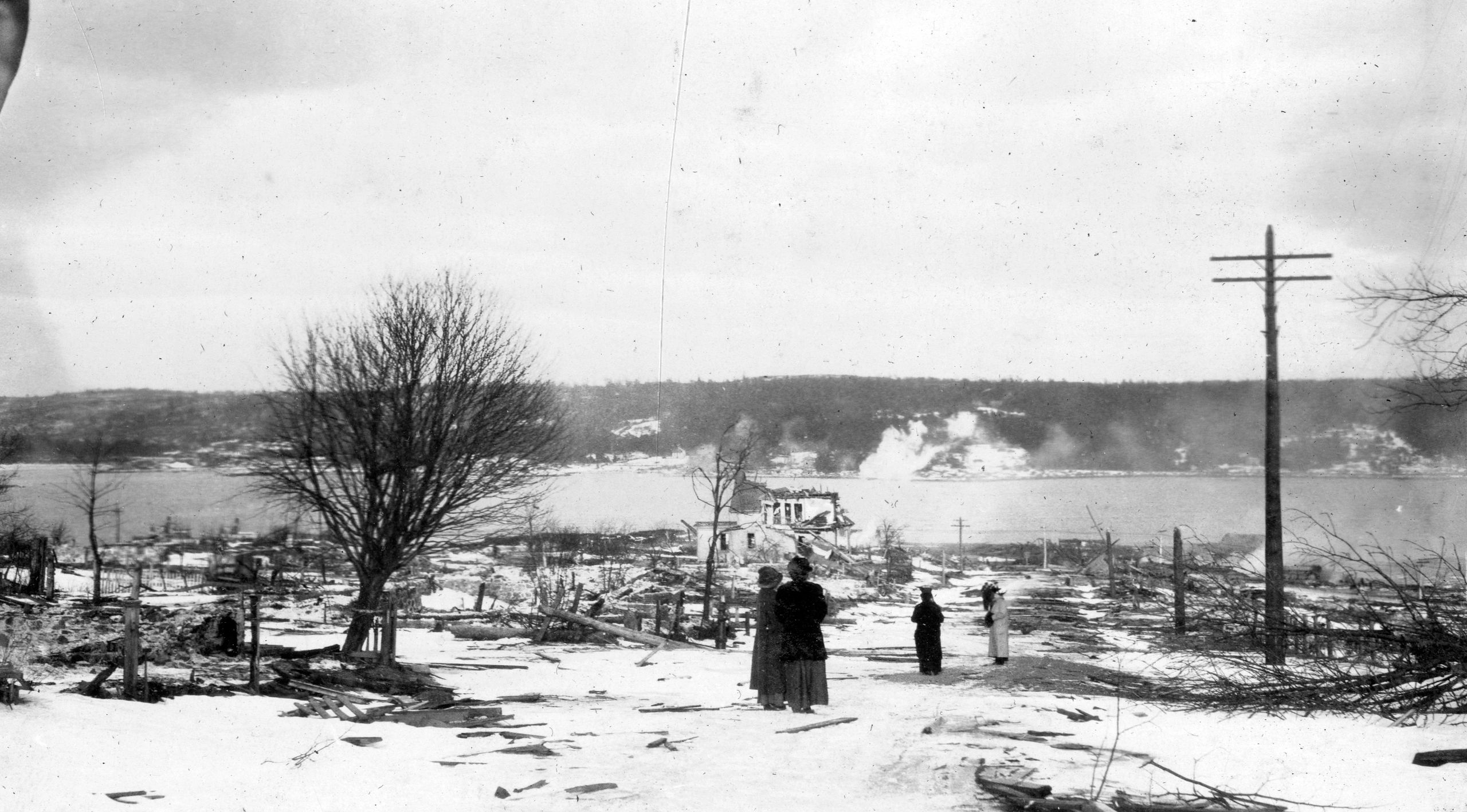
The Halifax Explosion remains by far the worst disaster in Canadian history. It left 1,782 people dead and an estimated 9000 injured. It flattened the city, setting off a humanitarian catastrophe on a scale Canada has never experienced before, or since.
Young Clara Dennis stood, unmoving, as the blast flattened her hometown, sparing her.
The fire truck she had seen race toward the harbour was hurled through the air by the explosion. It crashed down near her. The two black horses pulling it lay dead in the street. A severed hand, still gripping a piece of the fire engine’s steering wheel, landed at her feet.
Around her, she wrote, the city she had grown up in was destroyed:
“The streets I had been wont to travel had been entirely wiped out. The happy homes that had lined those streets were now but heaps of matchwood. … The trees were all gone. Not a single landmark of any description remained. All was desolation and destruction.”
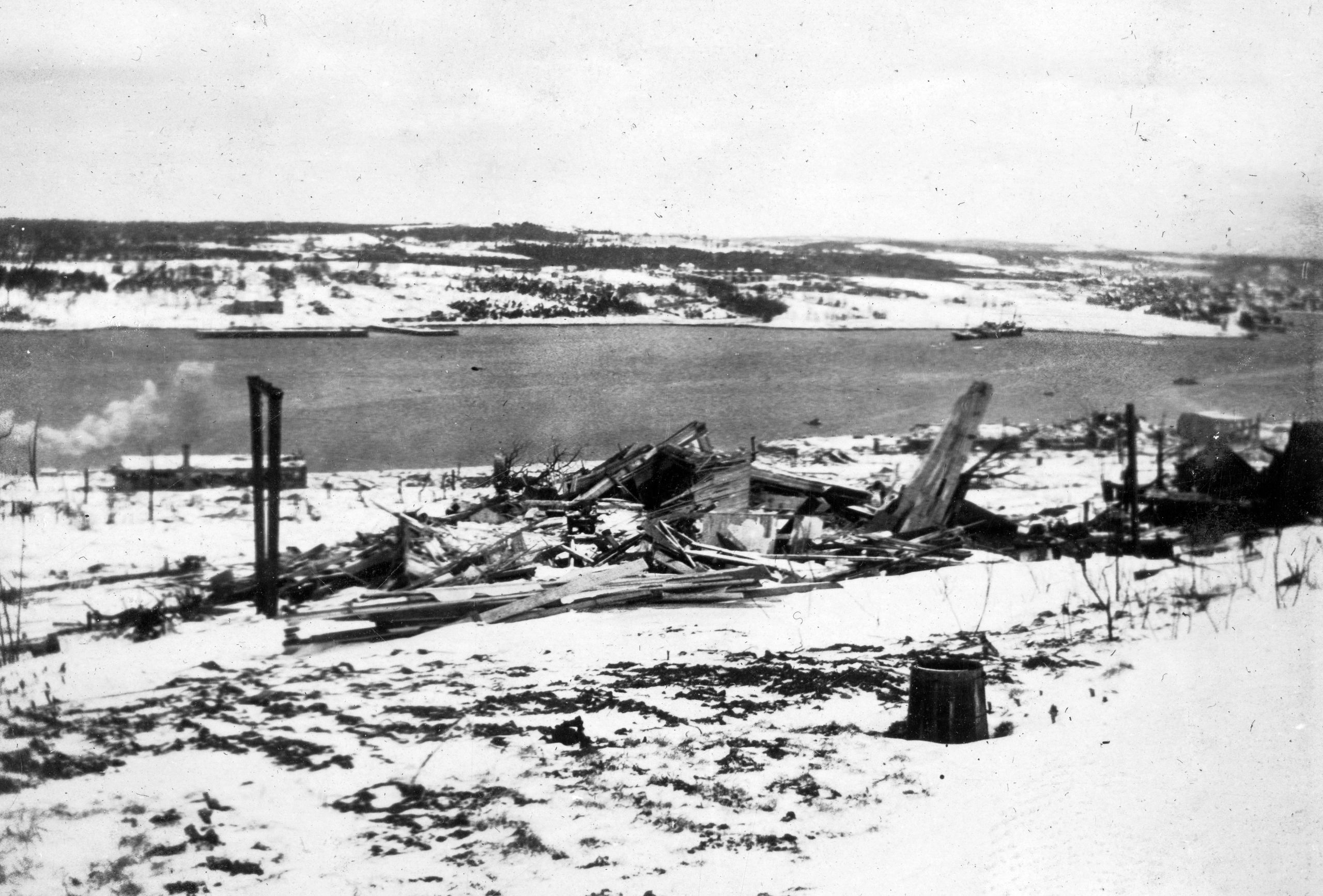
Her readers must have been shocked to learn the startlingly dark backstory behind a woman known for her bold, engaging travel stories. Her writing was generally upbeat, fun stories of her European adventures, not grim tales from Atlantic Canada.
Her plan for her homecoming was to drive a car around Nova Scotia, stopping in small towns and villages to gather history and stories. While women driving in 1934 was perfectly common, a woman heading on a solo road trip to write a book was still highly unusual back then.
She was beginning that trip in Halifax, but she soon found that as she walked the streets of her hometown, she was quite literally haunted by memories of the explosion — she kept having flashbacks to that day.
She had made the mistake of visiting her old neighbourhood: The Hydrostone.
As she walked around the rebuilt streets, memories from the Halifax Explosion came rushing back.
It was as if it were December 6th, 1917, all over again. As she walked the rebuilt leafy boulevards, she thought she saw a “blackened figure carrying over his shoulder a pillowcase — the pillowcase contains all that is left of his entire family.”
She recoiled, starting to leave, but her memory flashed back to the streets that day: “Nails and broken glass, broken glass and nails … that was seventeen years ago but seems like yesterday.”
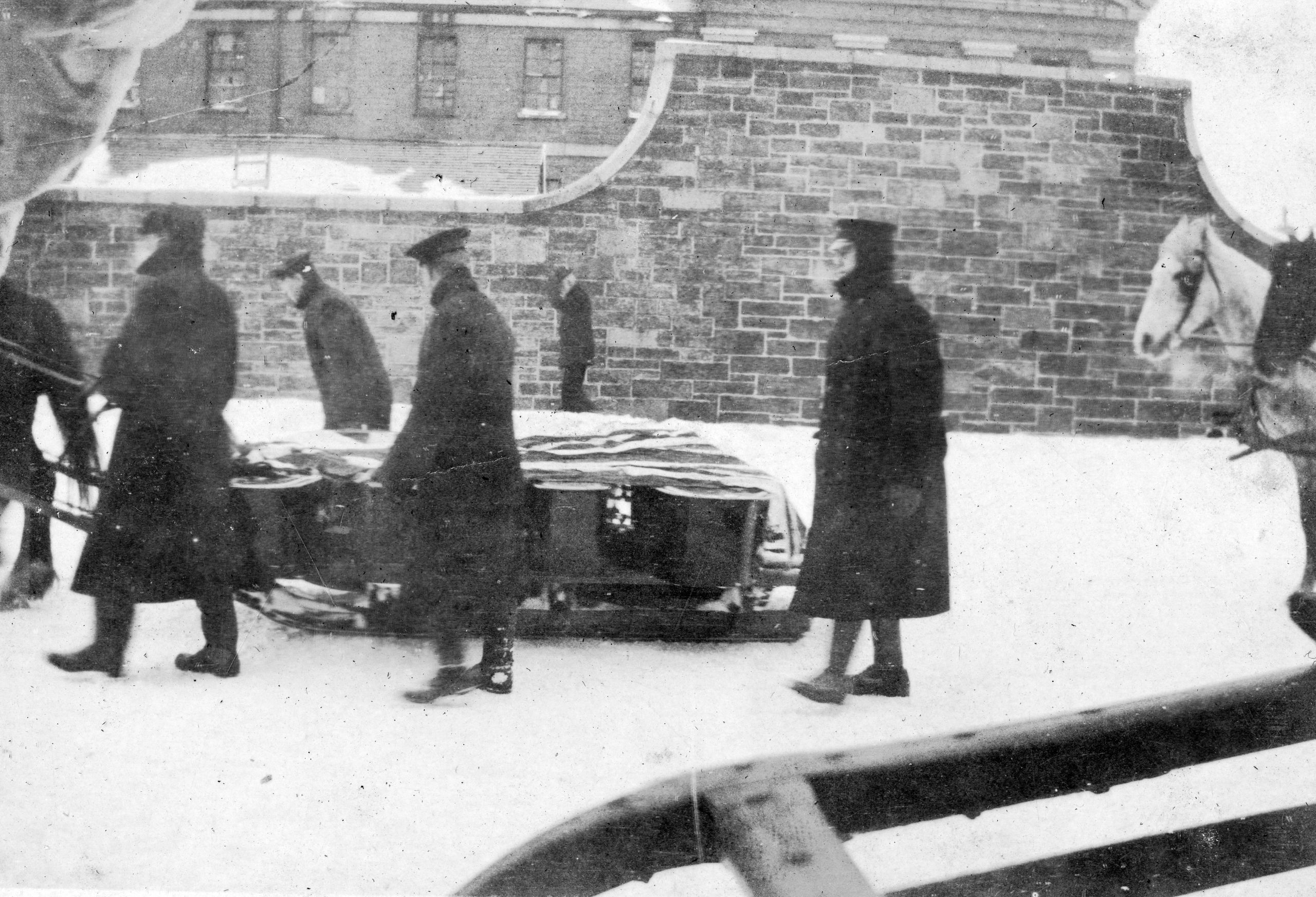
“I saw the cart with those strangely shaped forms lying silent and so still beneath an old canvas covering and a sorely-stricken man said, as he drew back the covering and disclosed the mutilated bodies of his mother, his wife and his children: “This is all I have left in this world.” ”
The man began speaking to her in a flat, emotionless voice. He told her about his little blonde-haired daughter’s favourite things.
Clara Dennis looked down at the girl lying cold on the cart, spun, and began running away.
She ran past memories of the survivors milling aimlessly about: “the living injured — the dazed, blinded, blood-stained, blackened humanity.”
“Only in memory do these scenes now exist,” she assured her readers, “for there remains today no trace of that appallingly harrowing time. … Wide streets have been laid out. Trees again adorn the land, shrubs in abundance have been planted, little gardens bloom in front of doors.”
Nonetheless, for her, the memories of what she’s experienced were all too real. She decided to quickly depart Halifax.
Reaching her car — the same one she would soon use to travel around Nova Scotia while writing her book — another memory struck her:
“Never can I forget … when I turned our car into a rescue car and drove all day and long into the blackness of a lightless night through the glass-swept, nail-strewn streets of this stricken city …
But let me not think about it!
I drive on …”
? Clara Dennis was not only a talented writer but a skilled photographer. Nova Scotians are almost certainly all familiar with her works, whether they know it or not; her black and white photos from her Nova Scotia tour are on display in many government offices, provincial parks, bars and restaurants. The Nova Scotia Archives has digitized thousands of her photos, and you can see them on their website!