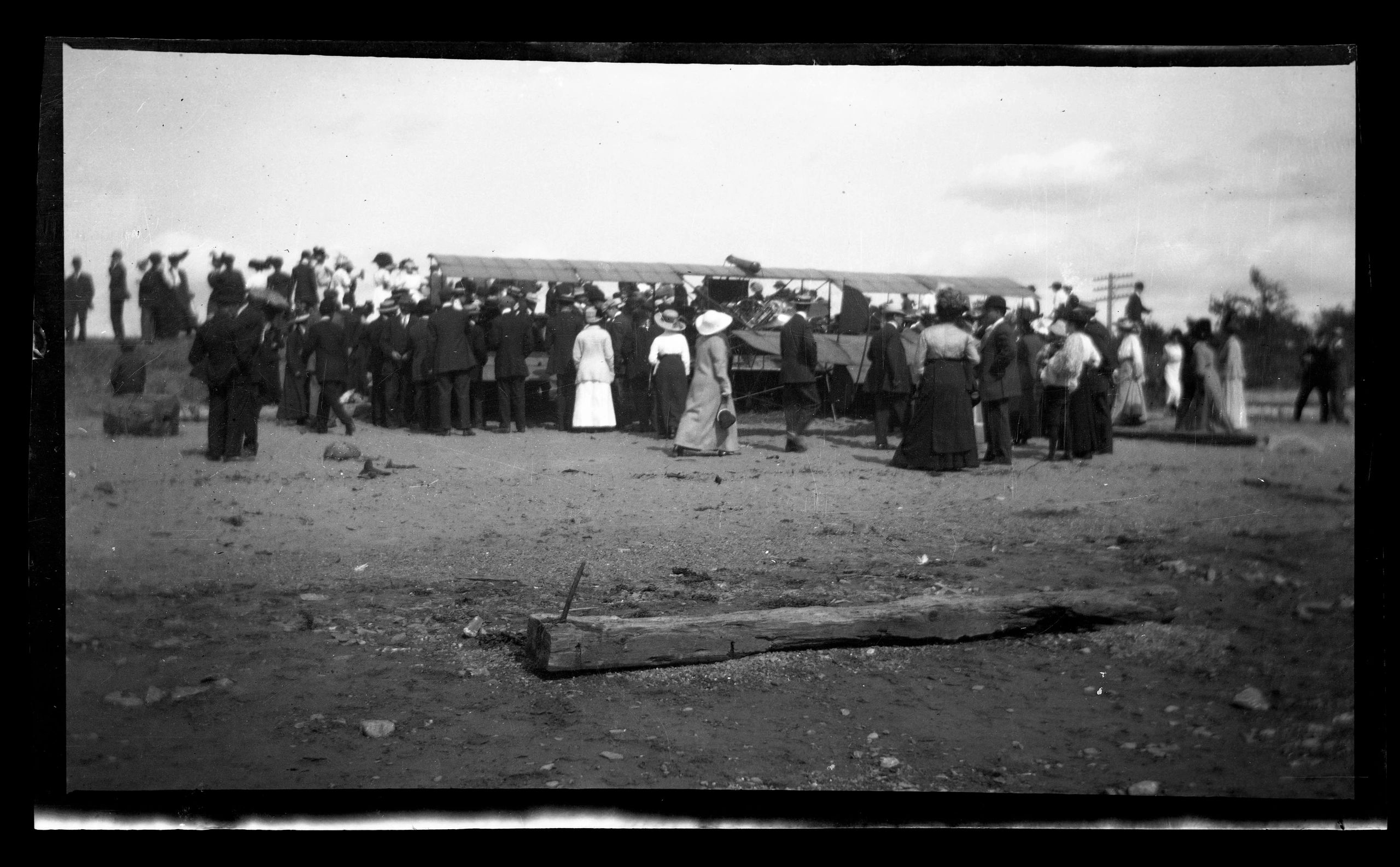
On a clear Autumn day in 1912, thousands of people gathered at the largest Exhibition in Canada to catch a glimpse of the first airplane they’d ever seen.
As petty rivalries were playing on the ground between pilots, one deeply reluctant reporter was being forced by his editor to go on a flight piloted by a 17-year-old boy who had learned to fly three months earlier. The reporter angrily began his article describing his experience flying with: “My editor is an autocrat…”
? Listen to this story brought to life on the Backyard History Podcast!
The world-famous Red Devil was coming to the bustling industrial port city of Saint John, the newspapers excitedly announced.
Its appearance was a last-minute addition to that city’s Exhibition, which was a massive event for the mid-sized city, drawing people from far and wide.
Saint John’s last Exhibition, in 1910, was the second largest ever held in Canada, and this year they were determined to defeat the famous CNE in Toronto to become number one in the whole country.
The announcement that the Red Devil was coming to Saint John caused a ripple of excitement in local newspapers, which desperately wanted to beat Toronto to take the title of having the biggest Exhibition in Canada. “Now it is guaranteed to be a success,” crowed the Saint John Standard newspaper in an article headlined “One Of World’s Most Renowned Birdmen Baldwin Coming In “Red Devil.” ”
(“Birdmen” was what they called pilots at the time. Honestly, I think it’s a shame they stopped. Imagine being on a plane today and the pilot comes on the intercom saying: “Attention passengers this is your Birdman speaking.”)
The Red Devil was Captain Tom Baldwin's homemade airplane, which he had been taking all over the world to show off, touring all over the United States, Europe, China and Japan.
What was so special about this airplane? Well, mostly that it was an airplane at all. This was 1912, and the airplane was incredibly new – it had actually only been invented only nine years earlier, and Captain Baldwin managed to somehow build his pioneering flying contraption all by himself.
Reporter J. J. Marshall, who would soon be forced by his editor to go on a flight in the Red Devil, wrote that: “to speak of birdmen is to think of Captain Thomas Baldwin. 41 years the Captain has paid cleaving the air and many a time he has brushed with the grim spectre of death. He has made ascents in many corners of the world and has made sensational flights at the Crystal Palace in London and spectacular journeys at the Rocky Mountains. He is a genial soul and courteous, and in breaking one’s neck no one could ask for better company.”
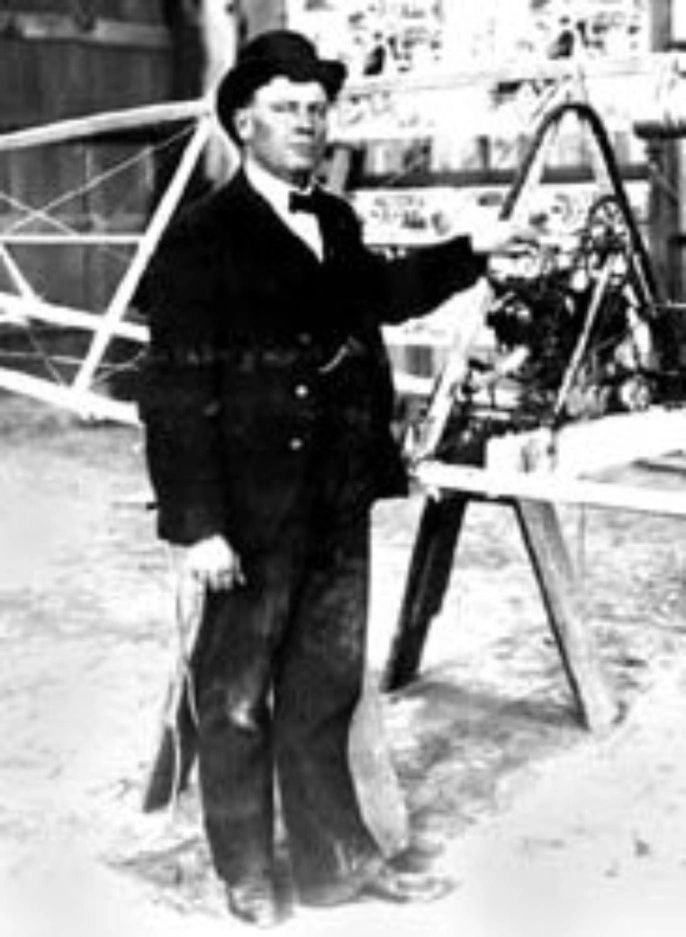
If you’re picturing Captain Baldwin as a dashing young pilot, you’re incorrect: Baldwin was 58 years old, “the oldest pilot in the world.”
When the reporter said he'd spent 41 years cleaving the air, he wasn't talking about airplanes, which, remember, were only invented nine years before. He meant other types of flying through the air.
Captain Baldwin's career began as a teenage trapeze artist in a circus. At the age of 21, he started doing his trapeze act from beneath a flying hot air balloon. At age 33, he began parachuting out of hot air balloons, which he pioneered.
Baldwin went on tour performing his dangerous parachuting-from-a-hot-air-balloon act, commanding the astronomical sum of $1500 per jump, which would be around $50,000 in today’s money.
In 1910, without any experience with airplanes, Baldwin designed and built one all by himself. Not one to be cautious, he decided to fly his homemade airplane across the Mississippi River. 200,000 people watched him become the first person to accomplish the feat for the first time.
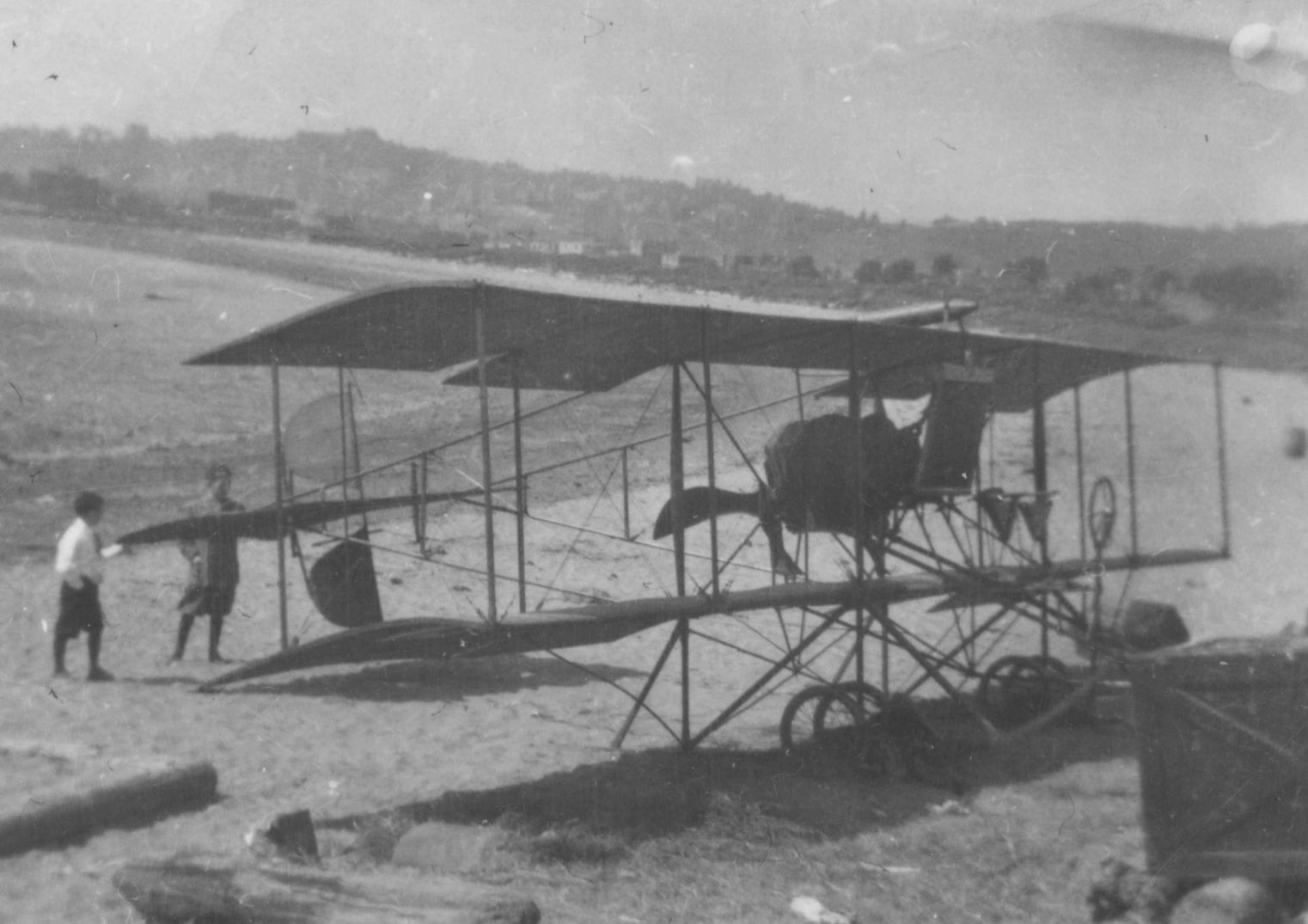
Airplanes were new and very rudimentary at the time: they flew low, they went slow, they couldn't go far, they would only stay in the air for a matter of minutes, and above all they were very dangerous. They weren’t very powerful either – Baldwin’s first airplane had only 25 horsepower.
(For contrast, my 11-year-old Honda Civic has 140 horsepower. A ride on lawnmower has between 15 and 30 horsepower … so basically people were flying around in airplanes less powerful than a modern lawnmower!)
The following year, Baldwin built his famous airplane, the Red Devil, by himself, from scratch. It had an auspicious beginning: on his first flight, he flew straight into a telegraph pole.
Undeterred, he rebuilt the Red Devil – and it would not be the last time he crashed it either.
The Red Devil was the most powerful airplane in the world at the time, boasting a whopping 60 horsepower! More than twice as powerful as a modern lawnmower! It was made of wood and steel, covered in fabric, and measured 30 feet long, 8 feet tall, with a 42-foot wingspan.
It actually still survives today! You can find The Red Devil on display in the Smithsonian’s National Air and Space Museum in Washington, D.C.
On the opening day of the Saint John Exhibition, 4000 people showed up just to watch Captain Tom Baldwin mount the pavilion and explain the basic mechanics of how flying The Red Devil worked. He wasn’t even flying that day – 4000 people showed up just to see him talk about flying!
To raucous cheers, Baldwin announced to the crowd: “The Red Devil will make 12 different flights the coming week over Saint John, flying 1000 feet in the air. It will be as good an exhibition of flying as witnessed anywhere in the world.”
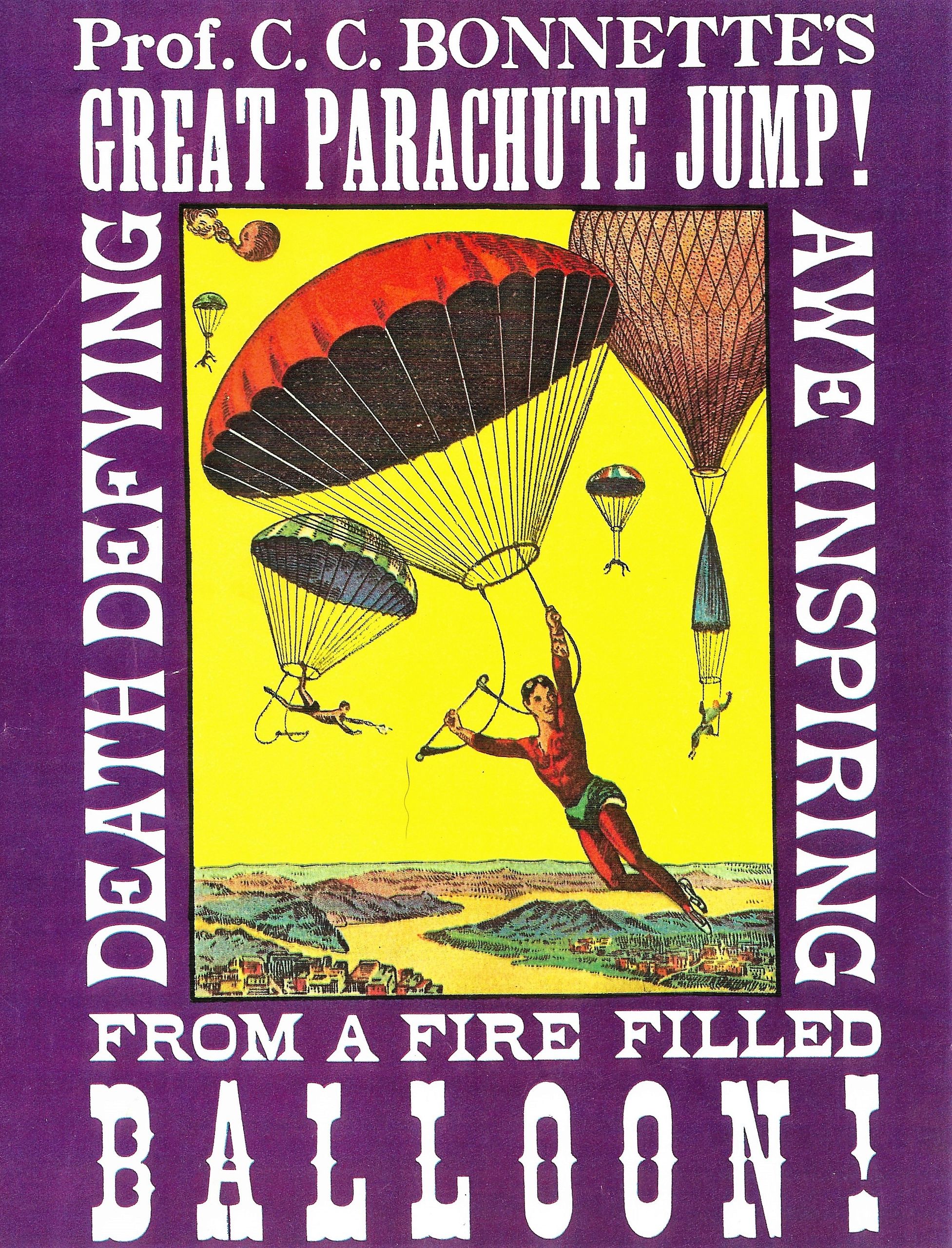
Not everyone was happy to see the Red Devil. A rival stuntman at the Exhibition named Professor Bonnette, who parachuted from hot air balloons, declared to the press that airplanes were a passing fad and that the future of flying was the balloon.
This may seem strange to us today, but at the time, it was an open question whether the future of flight would be in lighter-than-air balloons or airplanes. Back then, balloons were winning, the most famous example being, of course, Germany’s enormous Zeppelins. Balloons were considered safer than little airplanes, which at the time looked like a series of open wood and wires with a giant engine slapped on them, and didn’t exactly have a track record of being safe.
Professor Bonnette’s balloon stunts sound quite impressive. The Standard wrote: “Professor Bonnette’s flight yesterday was sensational. He rose from the ground and soon after the balloon was in the air, proceeded to hang by bended limbs from the bar of the parachute. There seems to be no end to the stunts Professor Bonnette is willing to pull off for the benefit of the fair, and he is one of the most popular entertainers ever seen in Saint John!”
In order to one-up his rival, Professor Bonnette the balloonist, Captain Baldwin decided that The Red Devil would take two local passengers on flights while at the Exhibition. This was wild because nobody had ever seen an airplane before, let alone gone on a flight.
The first New Brunswicker ever to fly in an airplane would be Horace A. Porter, Manager of the Exhibition, on September 6th, 1912.
The Saint John Standard newspaper seemed skeptical of airplanes, writing: “Mr. Porter thus has the distinction of being the first citizen of St. John to enjoy a ride in cloud land, and it is not likely that many will be found willing to emulate his example.”
Porter’s review of flying, given in an interview with The Standard as soon as he touched down, was hardly encouraging:
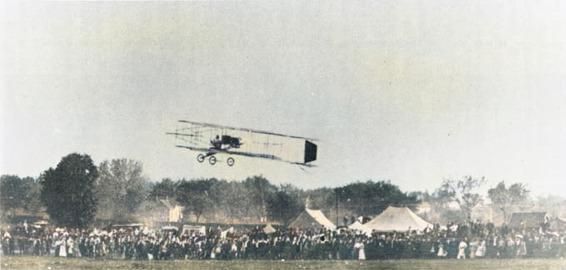
“I will admit I felt rather nervous during the first hundred feet or so of the ascent, but realized when that height was reached, that a fall from 100 feet would mean almost as certain death as from 1000 feet higher, so from that point on I enjoyed the experience.”
Professor Bonnette, the balloonist, was annoyed at the attention The Red Devil was getting.
He was irritable because he approached his arch rival Captain Baldwin, the day before, asking if they could collaborate together on a special event – the Professor wanted to fly on the Red Devil and then jump out of it with a parachute. The Captain, however, refused his offer.
Professor Bonnette declared to the press that it was discrimination that Porter flew in the Red Devil and not in his balloon. He complained that in the interest of fairness, the poor Exhibition manager should not only accompany him on a trip in his balloon, but also jump out of it in a parachute.
The Standard wrote:
“Professor Bonnette even went so far as to guarantee that if Mr. Porter took one parachute drop, he would not care for aeroplaning and would prefer the balloon. Surely this possibility loomed large in the mind of the exhibition official when he politely declined the offer with thanks.”
The competition between Captain Baldwin in The Red Devil and Professor Bonnette in his balloon was echoed by the competition between the Saint John Exhibition and CNE to see which would be the biggest in Canada. The newspapers breathlessly reported daily attendance numbers, comparing them to Toronto in headlines like: “Attendance at the fair today is lower, but our lead is still maintained. Over sixty-five thousand people have passed through the turnstiles so far, and crowds continue to flock to the city…”
Days later, J. J. Marshall, a reporter for The Daily Telegraph, would also fly in the Red Devil.
The headline for the extremely lengthy article the reporter penned after his flight is breezy and carefree: “Telegraph Reporter takes exciting flight at eighty miles an hour in Baldwin’s aeroplane.”
However, writers don't write headlines; editors write headlines.
And the opening lines of J J Marshall’s article about his experience flying, he makes pretty clear his opinions on his own Editor:
“The city editor of a daily newspaper is an autocrat, and his subjects are reporters. When he says “go” the reporter goeth and quickly. In this case he said “Fly.” ”
Marshall’s problem was the shock realization Captain Tom Baldwin would not be flying him, but rather his pilot would be Baldwin’s protege.
Marshall suspiciously examined this new pilot:
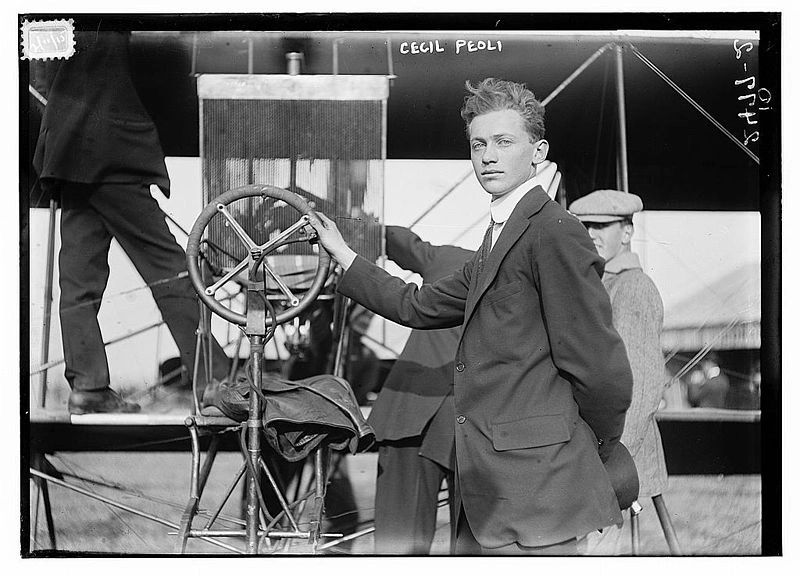
“Slight in build and rosy cheeked, he does not resemble the aviator of our imagination…”
Marshall was introduced to Cecil Peoli, the youngest pilot in the world, who was only 17.
“A quarter of a mile up in the air with your heart in your boots and a 17 year old boy holding your life in his hands!”
It wasn’t just the pilot’s age that was the issue, but also that he wasn’t terribly experienced.
“On the first of June of this year he started flying and within seven days he had qualified for and won his international aviation certificate.”
This was September 6th 1912, so J J Marshall’s 17 year old pilot had been flying for a grand total of three months. To make matters worse, the weather was bad that day.
“The weather here has so far not been favourable to good flying. Nearly every day the wind has been strong, and adding a passenger will make the difficulties of ascent more numerous.”
“The flight was set for 2 o’clock but a strong breeze was blowing at that time so Captain Baldwin sent up young Peoli to make a fly to see the conditions of the air.”
Peoli started and flew across the bay making several circles and staying in the air for about eleven minutes, making a record for Saint John.
“His report to Captain Baldwin was that the wind was gusty and strong, making flying tricky, but he thought an ascent might be made with a reasonable amount of safety.”
“All right,” said the Captain, “Dig in.”
“So the victim proceeded to clamber aboard and after getting badly tangled in the various stays he reached the little seat behind the aviator where there was little enough room for a man and small comfort for a long legged one.”
Exhibition staff took a photo at that moment, which shows Marshall strapped into his seat in the open air plane, his back to the engine, as Peoli is about to get into the pilots seat in front of him. The pilot is smiling and looks relaxed. The reporter looks pale, ashen, and panicked. Both are wearing heavy jackets but neither is wearing gloves, hats, or goggles, let alone helmets. The Red Devil has both skis and little bicycle style wheels as landing gear. The passengers are not enclosed at all, and the plane seems more like a glider with two wings than an airplane we’d recognize.
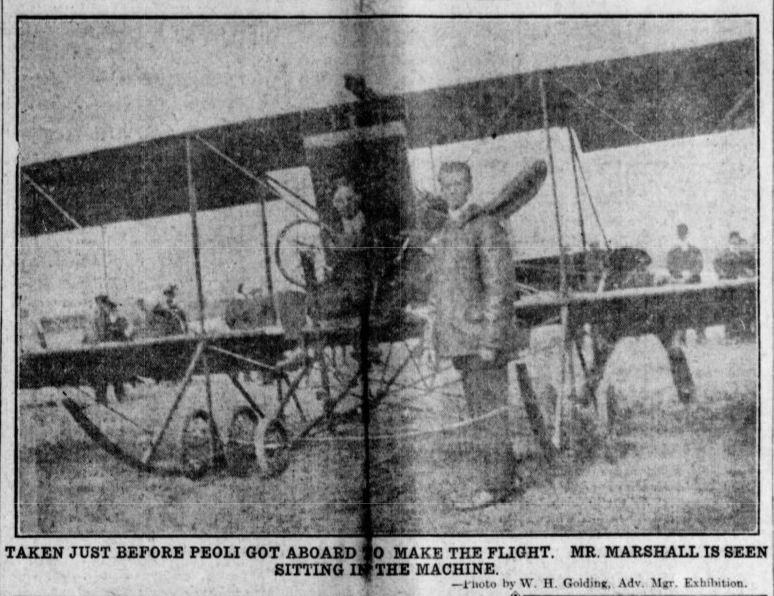
Peoli got in and started the engine…
“The motor cracked to life like a hundred rifles, and we were off.”
“In two seconds it was in the air rising steadily … in the direction of the graveyard … a most unhappy coincidence. There was no sensation of speed or propulsion but rather a sensation of being pulled as if some giant compelling force were dragging one towards the clouds. In a moment, we were over the Marsh creek and rising steadily towards the heavens. Hundreds of feet below shone the creek like a silver ribbon winding its way to the sea.”
“As we neared the town the breeze grew stronger and stronger blowing hard against our faces and giving a sensation of battling against some transparent but very solid matter and making one’s eyes shed copious tears.”
“Far below lay a panoramic view of Saint John. A thick cloud of smoke overhung the city and the western side of the peninsula was completely obscured from view. A few of the high buildings stood up conspicuously in the tumbled mass of structures. The court house, St Andrews Church, the Railway elevator, the cathedral and some of the offices on King Street towered above the rest. In the distance a long irregular stretch of land proclaimed Nova Scotia.”
“The roads could be seen plainly, intersecting the country in long white streaks and stretching for miles inland. The blue lines of the Loch Lomond hills shone up clearly while far beyond to the east and north were masses of hills piled on one another in a never ending series. The view resembled a raised geography map in colour and contour and the wavy lines of make-believe ocean, only it was the real thing. ”
“The houses, fences, and works showed up distinctly in miniature. The figures of men, horses, and cattle were minimised a hundred times as we were flying over the heads of the people turning swiftly to see our machine driving forward at an ominous angle.”
“The most sensational part of the flight, to this passenger, who did none of the work but instead sat like a log, was the quick rush down.”
“In the quick rush down it was impossible to notice much. The machine slid rapidly through the air towards the ground, appearing to make for a particularly hard looking fence in the Red Head Road. The sands, solid and impenetrable, rushed up with the speed of light to meet us.”
“As we were diving into their solidness Peoli turned his wheel adjusting his planes and we rushed along a few feet above the sands, past the people, past the starting point, and in a moment the wheels of the biplane had caught the sands and we were running quickly once more along mother earth.”
The reporter from The Standard newspaper was jealously watching his rival reporter J J Marshall from The Telegraph flying, and now he wanted to fly too.
He decided to see Professor Bonnette and see about flying in a balloon.
The reporter, who noted Professor Bonnette was behaving more recklessly than usual out of jealousy over the airplane, watched from the ground as the balloonist made a parachute leap that ended with him getting blown by a gust of wind into the Saint John Harbour, where he needing to be fished out by a passing fishing boat.
The reporter for the Standard changed his mind and decided that he didn’t want to fly after all.