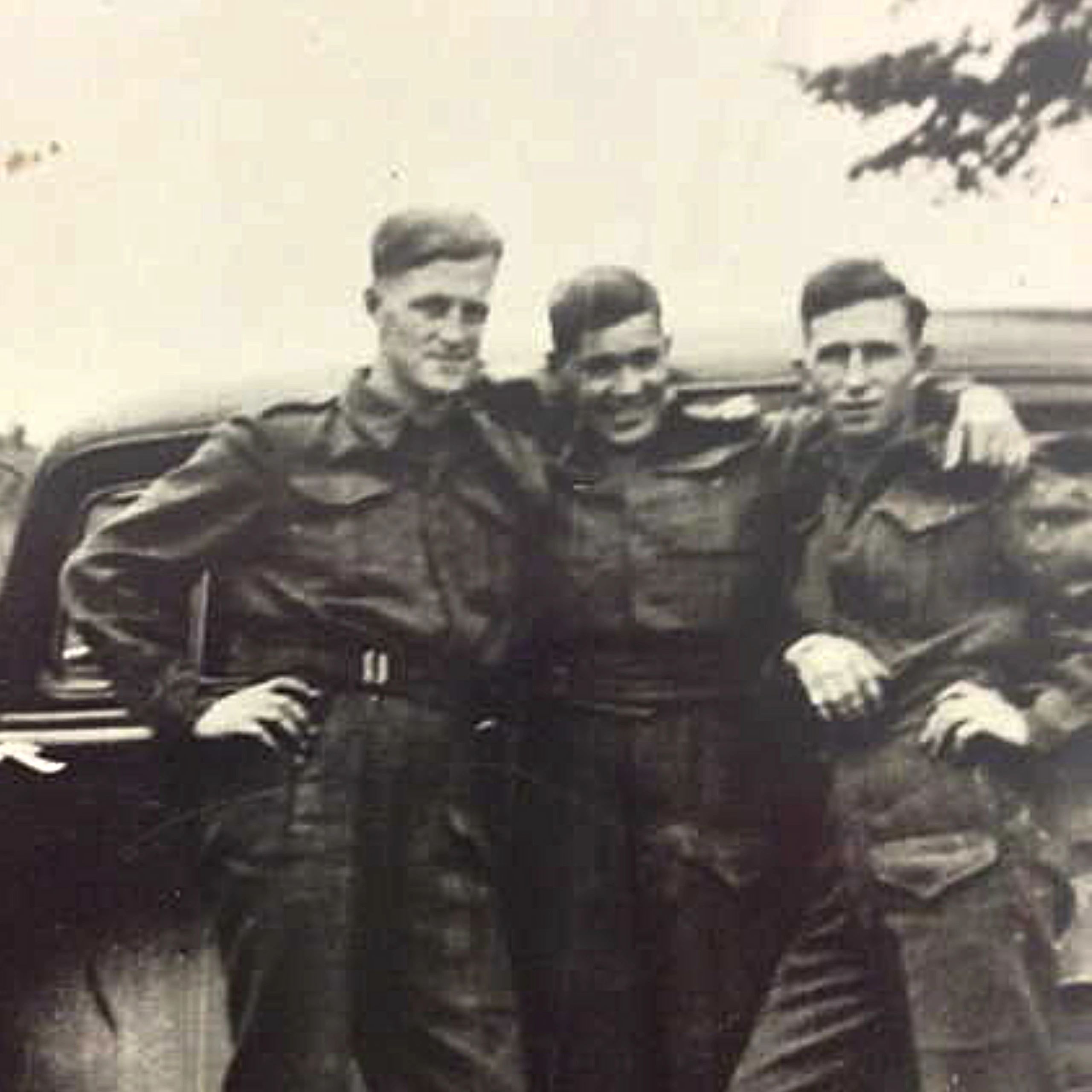
My grandmother had one rule: never ask my great-uncle about the war. Whether it was because I was too young to understand the weight of his memories, or because some things were better left unspoken, I’ll never know. But, as kids often do, I asked him anyway.
Aged eight years old or so, I marched right out to the sunlit porch of my grandparents’ house in Tide Head, NB, where my Great Uncle Wilfred Smith was sitting alone. I slid up to him on the faded sofa and demanded:
“What did you do in the war?”
His gaze drifted to some far-off place. The silence that followed felt heavy and endless. I realised I’d crossed a line. In a flat, almost hollow voice, he replied:
“I spent three and a half years in a Japanese prison camp.”
Wilfred was 19 years old when he enlisted. He had a grade five education and worked on his father’s farm in Glen Levit, NB.
He and two of his brothers fought for Canada during the Second World War. They enlisted less because of the politics, but rather out of a deep-rooted sense of duty — both to their family and to the community that had raised them.
Wilfred, his brother Bobby, and their cousin Simon Pollack served with the Royal Rifles. They trained in Quebec, were sent across Canada in a train, then boarded a ship in Vancouver, headed to an unknown destination.
Fellow North Shore soldier Andrew Flanagan wrote in his diary that those aboard the ship had only been told where they were going while refuelling in Hawaii: “Parade was called and our orders were read out. We would be sailing on to Hong Kong, China, to perform garrison duty. … Hong Kong of all places! I conjured up Marco Polo’s ancient spice routes and trading exotic goods with Kublai Khan.”
Canada and Japan were not yet at war, but Flanagan sensed it was imminent, writing: “I knew then and there that we would be fighting the Japanese in the very near future.” (Flanagan’s powerful story is captured in the book ‘The Endless Battle,’ written by his nephew, Andy Flanagan.)
The Canadian troops arrived in Hong Kong ahead of their heavy equipment, leaving them without tanks or artillery. Then, on December 8, 1941 — two hours after the attack on Pearl Harbor — the Japanese launched a surprise assault on Hong Kong.
Though vastly outnumbered and with no hope of reinforcements or escape, the Canadians
fought bravely, managing to hold off an invading force three times their size for seventeen gruelling days.
One soldier, Alfred J. Elsliger from Jacquet River, NB, was a poet. He described the battle in verse:
“We fought till we were famished,
with the hope that ground we’d keep,
for hours on end, the battle raged,
we fought on in our sleep.”
On Christmas Day 1941, they received orders to surrender.
About 2500 Canadians, including my Great Uncle Wilfred Smith, were sent to a North Point Prisoner of War (POW) Camp in Hong Kong for the next nine months.
On the porch that day, my great-uncle shocked and horrified me with his vivid and brutal descriptions of life in the Japanese prison camps.
I remember being told that they would only get fed a little bowl of rice a day, and it often had rocks and insects in it. He told me that the bugs were welcome because they added an extra bit of protein.
“After I got out,” my great uncle told me “I never ate rice again in my life.”
I remember being told that they were so hungry that they would hunt rats with their bare hands and eat them raw.
He told me one Canadian prisoner’s appendix burst, and he was operated on without any aesthetics. My great uncle’s face grew taunt as he told me how the screams echoed throughout the prison.
Later, the prisoners were loaded into the hold of the “hell ship” Tatsuta Maru, where they suffered excruciating heat and cramped conditions. The prisoners were being sent to do slave labour in Japan.
In Japan, Wilfred Smith was one of 160 Canadians forced to work in a coal mine owned by Furukawa Industries. 12% of the POWs working in that mine died.
My great uncle didn’t speak of this, but his discharge papers tersely hinted at brutal conditions: “he lost 40 pounds during his captivity,” and he “suffered a beating for lying in bed.”
There was fear among the POWs that when the war ended they would all be murdered. What actually happened was that one morning they woke up to find the guards had left, yet they remained locked in. Soon, American bombers flew low over their camp and dropped them food.
When the Americans reached the POWs they were horrified at their physical condition. Wilfred was suffering from dysentery. He spent six weeks recovering in hospital.
At the age of 25, he was given $100 and two medals — the 1939-1945 Star and the Pacific Star — and was discharged.
On his discharge papers, Wilfred was asked about his postwar plans. He wrote: “I’m returning to my father’s farm.”
An unknown other person elaborated on those plans, writing on his paperwork: “Actually, he wishes to go back to work as a wood man as he used to do before his enlistment, but he states that he won’t be able to go in the bush.”
Wilfred and Bobby Smith, Simon Pollack, Andrew Flanagan and A. J. Elsliger were five survivors among approximately 9000 Canadians who were captured during the Second World War. While he was a prisoner, Elsliger, the poet, wrote of his hopes for when he got home:
“There’ll be merrier Christmas greetings
Then we uttered this Yuletide last.
We’ll have happier Christmas meetings,
When the evils of war are past.”
Sadly, Elsliger’s Christmas dreams were never realised. After surviving years in a Japanese prison camp, he made it home — only to be struck and killed by a car on October 25, 1945, just one month after his return to the North Shore.


