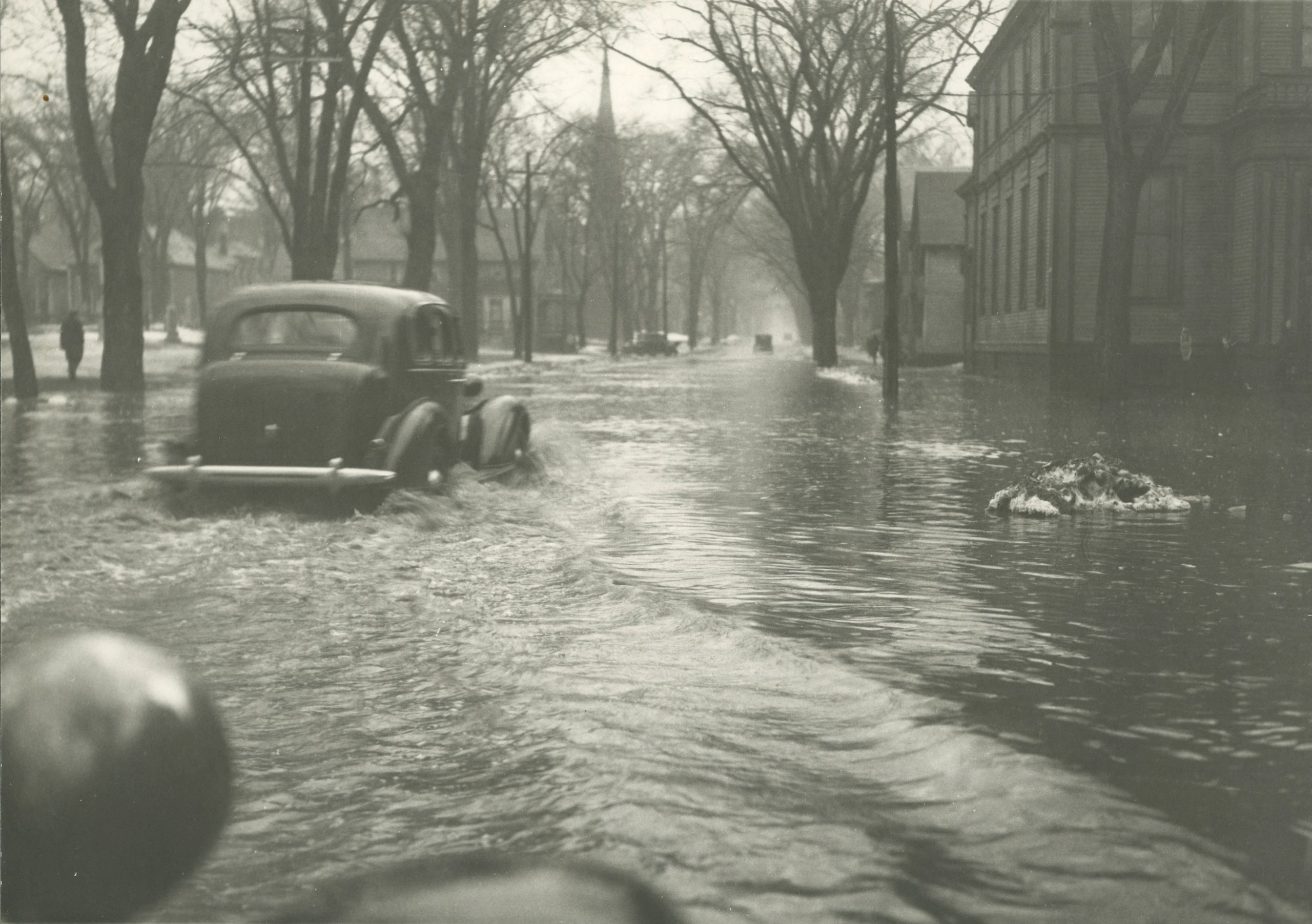
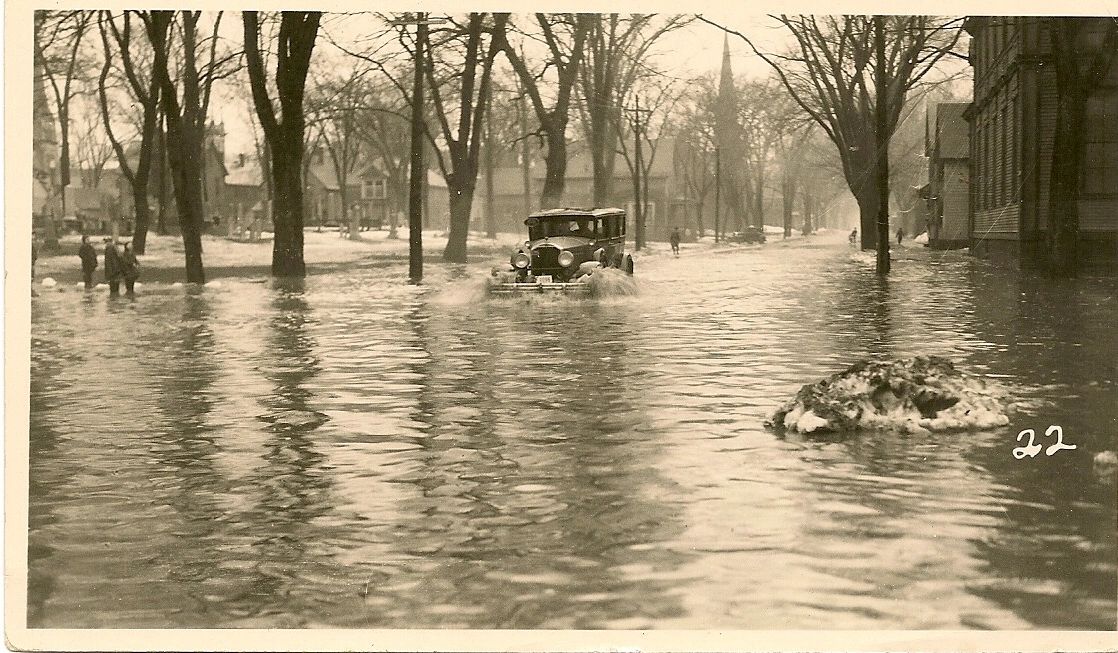
Believe it or not, despite the big floods of 2008 and 2018, flooding in Fredericton used to be quite rare. That’s what made the 1936 flood so shocking — it came out of nowhere with staggering speed. Not since the days when Fredericton was still the Acadian village of Pointe Sainte Anne, two centuries earlier, had the river risen like that.
In hindsight, the warning signs had been there. Days of heavy rain, combined with an unusually early breakup of river ice, sent massive chunks thundering down every river in New Brunswick.
“The Saint John River is repeating what occurred in the early days,” warned the Daily Gleaner newspaper on March 18th, 1936. But by the time it hit newsstands, it was already too late.
Overnight, enormous blocks of ice had jammed against the Canadian National railway bridge — right where the Bill Thorpe Walking Bridge stands today. As the ice piled up, it acted like a dam, and water spilled into the city with shocking speed.

School was cancelled — an almost unheard-of event — and the reason why soon became clear: kids flooded the streets and gathered dangerously close to the rising river.
The water surged by a staggering 10 inches an hour. Businesspeople and private residences alike raced to move their worldly possessions to safety. Homes on Waterloo Row were abandoned. City Hall’s basement filled with water.
By afternoon, the flood reached the city’s water pumping station. Superintendent John Mallory shut it down for the first time in city history. Though a brand-new backup generator could’ve kept the water flowing, Mallory made the decision to instead send it to the Victoria Hospital, which had just lost power when the lines were knocked out.
Telephone lines were severed. Moncton and Saint John newspapers reported that their local operators were inundated by calls asking for information about loved ones in Fredericton.

Radio stations urged Frederictonians to flee. Canadian Legion veterans paddled the city’s streets in canoes, yelling at people to evacuate.
By late afternoon, the city took on an apocalyptic feel. When the floodwaters reached the old city dump, rats fled en masse, racing through the streets. The out-of-school children seemed to turn feral, chasing the rats.
In the absence of answers, rumours spread. When the 3 p.m. train from Boston didn’t show, some feared an international catastrophe. Panic spread about high death tolls in neighbouring Maugerville and Sheffield. (None of it was true — the train suffered a mechanical issue in Maine, and though the farming communities were indeed flooded, there were no deaths.)

By 8 o’clock that night, all attention turned to Fredericton’s railway bridge after it began to “cry an audible warning.” Locals and newspapers alike spoke about the bridge’s final hours as if it were a living thing. Hundreds gathered and listened to their bridge’s “anguished wails.” (They were anthropomorphizing the metallic sounds of the steel girders and rails tearing apart.)
The last person to cross it was CN inspector Hazen Perry. He’d been guarding the south end but realized no one was watching the north — where children were climbing all over it. He sprinted the full length, risking his life to get them off.
An hour and a half later, the bridge let out what the Gleaner called “shrieks and groans.” By this point, water levels were rising by one foot an hour.
Meanwhile, at that exact moment, public historian and columnist Fred Phillips was delivering a pre-scheduled speech to the York Sunbury Historical Society about the bridge’s construction.
He recounted how, on the swelteringly humid day of June 20th, 1887, Prime Minister Sir John A. MacDonald had come to lay its cornerstone — except it had actually been his wife, Lady MacDonald, who did it. Then the gregarious historian recounted a second fun fact from that day: Senator Thomas Temple, who had pushed hardest for the bridge to be built, had only given a one-line speech: “All right boys; let ‘er ker-plunk!”
Just as Phillips read those words, the power went out, and a loud sound was heard outside. The bridge itself had “ker-plunked.”
At 9:25, the bridge “let out a final scream” and tipped over, falling onto its side atop the ice. Coincidentally, at that exact moment, the electricity went out across Fredericton — engineers had shut it off after water entered the power plant.
In the darkness, clustered around the river, hundreds of Frederictonians watched in eerie silence the strange spectacle of their three-quarter-of-a-mile-long bridge float away on an ice flow, “carried downriver to gradually fade out of sight,” wrote the Gleaner.

With the bridge gone, the ice jam finally broke. All at once, Fredericton drained as if someone pulled a bathtub plug.
Workers feverishly trying to sandbag the Queen Hotel watched in amazement as the water, only inches away, began receding. Employees at Lemont’s Furniture, busily carrying the shop’s wares out of a building with inches of water in it, stood transfixed as the water disappeared.
The water’s speedy retreat must have been a real relief to the suspects held in the Fredericton Police cells — the cops appear to have forgotten about the prisoners in their station’s basement. The cells had been filling up all afternoon while police had been off trying to move all the important files out of the courthouse’s basement.
Soon, all that remained were huge blocks of ice littering the roads as far up as Brunswick Street.

Top officials in Ottawa were watching. Before dawn had even broken, federal Minister of Railways C.D. Howe announced that the railway bridge would be rebuilt “immediately.”
As for Frederictonians, after the waters receded, they were quite pleased with themselves.
The news in the days before had been dominated by stories about flooding in Pennsylvania and Vermont, where hungry looters were being shot on sight — a policy the Gleaner denounced as “ghoulish.” But in Fredericton, no looting was reported. People came together. They watched their city experience its worst-ever flood, and the waters vanish just as quickly, taking their bridge with them — but somehow, they got through it all.