
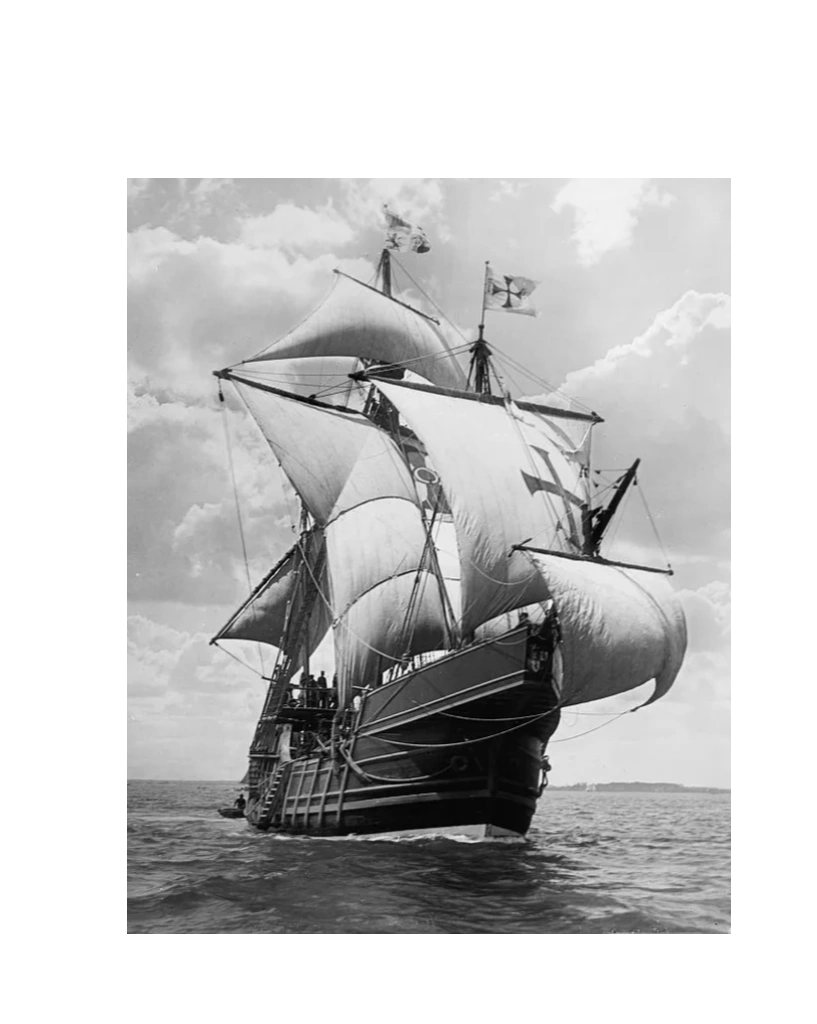
There is some surviving evidence of a 1521 Portuguese lost colony in The Maritimes. If true, this would be the first European settlement in the whole continent, even earlier than the much more famous American lost colony of Roanoke.
This story is included in the book Backyard History: Forgotten Stories From Atlantic Canada's Past
Recordkeeping over 500 years is notoriously difficult, and is made worse by the Portuguese national archives being flattened by a 1755 earthquake. Nonetheless, documents survive which tell of the forgotten early Portuguese exploration of Canada.
The first European, since the Vikings, to arrive in Atlantic Canada was John Cabot in 1497.
The Portuguese weren’t far behind.
The next year João Fernandes Lavrador explored the region. He landed in Labrador, which may be named after him. Curiously, “lavrador” is also Portuguese for “farmer.”
In 1500, Gaspar Corte Real went looking for China. Instead he found Newfoundland. He called it “Bacalaos,” meaning “Codland.” Furious that Newfoundland wasn’t China, he kidnapped 57 Indigenous people and sold them as slaves in Portugal to pay for the expedition.
The following year Gaspar Corte Real returned.
He was never heard from again.
One year later, his brother Miguel Corte Real arrived with three ships to search for his lost sibling. Only two ships returned. That was the last that was ever heard of Miguel Corte Real.
In 1521 Joāo Alvares Fagundes was given a commission that allowed him control of what the Portuguese named “The Land of The Corte Reals” – Nova Scotia.
King Emmanuel’s 1521 ‘Letter of Patent’ to sixty-one year old Fagundes still survives. It recounts how Faugundes had “at his own expense discovered said lands and islands and spent therein much of his wealth,” and now “should he set off to discover lands, to give and grant him governorship of all the islands and lands he may discover.”
The letter describes places he had visited already, including Newfoundland, Nova Scotia, and the place he wanted to build his colony: Cabo do Britȁo – Cape Breton.
It seems that after receiving his ‘Letter of Patent,’ Faugundes immediately set about establishing a colony possibly named “Sam Pedro,” which means St. Peters. Some claim it was on or near the small island in Bras D’Or Lake which still bears that name today.
Things didn’t go smoothly.
In 1570, Captain Francisco de Souza, governor of the Portuguese Madeira Islands and business partner of Fagundes, wrote about what “happened 45 years before”:
“Determined to settle some part of Bacalaos [Newfoundland] … they did in a carrack [large four masted ship] and a caravel [small, fast three masted ship], but finding the region to which they were bound very cold, they sailed along the coast east to west until they reached that running northeast and southwest, and there they settled.”
He describes the colony’s location: “This is at Cabo do Britȁo at the beginning of the coast that runs north, in a beautiful bay, where there are many people and goods of much value and … the soil is rich.”
This was possibly what Fugandes named “Terra de Muyta Gemte” (Land of Many People) – Bras d’Or Lake. It was heavily populated by Mi’kmaq, who named the lake Pitu’pok.
Mi’kmaw already eagerly traded with Europeans. An ancient elder’s dream foretold that one day blue eyed people would come across the sea on floating islands and change their lives forever. They decided that they should trade with, and learn from, the newcomers to better take charge of their future.
De Souza recounted what he’d heard became of the lost colony:
“They lost their ships, [and] nothing further was heard of them, save from the Basques who continue to visit that coast in search of the many articles to be obtained there, who bring word of them and state that they asked them to let us know how they were and that the natives were friendly and the soil was good.”
That reference to Basques highlights that even that early it wasn’t only those famous explorers in North America. Ordinary people like Basque fishermen and traders from Bristol also made trips across the ocean to fish and trade.
Jean Alphonso, a Portuguese explorer working for the French, had personally explored the Maritimes, and also maintained a network of contacts amongst these fishermen and traders. In 1543 he published a short note reporting what he’d heard happened to Fagundes’ colony:
“Formerly the Portuguese sought to settle the land which lies the lowest [on Cape Breton], but the natives of the country put an end to the attempt, and killed all of those who came there.”
If true, this would be unprecedented. However, Mi’kmaw-European relations did deteriorate in the 1530s.
Jacques Cartier –the explorer who famously misunderstood “Kanata” as “Canada”– had kidnapped Indigenious people to force them to act as his guides. Though little evidence survives, his 1536 visit to Cape Breton may have triggered conflict; Cartier had earlier precipitated conflicts with Mi’kmaq in both Miramichi and PEI.
After Cartier there was a long freeze in European-Mi’kmaw relations until the 1604 arrival of Samuel de Champlain, who was vastly more diplomatic, respectful, and open minded.
Champlain wrote that the colony’s end was different from what Alphonso had heard: “The Portuguese formerly attempted to settle upon [Cape Breton] and passed a winter there: but the rigour of the season and the cold made them abandon the settlement.”
Champlain also found cows on Sable Island, which he said came from a Portuguese “ship which was lost on its way to colonize Cape Breton Island … over sixty years ago.”
Mi’kmaq oral histories also tell of a pre-French colony on Unama'ki (Cape Breton). They tell of Europeans building earth-mounds near Sin Pie’lk (St. Peter’s Island) and of how the unprepared settlers were ultimately devastated by gesigsnugwat (sickness) during a particularly harsh gesig (winter).
In the early 1800s, Judge, historian, Member of Parliament, and author who coined the phrase “truth is stranger than fiction,” Thomas Chandler Haiburton, claimed to have discovered Portuguese artifacts on St. Peter’s Island. These allegedly included a cannon. He claimed that while he returned to Halifax to confirm the cannon’s authenticity, Cape Bretoners who did not understand its significance melted it down for scrap metal. Other artifacts Haliburton allegedly found are apparently lost.
Hopefully future historians and archeologists uncover more information to better confirm or deny this story of a mysterious lost Portuguese colony in Atlantic Canada


