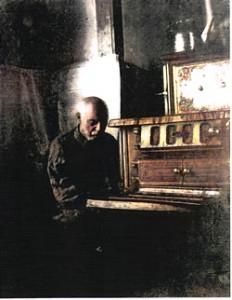
A few days before Christmas in 1859, a mysterious stranger was found freezing, but still alive, alone deep in the woods. Disabled by his injuries, he would be murdered to save the town money. Or did he escape death and start a new life?
Unravelling a legendary Maritimes mystery..
- This story is included in the book Backyard History: Forgotten Stories From Atlantic Canada's Past
A group of lumberjacks were about 15 km from the nearest house outside of Chipman, New Brunswick, when they came across the freezing man lying in the snow. Unsure what to do, they brought him home with them.
No one had ever seen him before. He could not speak English or French. They decided he was from Italy and called him simply The Italian.
It was apparent that there was much wrong with The Italian. His legs were in appalling shape with severe frostbite from apparently being in the Gaspereau River. Also, he didn’t seem able to communicate in a manner beyond the language barrier. It seemed to the people of Chipman that he had suffered a brain injury during his ordeal, possibly a stroke brought on by hypothermia.
His legs became gangrene, and he was transported to the nearest doctor in Gagetown, Dr. Harry Peters, who amputated them both above the knee. Dr. Peters mentioned in an 1861 letter that The Italian told him his name was “Ellerimo.” However, when he came to after the operation, he started shouting what sounded like “gamby.” This became his nickname.
In Italian, “gamba” means “leg.”
It was clear that The Italian would not be able to care for himself. So who would care for him?
At this point, New Brunswick did not have any kind of recognizable social welfare system. Care for people unable to support themselves was administered by Overseers of The Poor, who levied taxes to pay for individuals needing help to be housed in specific local people's homes. In a small town like Chipman, even a few people requiring aid could overwhelm this meagre system prone to abuse and corruption.
The Italian was brought to the Overseers of The Poor, who shuffled him around from house to house. He was apparently a difficult individual, prone to instability and moodiness, and occasionally, darker things were implied. One Chipman farmer who housed him, Phillip Gallagher, would later tell the Saint John Daily Telegraph “he appeared to be somewhat of a misogynist and was quite intractable when men were absent.”
However, the main preoccupation at the time was dealing with his not-insignificant costs.
The Overseers of the Poor invoiced his bills to the Parish of Chipman.
Chipman invoiced his bills to Queen’s County.
Queen’s County invoiced its bills to the government of New Brunswick.
All agreed that the costs of dealing with The Italian were excessive.
According to the Saint John newspaper The Morning Freeman on September 15th, 1863, “The rate payers of the parish were very impatient of this burden, and more than once deliberated on the best mode of getting rid of it.” According to the reporter, a plot was hatched to pay someone five pounds to “do away with The Italian.”
They ultimately decided against this dark path, but “they afterwards made, with a man whose name we have not learned, an agreement which was very similar in its real character, although different in name.”
According to the reporter, early in September 1863, unnamed people of Chipman made an agreement with this mysterious man that they would pay him twenty-five pounds to send The Italian to the Italian Consul in Liverpool.
“They took no pains, however, to see that this agreement was fulfilled,” continued the reporter. “They got rid of the burden and cared no more what became of a poor stranger cripple, in whose fate they supposed none would take the slightest interest.”
Rumours of what happened to The Italian spread across New Brunswick. For reasons that are not clear, New Brunswickers concluded that The Italian had been dropped off on a desolate coast of Maine in the middle of nowhere with one day’s food and no shelter and left there to die.
They were outraged.
Newspapers across New Brunswick demanded an investigation and called for murder charges to be laid. The matter was debated in the Legislature.
People from Chipman wrote letters to newspapers declaring this wasn’t their fault but the outcome of a broken and cruel system that was a corrupt tool of political partisans.
No charges were ever laid.
No changes to the system were made.
On September 8th, 1863, under cover of darkness, a mysterious large dark ship was seen along the shore of Clare, in St. Mary’s Bay, on Nova Scotia’s French Coast.
The next morning, William Eldridge and Robert Bishop were working on a hill above Sandy Cove, when "a rather simple minded young man of the village, named George Albright, came running to them excitedly shouting that there was a man on the shore with no legs."
Just before they reached the beach, they passed a spring. Beside it, "they found a quantity of ship's biscuit and a pitcher of water." Hurrying to the beach, they found a man with no legs in the water. He seemed to have used his hands to drag himself towards the sea, but the tide came in faster than he could get away. The men rushed into the surf and dragged him out.
"He was rescued from the tide and brought to … the village, where all possible efforts were made to elicit from him his history, but he could not talk English, and would say but a little of what thought was thought to be Italian," later wrote A. W. Savary. Many years later, Savary, who was a judge from Annapolis, befriended Eldridge and learned about the story. He became fascinated with the story, travelling to Sandy to try to piece it together by interviewing people who had met the stranger.
The locals offered the stranger a pen and paper, but from his reaction they understood that he'd never learned to read or write. They thought his response to their question to who he was sounded like "Jerome." When asked where he came from they thought he said "Colombo," but nobody really understood whether that meant his last name, his hometown, or the name of a ship.
"He seemed to be of feeble intellect," Savary said. It quickly became clear to the locals that something was quite wrong with his mind, and that he was growing worse, and becoming less verbal.
"I saw Jerome the day after he landed," A.M. Gidney told Savary. "He answered, or tried to answer, questions readily enough. He used the words "Si, si" often and from his manner of using them I thought he meant yes. His intellect appeared to be very feeble, but perhaps this impression was just due to his ignorance of our language."
The Nova Scotian locals seemed to be aware that he was in decline, and that they had only a limited window of time in which to figure out who he was. Convinced he was Italian, the locals summoned the only Italian-speaker they knew of; John Nichola, a hermit who lived on the opposite side of St. Mary's Bay. Originally from Corsica, Nichola had survived the Crimean War. In Savary's opinion, this was hopeless, since Nichola himself had a severe speech impediment and "was not able to enunciate properly in Italian, French, or English." However, apparently Nichola was able to glean some clues: Jerome had a specific dialect found only on the Northern and Adriatic coasts of Italy. He mentioned Trieste, which, at the time, was in Austria, but had a large Italian population. Mostly, though, Nichola reported that the man repeated "fretto, fretto" over and over — "cold, cold."
Jerome's mental health soon deteriorated further, and he stopped talking altogether.
The Comeau family in the Acadian village of Cheticamp (now called St. Alphonse) took him in and named him Jerome.
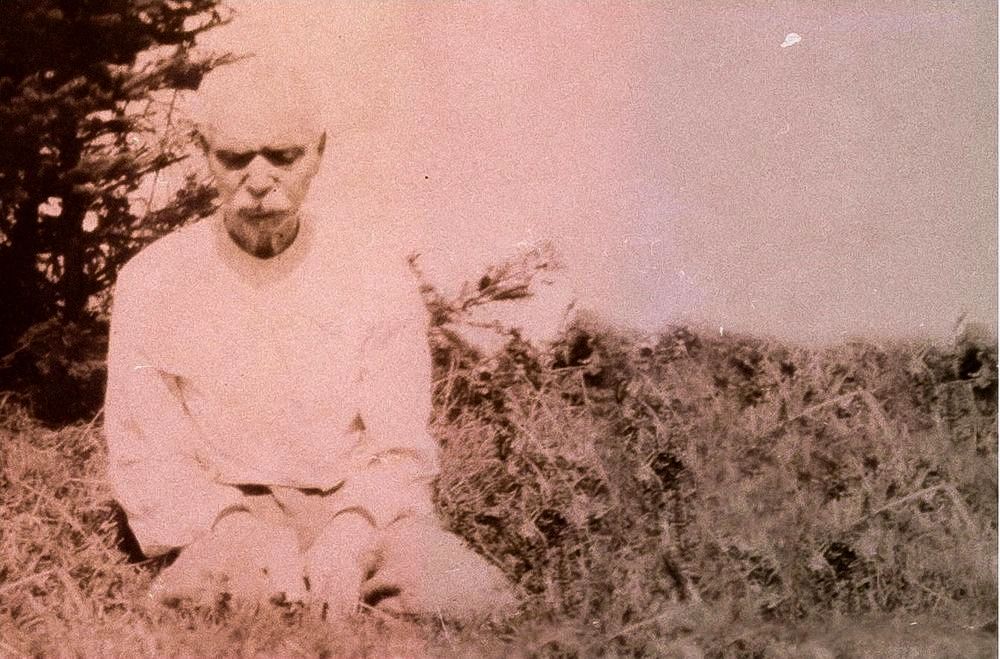
Jerome never spoke a word, a mysterious, seemingly broken and morose figure who detested any intrusion into his silent world, and above all had a deep fear of doctors and medicine.
Meanwhile, speculation of who Jerome really was grew more and more exaggerated.
Jerome is a famous — and highly romanticized — figure to this day in Nova Scotian culture. There are songs, paintings, and films about him.
He was thought to be a pirate.
Or an illegitimate son of the King.
A European nobleman.
Perhaps a politician is hiding secrets.
Or a foreign military office.
Maybe a sailor whose legs were cut off in retaliation for leading a mutiny.
Jerome never revealed who he was.
It appears that the Comeaus genuinely took good care of him. He had his own room — a big deal in a house with 13 children— and spent much of his time staring out the kitchen window while warming himself by the fire. Although on Sundays after mass they did charge tourists who wish to see him a fee to see him.
The Nova Scotia government voted to award a unique special weekly stipend to help them take care of him.
The Comeaus said that occasionally, when he thought everyone was asleep, Jerome would beautifully sing sad songs in a foreign language.
Jerome lived with the Comeau family for 49 years until he died in 1912, never speaking to anyone.
It is possible there were two different legless, seemingly-Italian, nonverbal mystery men, one who appeared, and one who disappeared in The Maritimes during the first week of the September of 1863.
Or perhaps they were the same person.
Judge A.W. Savery, who investigated the story and met Jerome in person, certainly thought they were one and the same, bitterly writing:
"Who cared about a wretched Italian wastrel from the dregs of society who could not even write his own name?"
Savery noted that not a single newspaper in Nova Scotia had reported on the discovery of a disabled Italian man on a beach.
But, once he had stopped talking:
"it remained for the imaginative … to invest him with the importance of The Man In The Iron Mask, suggesting that he was left on the shore by a large ship, or a gunboat which disappeared like the phantom ship of the weird old legend, and that he had on an officer's uniform, hinting that his legs were cut off to somehow deprive him of the power of speech, lest he divulge some awful secret, some Mafia crime or something like that, or that he might be the heir to some great estate, mutilated by the next in succession…"
This story is included in the book Backyard History: Forgotten Stories From Atlantic Canada's Past


