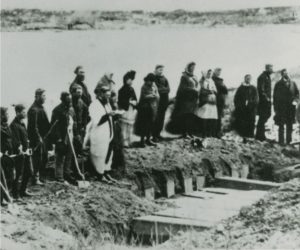
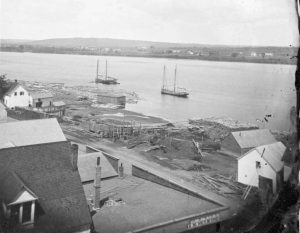
The first Canada Day was perhaps surprisingly controversial in The Maritimes. As rumours of anti-Canadian rebellion swirled, black flags were flown in New Brunswick and Nova Scotia on July 1st 1867 to mourn the loss of their independence.
The Saint John Globe newspaper sneered: “we have yet to learn what there is to rejoice about. … our own impression is that there will be a good many Union Jacks upside down next Monday [Canada Day].”
Not everyone felt that way though. Rival Saint John newspaper The New Dominion mocked the Globe’s editorial surprisingly bluntly, writing: “Sour grapes! Ha! Ha!! Ha!!! … How we would like to see the astute editor [of the Globe] himself upside down on that day.”
Tensions were certainly high in the lead up to the first Canada Day.
The context for the tensions was that soon Canada would be having its first ever federal election, which would run from August 7th to September 20th 1867.
Meanwhile in Nova Scotia, tensions were perhaps even higher. The Nova Scotians were led by legendary anti-Confederation firebrand Joseph Howe. Under his leadership the anti-Canada factions were vastly more organized and united than in New Brunswick.
Some pro-Canada newspapers, like Saint John’s The Morning News worried that “mischief makers in Nova Scotia” were poisoning the Canada Day atmosphere in New Brunswick.
However, it was in many ways the other way around. New Brunswick had been first to organize against joining Canada, and had come considerably closer to halting Confederation than the Nova Scotians ever would.
Before there ever had been any talk of a country called Canada, the three Maritimes provinces had wanted to unite. Three years earlier, the leaders of New Brunswick, Nova Scotia and Prince Edward Island met in Charlottetown in September of 1864 to discuss Maritime Union.
Although leaders from Quebec and Ontario –notably John A. MacDonald– weren’t actually invited, they expressed interest and talked their way into attending that Maritimes Union meeting as observers.
Many Martimers were surprised to see their leaders go off to a meeting to discuss Maritime Union and return talking about uniting with Quebec and Ontario instead.
The Fredericton Headquarters newspaper expressed its bewilderment at how their Premier Samuel Tilley left to discuss Maritime Union, and somehow returned extolling a union with Quebec and Ontario.
That newspaper implied that the Canadians (meaning Ontarians and Quebeckers) were seeking to join The Maritimes to get some “considerable material advantages … a portion of the revenue of this Province [could be] drawn off to deepened and extend Canada’s magnificent canals, as the Toronto Globe [newspaper], with scarce concealed exaltation, says will be done.”
The people didn’t get to vote on whether or not they actually wanted to join Canada, except, New Brunswick – albeit in a rather roundabout way.
A provincial election happened to fall during all this talk about Confederation, and it became an informal referendum on the idea of joining Canada.
A fiery orator from Westmoreland County, Albert Smith, toured New Brunswick that election, angrily deriding the idea of Confederation. He argued in favour of Maritime Union instead.
Smith promised to negotiate a trade treaty with the Americans, build a railway from Saint John to the United States, and offered the people a vision of two futures: “one [Canada] suffering from anarchy and disquiet . . . [the other] New Brunswick . . . enjoying all the blessings of this life.”
When the election results came in they sent a shock through not only Canada but even faraway London, seat of the British Empire and major supporter of Confederation. Albert Smith and the anti-Confederates won 26 out of 41 seats, routing Tilley’s Confederation supporters, who were left with only 11 seats.
However, Albert Smith’s coalition of diverse political figures ranging from aristocratic Fredericton conservatives to working class Saint John radicals struggled to agree on enough to govern.
Only two years later, amid allegations of Canadian and British meddling to sabotage Albert Smith’s government, his promises to get a trade treaty with the Americans and build the Saint John railway collapsed. His government fell apart, and an election was called.
Samuel Tilley made a remarkable political comeback, being re-elected and leading New Brunswick into Confederation.
That first Canada Day the mood was tense across New Brunswick. Albert Smith still railed against Confederation, and he still had many followers.
There were fears that the first Canada Day would be marred by violence across the province, and possibly even open rebellion in Saint John.
For example, The New Dominion wrote: “Startling rumours! Semi-official intelligence reached this office … a well planned plot at rebellion … has been in contemplation for some weeks; and as far as we can learn has been prepared on the South Market Wharf, the object of which is the dismemberment of City Council.”
In the end there was no violence on the first Canada Day in Saint John. In fact there was relatively little reaction at all. The mood appeared to have been more of a collective sulk; a resigned sigh recognizing that the opportunity to escape Confederation with Canada had slipped away with the electoral defeat of Albert Smith.
New Brunswickers tacitly recognized that if there were to be any revival of Maritime Union, it would fall to the Nova Scotians.
Months later, in the first ever federal election, New Brunswick would fail to elect a single Anti-Confederation candidate, instead voting in 12 Liberals and 3 Conservatives.
Nova Scotia, meanwhile, elected Anti-Confederate candidates in all 18 of its seats.
One year after Confederation, Joseph Howe would lead those Nova Scotian MPs in an effort to dissolve the new country of Canada. His effort was soundly defeated.
In the aftermath, the two Martimers who led the anti-Confederation efforts, Albert Smith of New Brunswick and Joseph Howe of Nova Scotia, realized that the writing was on the wall. Canada was here to stay.
Rather than continuing to rail against Canada, both joined it, becoming high profile cabinet ministers in the federal government. They would use their positions to be strong voices standing up for Maritimers in the new country of Canada.