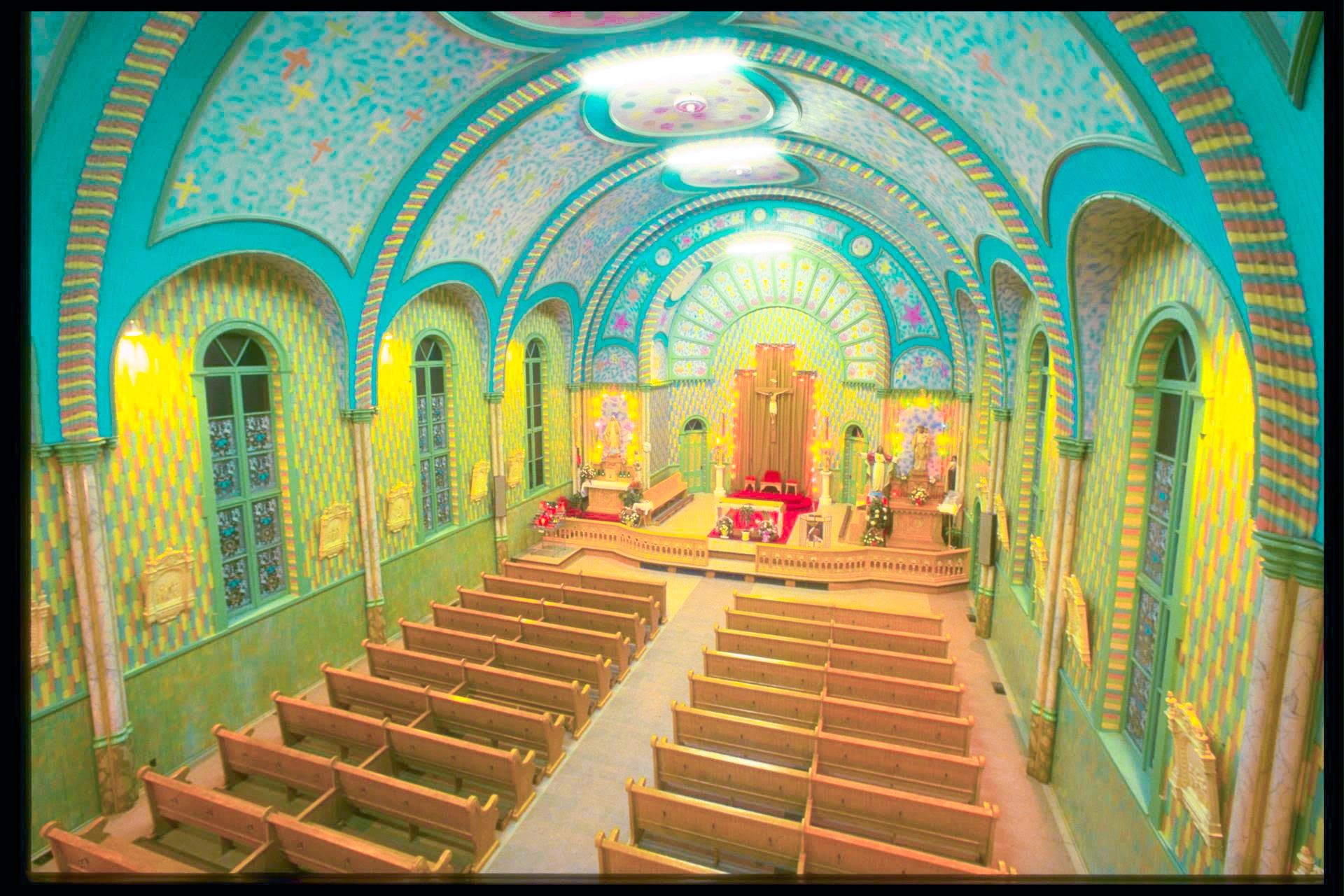
There is a church in northern New Brunswick that, on the outside, appears rather ordinary: large and ornate and painted white with black details; however, the interior is painted in bright, sunny colours and decorated with musical notes and flowers. This unique colour scheme earned the building the nickname “The Candy Church.”
When Lamėque Island’s Église Sainte-Cécile was first constructed in 1913, it was distinctly more traditional. Based on Romanesque architecture, the church invoked that style’s usual motifs, like high arches, thick walls, and small windows.
Its interior boasted wood imported from Columbia. Its pews were painted a stark white.
The rest of the interior features—the pillars, columns, pews, and altar—were all painted in the then-stylish and extremely popular trompe l’oeil style, literally meaning “a trick of the eye.”
This style had been around since Ancient Greek times and used painting tricks to add the perception of depth to artworks. The painters’ intent for the Église Sainte-Cécile was to paint the inside with browns and beiges to look like wood.
However, the shades of dark-coloured brown paints, along with the building’s small windows, had the rather unfortunate effect of making for a dark and dreary interior.
The North Shore did not have electricity in those days, which meant that the church had to be lit with oil lamps and candles. Over time, the smoke and soot from the lighting made the interior of the church become darker and drearier.
As the decades passed, the inside became a foreboding dark brown colour.
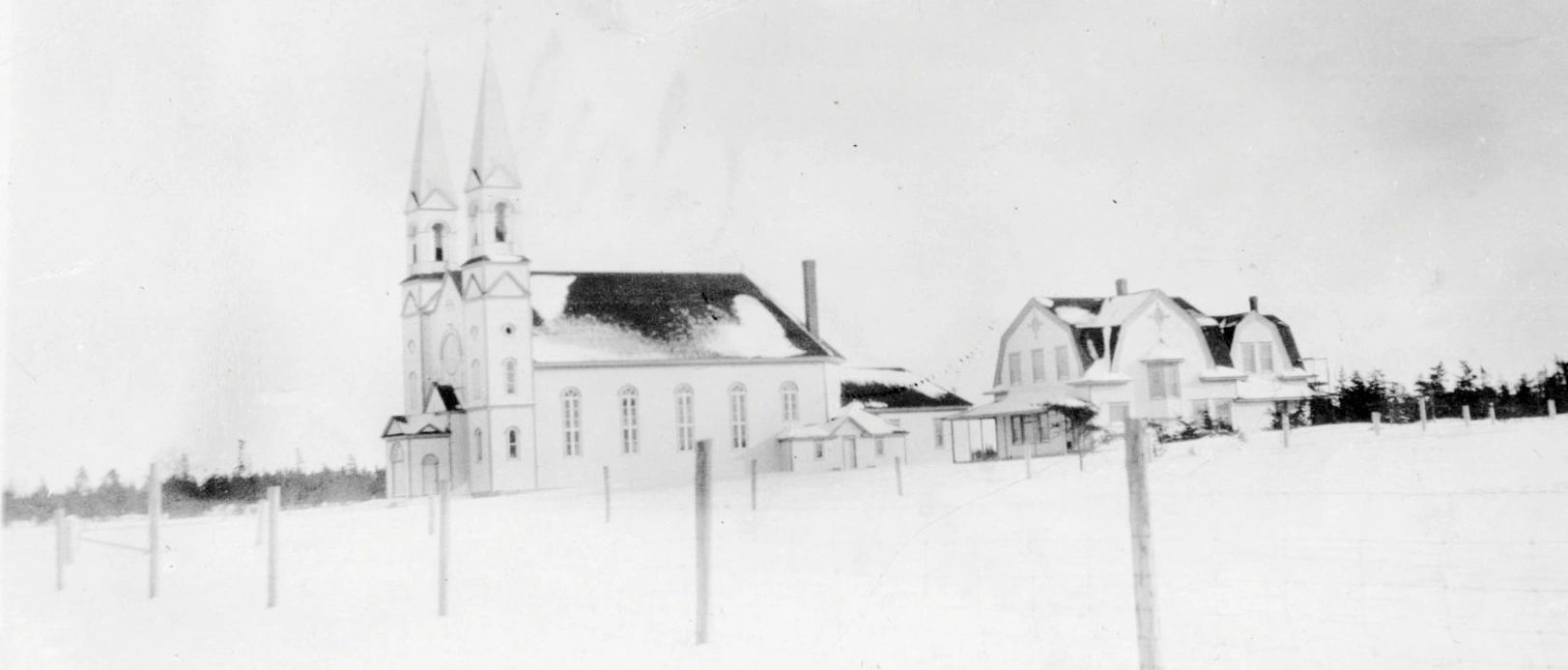
In 1968 Gerard d’Astous became the church’s new Reverend. He decided that something had to be done with the rather depressing interior. D’Astous decided that it would be easier to repaint the church than it would be to clean off the old trompe l’oeil fake wood.
That Remembrance Day, the Reverend, accompanied by two assistants, began repainting the church. They worked all winter, unveiling the newly-repainted interior in the spring of 1969.
The Reverend didn’t have to look far for inspiration on how the church should be repainted. After all, the building was named in honour of Saint Cecilia.
Cecilia had been a Roman noblewoman. She was the daughter of a primant Senator who had lived from approximately 200 to 230 CE.
During her life she’d been known for her talents of singing; her love of flowers and crowns made from them; her fervent beliefs in Christianity; and her lavish and expensive acts of charity to help poor and hungry Roman citizens.
For reasons that aren’t especially clear, the latter angered the Roman Prefect Turcius Almachius, who condemned Ceilia to death. Her execution was badly botched and she continued to live for a further three days before finally succumbing to her wounds.
Cecilia was canonized as the patron Saint of flowers and music. Music festivals held in her honour were noted for their joyful songs and bursts of upbeat colour; not necessarily something every early Christian festival was known for.
Since the church in northern New Brunswick was named in honour of Cecilia, the new Reverend Gerard d’Astous decided that the best way to honour her would be to paint it in a wonderland. Though the exterior remained the same plain white it had always been, parishioners opened the doors to the smell of fresh paint and their eyes feasted on a cornucopia of colours.
The site of this church on Lamèque Island is extremely important in New Brunswick’s history. In the greater scheme of that site’s history, the 1913 iteration of the church is just a baby.
Before the Candy Church there had been a church built in 1874 in its place. Before that, it had been the site of a French missionary outpost.
Even earlier, according church’s officials, that was where Nicholas Denys—himself an important and rather colourful character in New Brunswick’s history—first disembarked in 1645.
Prior to his arrival, Denys had already lived a long and rather unsuccessful life. He was a failed businessman, a failed governor, a failed military leader, and even a failed fisherman. In his old age he took up writing, which is what we remember him for today.
He certainly had a unique writing style.
Leafing through one of his imposing 800-page works would be much like gazing at the tall and imposing exterior of the Église Sainte-Cécile. Much like when one is greeted with the blast of delightful technicolor that is the church’s interior, flipping through the pages of Nicholas Denys’ works is an unexpected treat.
Denys’ writings are incredibly entertaining! He has a sense of humour and level of self-awareness that is rare in historical writing from his time. For example, in his book Description géographique et historique des costes de l’Amérique septentrionale, he playfully makes fun of himself for not being a better writer: “Please excuse this fisherman. If I had given as much time to study as I have to … following the Cod, … I would have given you more satisfaction than I have done.”
Denys left behind hundreds of pages of writing describing everyday life for the average Acadian, Mi’kmaq, and English person in a way nobody else did at that time. His playful and unconventional writings are often the only surviving accounts of that time in New Brunswick’s North Shore’s history.
Because Denys’ writings are often the only surviving sources about that time, early Maritimes history is recounted in his uniquely playful and irreverent way. In many ways, Denys’ unconventional writing style captured what makes the Maritimes special, and offers a wonderful early example of the storytelling our region is renowned for.
He would likely be proud of the similarly playful and irreverent Candy Church which today stands on the site of one of the places where he wrote, some 400 years ago.