The Maritimes once built thousands of ships. As a testament to how well-built these ships were, there is a real-life tale of a “ghost ship” which sailed hundreds of miles without any crew for nearly half a year..
In the 1800s Canada built the fourth most ships in the entire world. And many of those ships were built in The Maritimes.
The sudden rise of the shipbuilding industry, which brought unprecedented wealth, prosperity and modernity to the Maritimes, can be attributed, oddly enough, to Napoleon Bonaparte. Most British ships had been built in the Baltic states until Napoleon cut off trade. Desperately needing a new source for both wood and ships, Britain turned to Canada.
Almost overnight New Brunswick experienced prosperity and wealth on a scale it never had before. Every small town started building wooden tall ships that would sail the world — St. Andrews, Miramichi, Richibucto, Rexton suddenly all became major shipbuilding centres. Locations didn’t even need to be by the sea — despite being 90 miles from salt waters, some 22 ships were built in Oromocto. St. Martins used to be known as the wealthiest village in the British Empire.
Lumber was in high demand in Britain at the time. Typically, the ship would be built in New Brunswick, loaded up with lumber, sailed to Britain and the ship and wood would be sold together as a package deal.
The biggest city in New Brunswick for shipbuilding was Saint John, and the biggest family in shipbuilding in Saint John was the Troop family.
Unlike many of their competitors, the Troop’s company, Troop Line, didn’t sell off their ships, but ran a large company that sailed around the world, at one point maintaining a fleet of 84 ships.
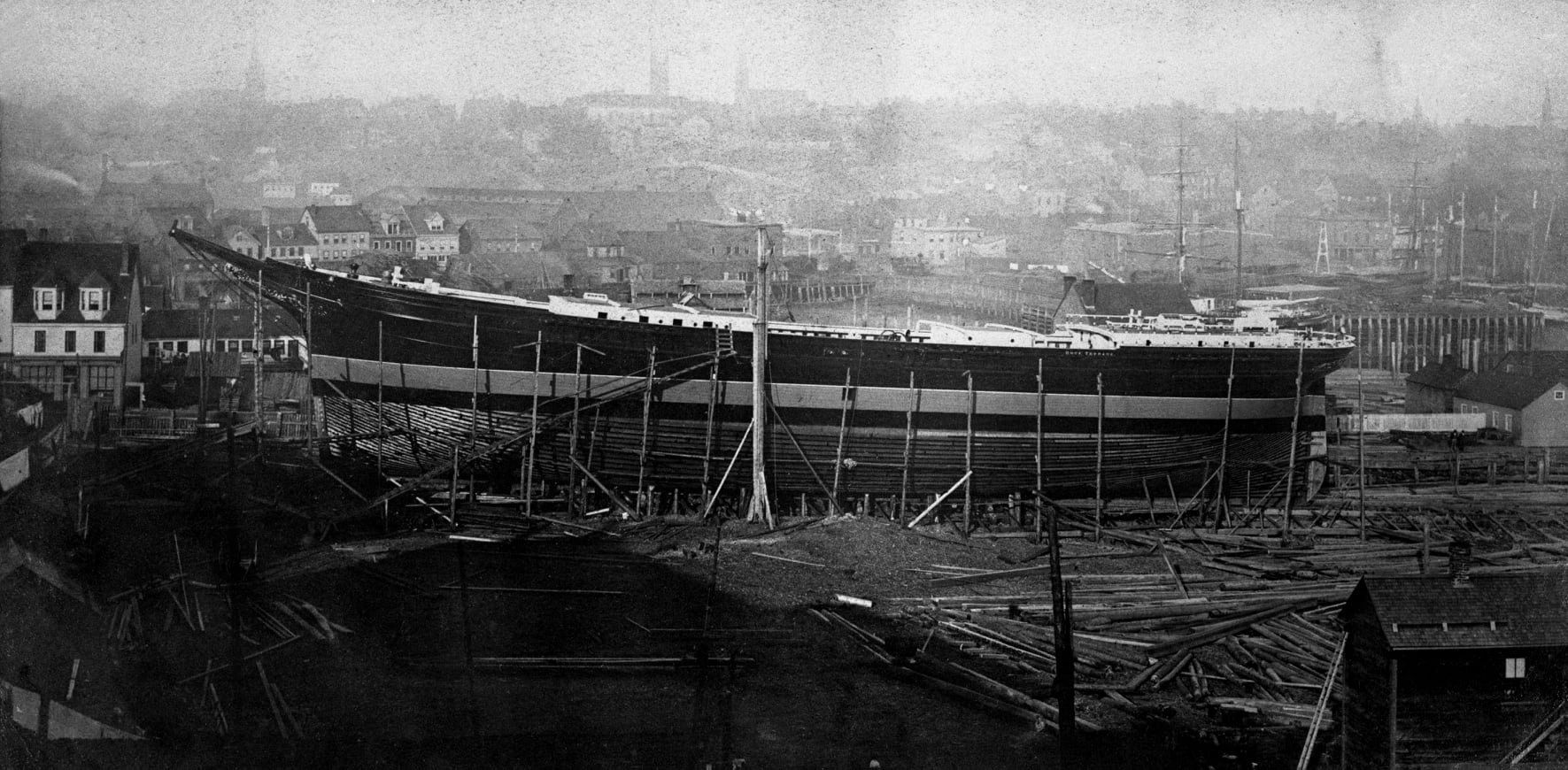
One of their largest ships was called the Rock Terrace, a massive sailing vessel that could hold 1769 tons. It was designed by David Lynch, who the Saint John Standard called “one of the most noted ship builders of his time.” He had immigrated from Ireland at age 9 with his father, apprenticing and working for assorted Saint John ship designing companies. One of the first ships he built after launching his company at the age of 37 was the Rock Terrace.
The construction of such a massive ship took up a large amount of waterfront in Portland –then a separate city from Saint John– where it was built, and dwarfed the nearby houses.
The ship was registered in Saint John. At the time The Port City was the fourth busiest port in the entire world in terms of registered ships.
In the ensuing 13 years you might have found the Rock Terrace anywhere from Philadelphia to Sydney (both Australia and Cape Breton), from Peru to South Africa.
The Rock Terrace was on its way from New York to Hyogo, Japan, on January 28th when it crashed into Brougham Reef — if you were to draw a straight line between Australia and Hawaii on a map they’d basically be in the middle.
Despite taking on water, the ship was successfully floated off the reef. Still taking on water, the ship continued towards the Philippines, with the 25 crew members continually pumping out water.
For 34 days the ship sailed like this, covering 2000 knots. Then, according to the May 19th 1888 copy of the Japan Weekly Mail “the crew were dead beat with pump work, and it was found impossible to run the ship onto land, so the Captain decided to take to the boats.”
In what is perhaps a testament to the skill of New Brunswick’s bygone shipbuilders, the Rock Terrace continued to sail after being abandoned, floating alone and crew-less through the Pacific like some kind of real-life ghost ship.
Through high winds, rain, storms, the ship floated on, alone, on the opposite side of the world from where she was built.
The Rock Terrace was passed by a German gunship who didn’t notice anything amiss.
Back in New Brunswick, Troop Line was searching for its ship which had failed to show up in ports months ago…
The Daily Times, a newspaper in Sackville, home to the Rock Terrace’s Captain, wrote on May 4th: “Considerable anxiety had been felt in Sackville concerning the St. John barque Rock Terrace and Capt. Stephen Atkinson … on Wednesday Mrs. Atkinson received a letter from the owners, advising her to be prepared for the worst, as they had just about given the vessel up.”
Exactly a week before the captain’s wife received that letter, on the other side of the world, a Spanish mail delivery ship named the Don Juan spotted people on the shore of an island.
After abandoning their ship, the Rock Terrace’s crew had managed to make it to Guam, where they’d been living for two months.
The Don Juan carried the 25 of them –they all survived– to the Philippines. In Manila, Captain Atkinson contacted the British Embassy, and instructed them to tell New Brunswick they had survived.
A telegram was rushed to Troop Line’s headquarters, who dispatched a courier to Sackville to inform Mrs. Atkinson.
Only two hours after being informed that her husband’s employers were calling off the search for her husband, and to prepare for the worst, she received the news that her husband had been found alive.
Meanwhile, the Rock Terrace sailed onward. Reports emerged across the Pacific about a mysterious crew-less ship sailing on its own.
Months later she was found by the German gunboat that had previously spotted her. She was stuck on a reef near the islands of Tarawa.
The Germans were astonished that somehow the abandoned sailing ship had raced their high-tech military ship some 850 miles.
The loss was a major setback to the Troop Line; they’d suffered many losses recently. The world was changing, with new metal hulled steam powered ships replacing the wooden sailing ships.
In 1904 the Howard Troop wrote a letter to the widow of David Lynch, who had built the Rock Terrace: “the vessels under our management are making a very poor showing in addition to the fact they were getting old. I have seen tough times with ships, and have passed through some very hard experiences, but never any approaching the present, and fail to see where there is a possibility of improvement.”
Soon after, the Troops’ remaining ships were sold off. It was the end of an era.


