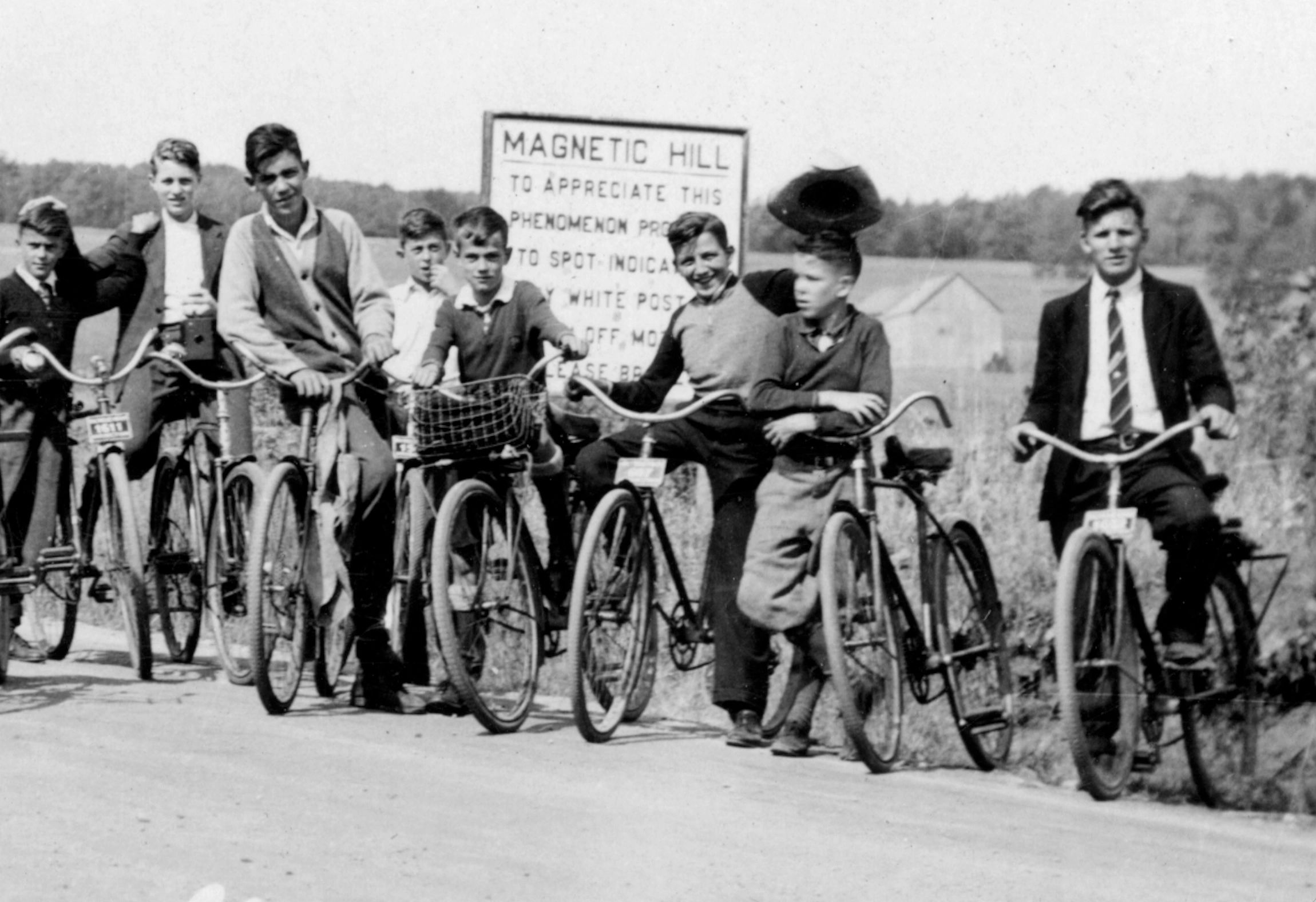
It was a dark and stormy night, six miles outside Moncton, when a clergyman driving a carload of children stopped on a hill.
He had been ferrying the kids home from a church event when the storm had swept in. Rain pounded, a particularly violent crash of thunder startled everyone, and lightning illuminated the scene. The children screamed — the car was moving on its own backwards, up the hill!
Panicked, the driver put it into gear and sped away.
Some time later, the clergyman mentioned that story to Alex Ellis, the superintendent at the Telegraph-Journal’s newsroom. Intrigued by the perplexing tale, Ellis told his staff:
“There’s a hill near Moncton up which they say water will flow. If you stop your car at the foot of the hill, shut off your engine, put the gears in neutral and take off the brakes — it will back up the hill.”
The Saint John newsroom erupted in laughter.
It was August of 1933, and the Telegraph Journal, which proudly called itself “The Greatest Newspaper in the Maritimes,” was not in the habit of chasing whimsical tales of magical hills.
Yet three staffers — reporters, Stuart Trueman and Jack Brayley, along with editor John Bruce — weren’t laughing.
They were working the night shift at the paper, which ended at around 3:30 in the morning. Normally, they went to sleep afterwards, but that night they piled into Bruce’s car, a ‘31 Roadster, all sharing its one seat. Their destination was “the magic hill of Moncton.”
“If this isn’t it,” the editor said brightly, “we’ll have had a nice 250 mile roadtrip.”
“Brayley and I were too sleepy to answer,” Trueman reminisced decades later during Magnetic Hill’s 40th anniversary, by which point the site was the 3rd most visited tourist destination in Canada.
Back in 1933, though, there was no indication of where the story would go. The trio were reluctant to be associated with the strange tale and omitted their names from the article that followed.
“It was embarrassing,” Trueman admitted in a column in that same newspaper 53 years later. “We stopped at the foot of every hill, on each deserted side road. Sometimes a farmer herding his cows would call out helpfully, “Having any trouble?” and we’d reply, “No, just wanted to see if our car would coast up the hill.” He’d keep staring back over his shoulder at is as we went along.”
Eventually, they found their destination: a gentle but distinct slope six miles outside Moncton.
Cutting the engine and brakes, they watched the car roll backward — slowly. After rolling about two feet, it stopped.
They were not impressed.
This was hardly worthy of a news story in “The Greatest Newspaper in the Maritimes.”
They moved further up the road to try again. At that point, “the car coasted backward with sufficient momentum to crest the knoll … the brakes had to be used to stop it on the succeeding slope.”
Writing that they were “dumbfounded,” they spent the next hour and a half examining the hill from every angle to try and sort out what was going on.
“It must be an illusion,” one of the reporters grumbled.
They decided to ask local farmers about what was going on.
For the farmers, the hill’s strangeness was old news. Rather cryptically, they muttered to the reporters that the water flowing uphill had “caused a great controversy some 40 years ago.” That was long ago, though, and people had since accepted that the water just happened to flow uphill there.
They encountered a young woman making ice cream on her father’s porch. Her name, she said, was Muriel Lutes – like Lutes mountain, she cheerfully added. Her family had lived there since 1752. “My father remembered his father pointing it out to him,” she said of the hill’s strange properties, but she could offer no explanation.
The trio now accepted that it was a real phenomenon, yet they figured it had a rational explanation rather than magic.
The reporters noticed that, from a certain angle, the hill looked flat. “That,” the one wrote, “supplied the first clue to the illusion.”
When they ventured further away, they realised that “the whole countryside rises slowly toward the summit of Lutes Mountain … this gentle slope, mistaken for more or less a level area, may account for the entire illusion.”
Admitting their explanation might be confusing, they brightly concluded their article by writing:
“While the phenomenon is difficult to explain, it’s rather easy to experience … Try it yourself if you don’t believe this story!” Then they offered directions.
Then they went home to Saint John and finished their article in time to make the morning edition.

The early reaction was distinctly unfavourable: a Moncton newspaper ran a small article with the headline “Silly Story in Saint John Paper.”
The people, however, were intrigued.
One day later, a Moncton newspaper reported that “curiosity seekers in droves visited Lutes Mountain for the thrill of coasting backwards in their autos.”
Days later, a carload of Telegraph-Journal reporters visited the hill. They hadn’t believed the words their colleagues had written and wanted to see this “magnetic hill” for themselves.
When they reached the hill, they were shocked to find a vast lineup of cars waiting for their turn to try it.
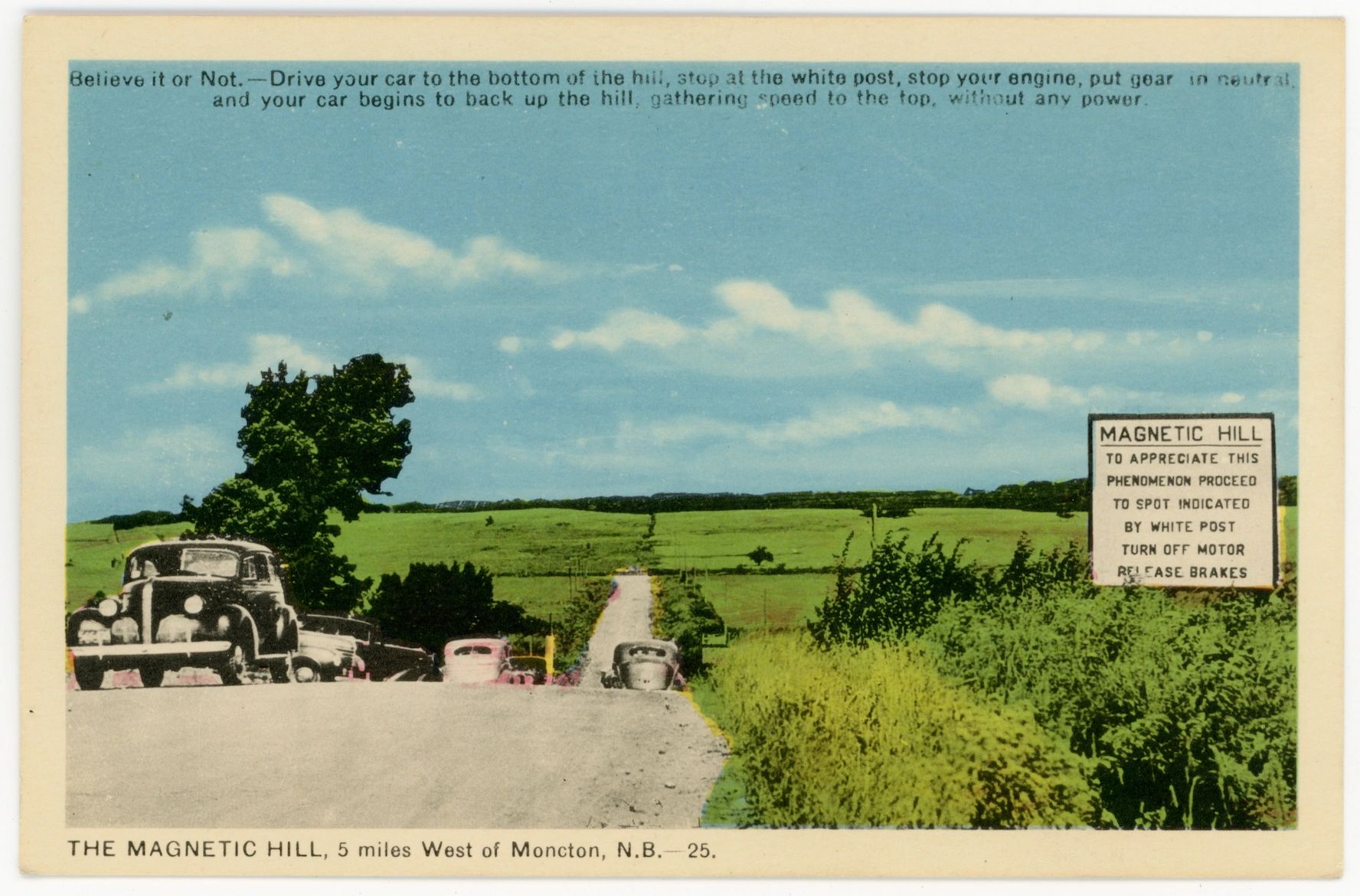
As they milled around, one reporter overheard a local farmer say: “I never saw so many gosh darn cars on this road since the circus train wreck a few years ago.”
The reporters noticed that a young woman had set up a roadside stand and was selling ice cream to the visitors. It was Muriel Lutes.
“It is expected,” wrote the reporters, “that over the weekend hundreds of others who have not as yet seen or experienced coasting up a hill backward will visit the scene.”
Muriel Lutes (later Sikorski) soon began selling souvenirs alongside the ice cream. Over time, she expanded the operation into a full-fledged attraction — building dining rooms, a motel, and the largest gift shop in Canada.
“Almost overnight, Cinderella-like, Magnetic Hill was transformed from another dip in the road to one of Canada’s most widely publicized tourist attractions,” Stuart Trueman wrote decades later.


