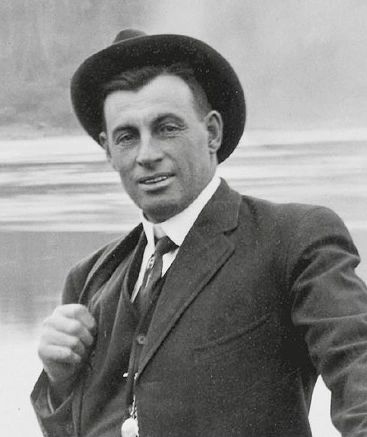
One of my most popular articles was on the legendary rum running mob boss Joe Walnut, and his epic conflict with straight-laced English Detective William Carr. This prequel of sorts recounts their first conflict, years before that climactic battle..
“I was in St. Leonard on a supposed hunting trip. The real purpose of my visit was to check up on the strangest story of bootlegging and smuggling I had ever heard,” wrote the newly hired, straight-laced British Detective William Carr, who would first encounter his future arch-nemesis, the Maritimes' biggest bootlegging gang leader, Joe Walnut.
Six years before their climactic 1927 battle, the duo had their first encounter when the Detective went undercover to investigate Joe Walnut’s bootlegging operation.
Joe Walnut’s Madawaska Mob was then just another mid-sized regional Maritimes gang involved in smuggling illegal liquor from European ships to the United States. However, they were about to make a move that would catapult them into the big leagues.
The young detective was in St. Leonard investigating strange rumours that thousands of gallons of denatured alcohol was being smuggled into the small border town. The stuff was used to manufacture everything from perfume to antifreeze and was extraordinarily toxic to drink, so its purpose was baffling.
Detective Carr checked into the Arrow Hotel –owned by Joe Walnut himself– saying that he was merely a tourist hunting moose.
The Arrow Hotel had a bar called La Belle Beer Parlour, where alcohol was sold openly despite being illegal.
“I spent many hours in the place,” Carr would write in his 1938 book ‘High and Dry,’ “listening to the tales of the activities of the infamous Joe Walnut, the uncrowned king of Madawaska county, and his gang.”
Carr heard Joe Walnut described as “Tall and slim, agile as a cat, dark-featured with thin, cruel lips. His eyes were black as coal, yet slightly protruding, the white bloodshot from constant drinking. He had a fiendish temper and few scruples. It was said he could jump in the air and kick a man in the face with both feet before the first foot touched the ground again.”
Carr also noted: “He had eleven children; several of the older boys were actively engaged in the bootlegging and smuggling game with him, others attended private schools, while most of the girls were in convents.”
Walnut’s daughters were outliers; the Madawaska Mob employed both men and women.
Detective Carr heard one tale of a high-speed chase when a truck full of illegal whiskey was racing at 60 miles an hour along the winding roads, over the border.
The Americans border guards “had been on their guard and prepared to use their guns [but] hesitated to do so, for at the steering-wheel of the speeding car was a woman,” wrote Carr, adding “imagine that!”
Carr heard of some ingenious methods the Madawaska Mob used to smuggle booze. “Six dozen bottles of liquor packed into barrels, then covered with fish guts … grain alcohol shipped in coffins … another as Bible tracts … another shipment worth $100,000 was covered with Christmas trees and shipped as such. Many a boxcar was loaded at both ends with liquor and the doorway with lumber or laths.”
The smuggling was not a one-way street, Carr discovered: “no smuggler ever ran a load of liquor across the American border without bringing back a load of dutiable goods.” He recalled the unusual amount of luxury goods he had already noticed back in Saint John, suspecting they were products of bootlegging, including silk, jewelry, cotton goods, radios, and automobiles.
Carr was bewildered by recent reports that Joe Walnut’s mobsters suddenly switched to bringing back enormous amounts of scrap metal.
Carr observed police and customs agents –Canadian and American alike– openly drinking with well-known smugglers and bootleggers.
The youthful and idealistic Carr rationalized this away: “Many men had a wholesome regard for his enemies. Who can help but admire brave opponents? The British and German troops fraternized in France at Christmas. Why then shouldn’t the customs officers and smugglers fraternize between skirmishes?”
He began to grow suspicious after visiting some customs officers’ houses: “When one considers that these men are very poorly paid, it seems astounding that they could afford the luxurious homes that they possessed.”
Carr heard that some nights, the power would go out in St. Leonard. “That was always done when Joe was operating. Not to conceal what he was doing, but as a warning to curious persons that they had better stay indoors.”
“I got some very interesting information,” the Detective wrote as his investigation progressed.
The Madawaska Mob was purchasing all the old empty liquor bottles they could find.
He also learned that Joe Walnut had recently bought a small printing press in Maine.
The detective struggled to piece together these mysterious clues.
Perhaps as a warning, patrons at La Belle Beer Parlour told him of another detective who had investigated Joe Walnut: “He had arrived at the St. Leonards Hotel and joined the life of the town, tickled to death with the evidence he was accumulating. Joe played him like a cat and mouse.”
“He arranged a party and invited the would-be Sherlock Holmes along. The party grew wilder and wilder, and when the climax was reached, Joe told the little detective that he had known who he was the whole time.”
“The victim was “'drenched' with rum out of a cow’s horn, like a veterinarian would drench a sick cow, and given a good deal of rough handling. He was then stripped of his clothes and left at the top of Van Buren Hill. Later, the detective was seen staggering down the hill, drunk as a lord. He was so thoroughly ashamed or frightened he was never seen again.”
“Joe had the reputation of being a great practical joker,” Detective Carr drily replied.
To maintain his cover, Carr went out moose hunting when “a bullet whistled over my head, cutting a twig off a branch of a tree immediately above my head. I fell on my stomach behind a windfall and demanded in no uncertain terms:
“What the hell?!” ”
He decided it was time to leave St. Leonard.
Only later did he piece together Joe Walnut’s plan.
The Madawaska Mob was using the scrap metal to build a secret network of stills all over the North Shore to re-distill the toxic, industrial alcohol to take out the poison. They’d then package it in the used liquor bottles they bought, labelling them with popular high-end brand names.
The astronomical profits from this would soon make Joe Walnut an extraordinarily wealthy internationally infamous gangster with a vast criminal empire dominating the Maritimes and New England.
DON'T MISS DETECTIVE WILLIAM CARR AND JOE WALNUT'S CLIMACTIC FINAL ENCOUNTER!


