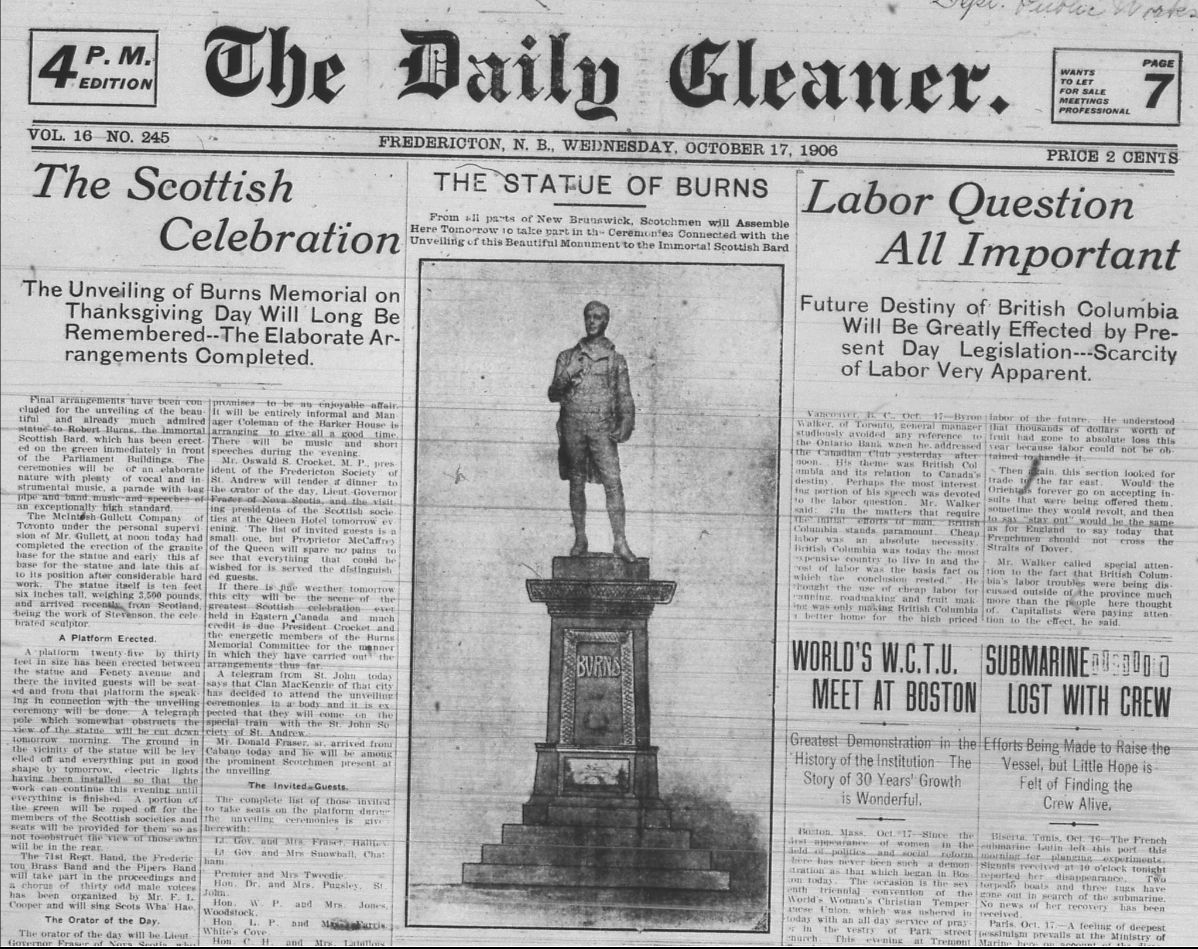
When Fredericton’s Robert Burns’ monument was unveiled in 1906, it was not only the first personal statue in the capital, but one of the earliest in the province. Its unveiling was a point of pride for people of Scottish descent all over Canada and the event drew more than 5,000 people to the city.
The Scottish cultural scene had been thriving all across Canada for decades by then, hosted by local civic groups. Often a centrepiece was the great poet Robert Burns, who, despite dying at the age of only 37, left an indelible mark on literature.
The construction of the statue of Burns was spearheaded by the Fredericton Society of St. Andrew, which, according to the Daily Herald newspaper the day before the statue’s unveiling: “inaugurated the movement to honor the memory of Scotland’s greatest poet and have made elaborate preparations for tomorrow’s great events.”
The first mention of a statue of Robert Burns appears to have come as an offhand comment at a meeting of the Fredericton Society of St. Andrews in November 1903. The meeting was instantly derailed with enthusiasm for the new idea. By the end of the evening, some $2800 had already been pledged toward the Burns’ statue which would, in the end, cost $6500 (upwards of a quarter of a million dollars in today’s money.)
Many other Scottish groups travelled to Fredericton en-masse on special trains for the statue’s unveiling, including representatives from seemingly every city and town in the Maritimes.
Also in attendance were the Mayors of Campbellton, Chatham, Moncton, Newcastle, Saint John, St. Stephen, Sussex, and Woodstock; every major newspaper editor; virtually all major religious leaders; numerous Police Magistrates and Judges, as well as top military brass: a remarkable illustration of the region’s deep Scottish heritage.
The weather cooperated for the mid-October unveiling, with one newspaper commenting that “the sun shone bright and clear from a cloudless sky, and there was hardly a breath of wind during the day.”
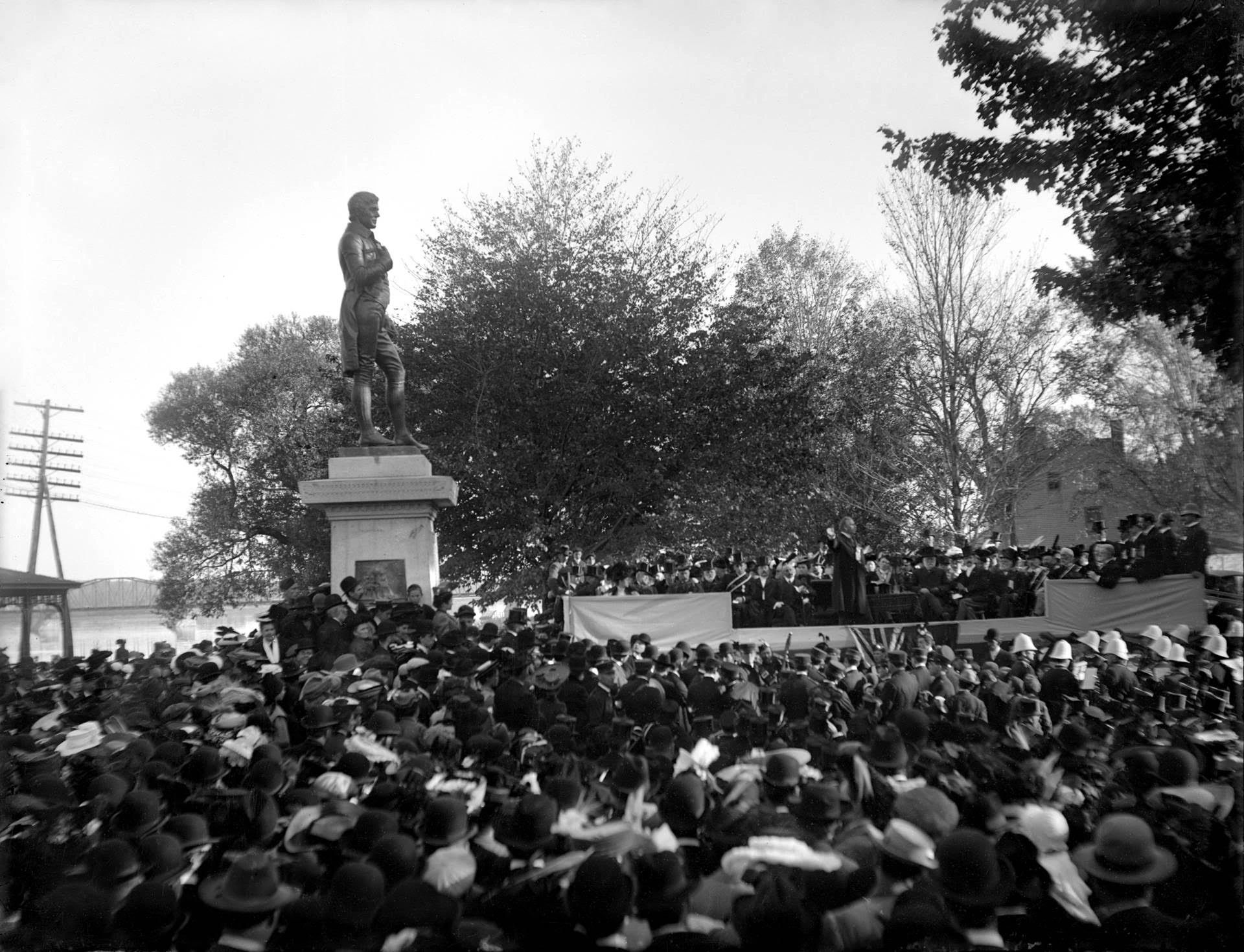
Upwards of 5,000 spectators assembled on the Fredericton Green, where the new statue was covered in a flag.
After some brief introductory remarks by elected officials, a signal was given to Belle J. Hutchison, the daughter of a local Member of Parliament, who the Daily Gleaner’s reporter described as “the most charming and beautiful young lady … costumed in a tailor-made suit of grey with pretty trimmings and the most becoming black picture hat,” to reveal the statue.
She pulled on a cord which, according to the Herald: “removed a flag which covered the statue, exposing it to the view of the thousands of spectators.”
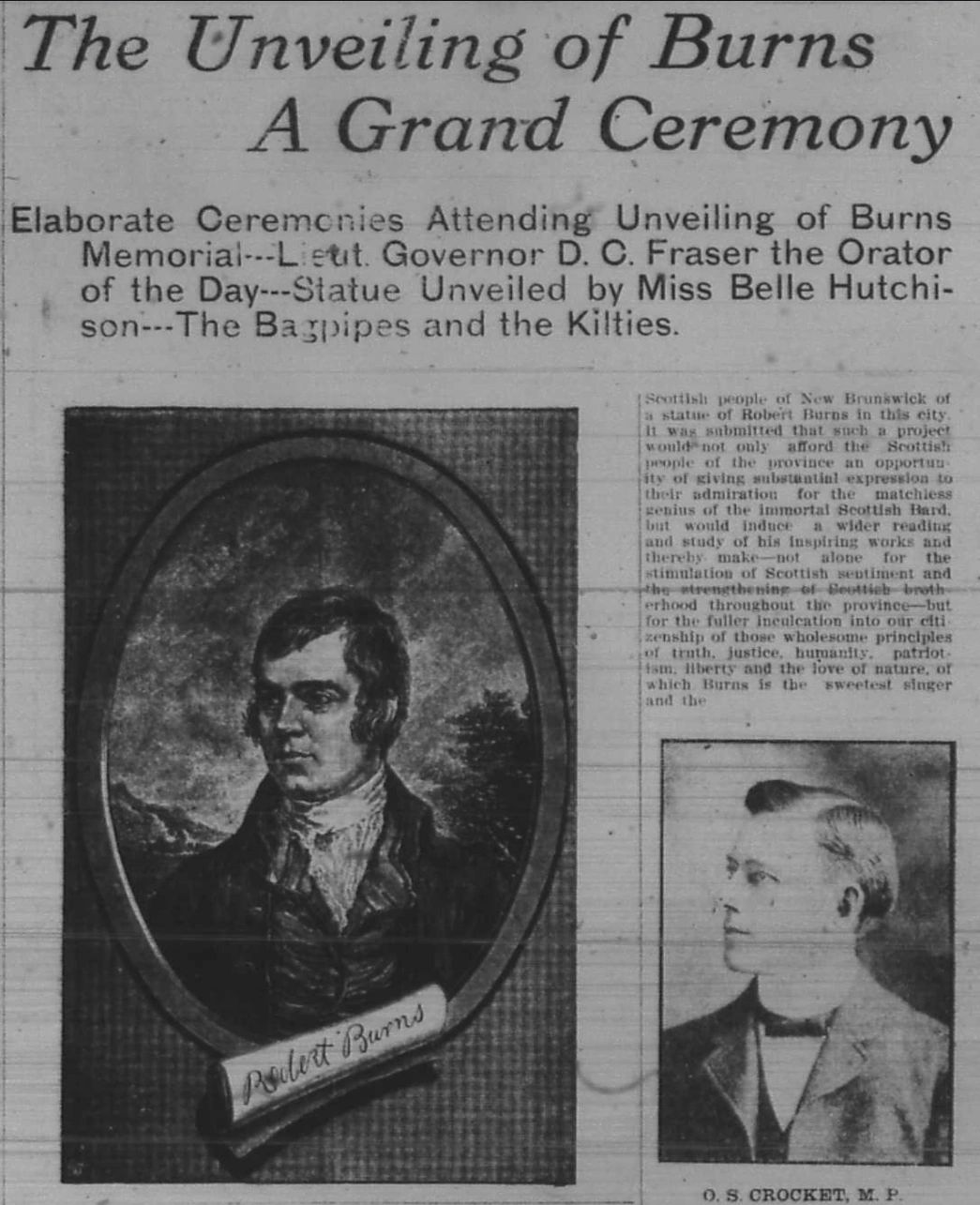
Revealed was a ten-foot-tall bronze statue mounted on a twelve-foot pedestal of grey granite. It had been sculpted in Edinburgh, Scotland by Grant Stevenson, who had boasted that it was “one of the best ever made of the immortal poet.”
The seemingly infatuated Gleaner reporter wrote that the crowd gave “three hearty cheers and a tiger for Miss Hutchison,” though we should probably assume the crowd was actually cheering for the new statue.
(The three cheers the reporter referred to were the same “hip hip hoorays” we are familiar with today. The “tiger,” on the other hand, was a curious short-lived fad where crowds would growl with an increasing volume to show their appreciation.)
The bagpipes then kicked into a rendition of ‘Scots Wha Hae’ (written by Burns) accompanied by a choir of 30 male singers.
The celebrations went on at length, variously mixing speeches from dignitaries, bagpipe music, poetry readings, more bagpipe music, boisterous crowds singing along to Burns’ songs, and yet more bagpipe music.
The keynote speaker that day was Duncan C. Fraser, the newly appointed Lt.-Governor of Nova Scotia, who startled the crowd by delivering a fiery political speech.
The Governor reminded the crowd that Burns had been a political radical who had espoused an early version of universal human rights for both women and men, as well as the then-controversial brand-new idea of democracy for all.
Fraser asked the audience to imagine Robert Burns as a contemporary Maritimer.
He then roared that if he were, Burns would be fighting to bring electricity to lower-income Maritimers; fighting for better living conditions for men and women workers alike; and fighting for “those trodden down by the foot of tyranny and wealth.”
Although at odds with the otherwise apolitical speeches that day which focussed on Burns’ poetry and songwriting, the Governor’s speech received a rapturous reception from the crowd.
Later that evening there were a variety of events in the offering for Scottish-themed dining and entertainment, ranging from public dances to a sumptuous multi-course dinner and dance held at the Barker House hotel.
The latter invite-only, mens-only private event, was called a “smoking party” (the origins of references still used today about “smokey backrooms of politics.”) Perhaps at odds with his populist speech, the Governor of Nova Scotia was seen dancing at the smoking party until the wee hours of the morning.
Rival hotels also spared no expense in attracting dignitaries either; with the Queen Hotel going all out by covering itself in cut flowers in Scottish blue.
At midnight, a perhaps-less-than-sober Mayor Sears of Saint John stumbled through that hotel’s doors and led an impromptu parade of Saint Johners down York Street chanting “up with Burns,” accompanied by bagpipe music, towards the railway station to go home.
According to the Daily Gleaner, as he stood on the train platform, Mayor Sears delivered a spur-of-the-moment speech in which he declared “The erection of the Burns monument in this city is an example by which the people of St. John might well profit.”
The reporter wrote he then muttered something vague about “the erection of a statue to Champlain” in his own city. (That Champlain statue can be found today in Queen Square in Saint John.)
The statue had been unveiled on October 18th, 1906 simply because it was a Thanksgiving holiday long weekend. However, January 25th is Burns Night, an annual celebration of both Robert Burns and Scottish culture and heritage.